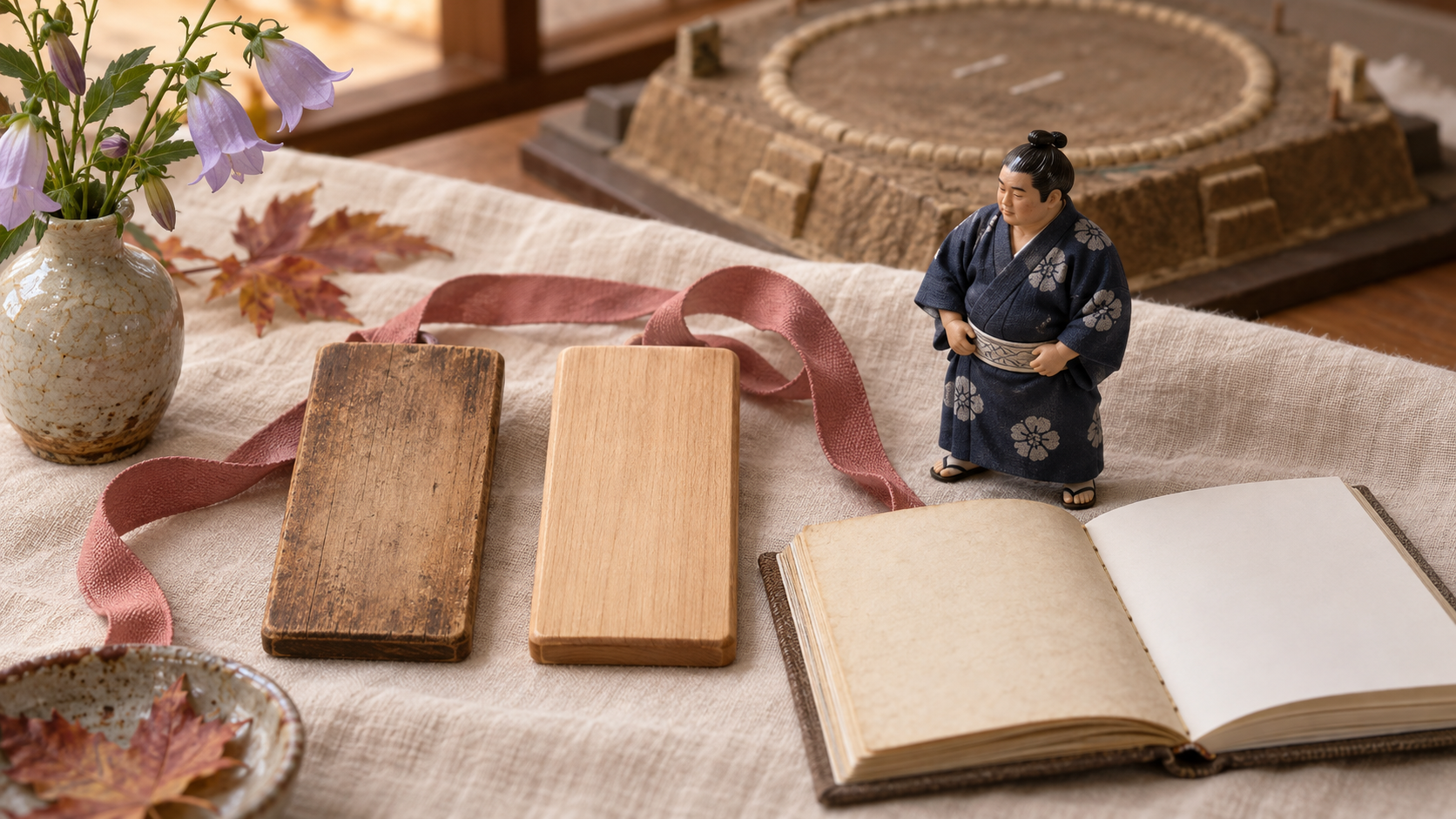
When a wrestler changes his shikona, use the Japan Sumo Association’s change list for the former name, current name and tournament context shown there, then cross-check the current profile and banzuke. Do not rewrite every old result as if the new name had always been used. Connect both names along one dated timeline.
Across fifteen days, separate finding the new written name from observing how it is called and what is visible in each bout. This is a notebook method, not an Association naming rule.
Save three facts before following the bouts
Use the Association’s list for the before-and-after forms and the current wrestler profile to confirm identity through several fields such as stable and origin. Record the tournament context exactly as displayed. Do not infer a separate announcement date from that entry; if publication date matters, find a dated official announcement.
The name’s etymology, chooser and intended meaning may remain unknown. Attractive kanji can evoke a teacher, landscape or ideal, but that is a reader’s impression unless the wrestler, stable or Association explains it. Put only the verified change in the fact field.
Keep search and internal history connected
For a site or personal notebook, deleting the old name can make earlier records harder to follow. Store a person ID, former name, current name and the displayed tournament context separately. This is an editorial recommendation, not an Association style rule.
A stable public URL usually preserves continuity. If a route must change, create a one-to-one redirect and record the relationship in the ledger. If the platform cannot redirect, keep an explicit link from the old page to the current one instead of silently breaking the route.
Watch four things across fifteen days
- How the yobidashi stretches the new shikona
- The new form on the banzuke and daily bout list
- Official result and winning technique
- One movement that has nothing to do with the name
For the first few days, simply locating the new characters may be enough. There is no reliable promise that a reader will connect spelling and arena sound within a fixed number of days. When ready, move attention to one visible cue after the tachiai rather than inventing tactical intent.
Hearing the current shikona called can make the banzuke’s ink feel as though it has become a voice. “A new chapter” is our editorial metaphor, not a claim about the wrestler’s feelings. Keeping old and new names on one dated line also makes past bouts easier to find.
What One Bout Cannot Tell Us
A bout recording and name-change entry do not establish personality, emotion, injury, fatigue, feelings about the new name or the next strategy. Leave those fields unknown unless an attributed statement from the wrestler or an authorised source establishes them.
Sources
- Japan Sumo Association, list of shikona changes, wrestler search and banzuke, checked September 3, 2026, for separate verification of former name, current identity and banzuke form.
Source links used for verification
Each link was used for the corresponding claim in this article; inclusion is not a blanket endorsement of the whole page.
Article verified:
- Japan Sumo Association list of shikona changesPrimary source (as checked for this article)
- Japan Sumo Association wrestler searchPrimary source (as checked for this article)
- Japan Sumo Association banzukePrimary source (as checked for this article)