Shiori’s Research Journal #020 · Thursday evening, October 22
Who will move first?
When I see two wrestlers locked together, I find myself waiting to see who moves first. Will one drive forward, or go for a throw? It is usually the big movement that makes me sit up. Tonight, I wanted to look at what comes before it.
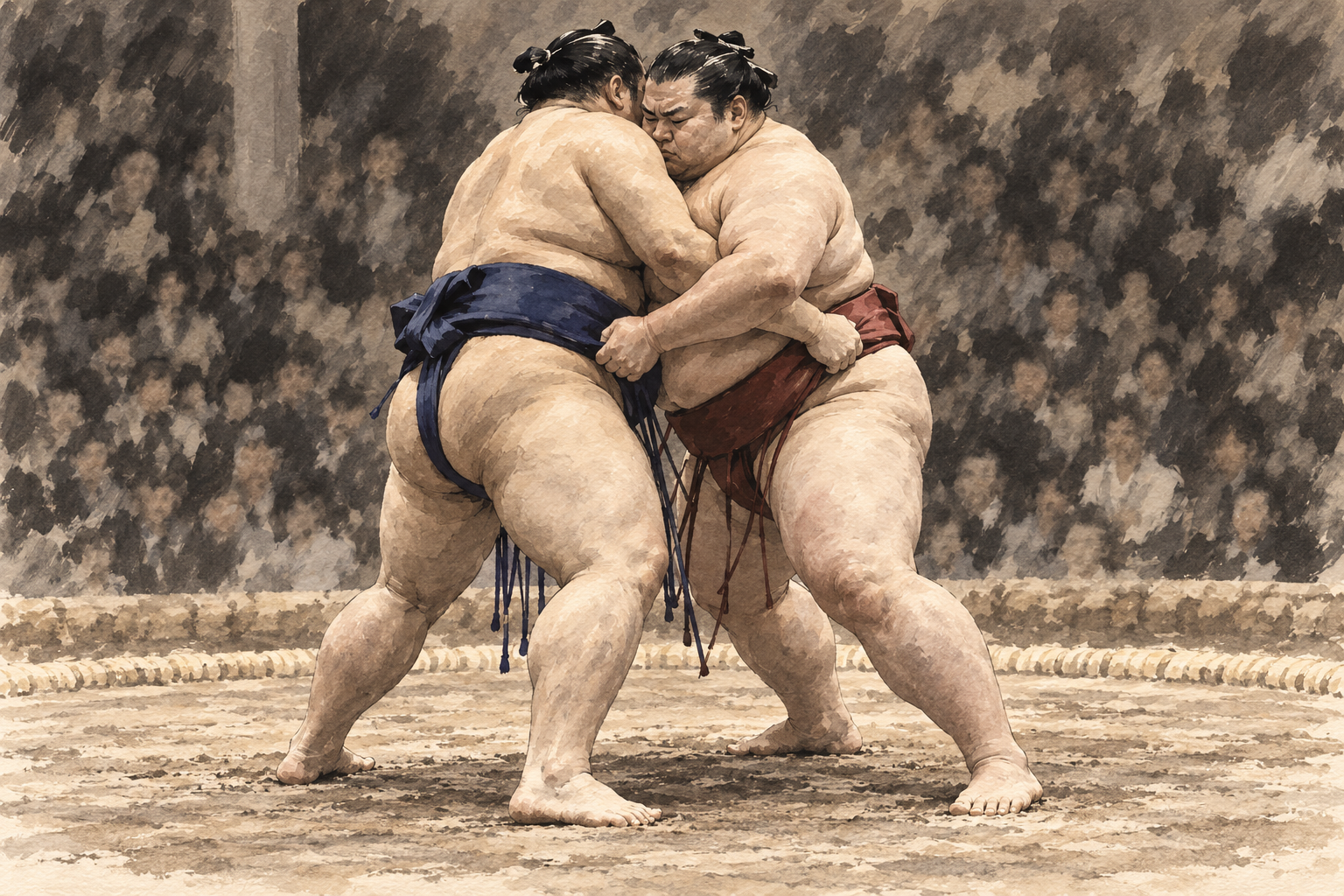
After work and dinner on Thursday, I opened my tablet on the sofa. A Japan Sumo Association quiz showed two wrestlers holding each other’s belts. The answer was migi-yotsu: a right-inside grip. A familiar term. But as I looked at the two men facing one another, I suddenly got confused. Right from whose point of view?
I enlarged the photo and followed one arm from the shoulder. His right arm was inside his opponent’s left. What about the other man? His own right arm was inside his opponent’s left arm, too.
Oh. Both of them. I had been thinking in terms of the left and right sides of the screen, and tying myself in knots. I made the photo smaller again to see them together. The overlapping arms were a little easier to follow now.
Inside, outside, and in between
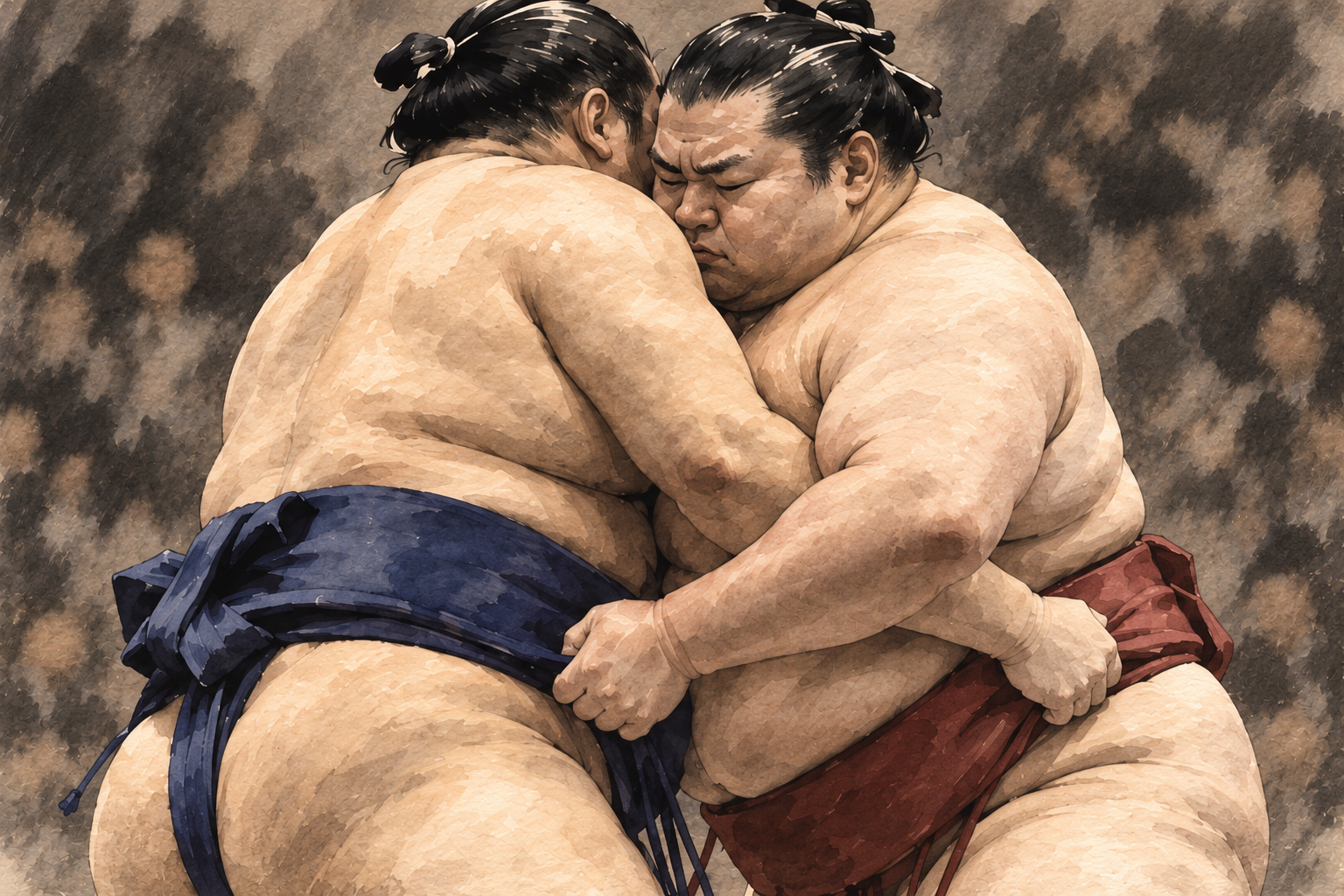
A belt grip taken from inside the opponent’s arm is shitate, the inside grip. From outside the arm, it is uwate, the outside grip. In the photo’s migi-yotsu position, each man has his right arm inside and his left outside. Following the path of an arm makes more sense to me than looking at the words on their own.
What I had thought of as simply holding on with both hands has an inside and an outside. One arm goes in closer to the other man’s body; the other passes over his arm. Both reach for the belt, but I cannot imagine them moving in quite the same way.
This time, I tried not to look only at the hands. Shoulder to elbow to belt. Then the other side. A closer look, then both wrestlers together again. Every small thing I understood made me curious about something I had skipped past.
I opened a sumo teaching guide as well. Its guidance on driving forward included taking a deep inside grip and a shallow outside grip, and turning up the inside arm. So securing the belt is not the end of getting into position. There is still the question of how to use your body against the other person.
The same position, the same feeling?
I checked two more terms: ai-yotsu and kenka-yotsu. I had almost assumed that these, too, simply named the arrangement of the arms at a particular instant.
The Association explains ai-yotsu as a pairing in which both wrestlers prefer the same inside arm: two who favour migi-yotsu, or two who favour hidari-yotsu, the left-inside position. In kenka-yotsu, one prefers right-inside and the other left-inside.
So the position I can see and the position each man prefers are two different things.
Even if a photo lets me recognise migi-yotsu, it does not tell me whether both men are in their preferred position. Did this wrestler want to get here? Would the other rather change it? I had started by looking at their arms. Now I wanted to know what each of them was trying to do.
I cannot say, “It is migi-yotsu, so this man wins.” But knowing what each wrestler likes might make me curious about how they get into the clinch, too. That sounds much more interesting than just memorising a name.
Migi-yotsu
Each wrestler has his right arm inside his opponent’s arm.
Ai-yotsu / Kenka-yotsu
Whether their preferred inside arms are the same or opposite.
The position visible now and the positions each wrestler prefers are different information.
Even while putting the dishes away
The dinner dishes were still waiting. I set the tablet down and went to the kitchen. Wash, drain, dry with the cloth, put away. My hands were doing something familiar, while those two pairs of arms were still on my mind.
One person wants his preferred position. His opponent may want to stop him getting it. That does not end just because they have come together.
The teaching guide also described makikaeshi: changing an outside arm to an inside one. Make space between the bodies, then bring the arm inside quickly. Thinking back to that explanation, I felt that even a little separation during a clinch could be worth paying attention to.
I put away the last dish and dried my hands. I think I had finished the washing-up a little faster than usual, because I wanted to get back to reading. Funny how efficient I can be when it suits me.
Both wrestlers, once more
This time, I sat on the floor in front of the sofa and opened my notebook at the low table. With my right hand, I wrote a short note: the position now, and the position each wrestler prefers. Two different things. I smiled at myself for having bundled them together.

I put down the pen and returned to the first photo. Earlier, I had looked at these two men to work out how their arms overlapped. Now I wondered whether each wanted to keep that position or change it. Rather than trying to find every answer in one photo, I wanted to see what happened before and after it.
Not just the hands holding the belt, but where the elbows are. What happens to the arms as the bodies come closer or move apart. Following everything at once would probably keep me rather busy. For a start, I can simply keep watching once they come together. That seems manageable.
Before closing the tablet, I looked at the whole scene a little longer. Two wrestlers in a clinch. That had not changed. But now even the wait for the next movement felt interesting. Tonight, I found something else to watch, a little farther from the finish.