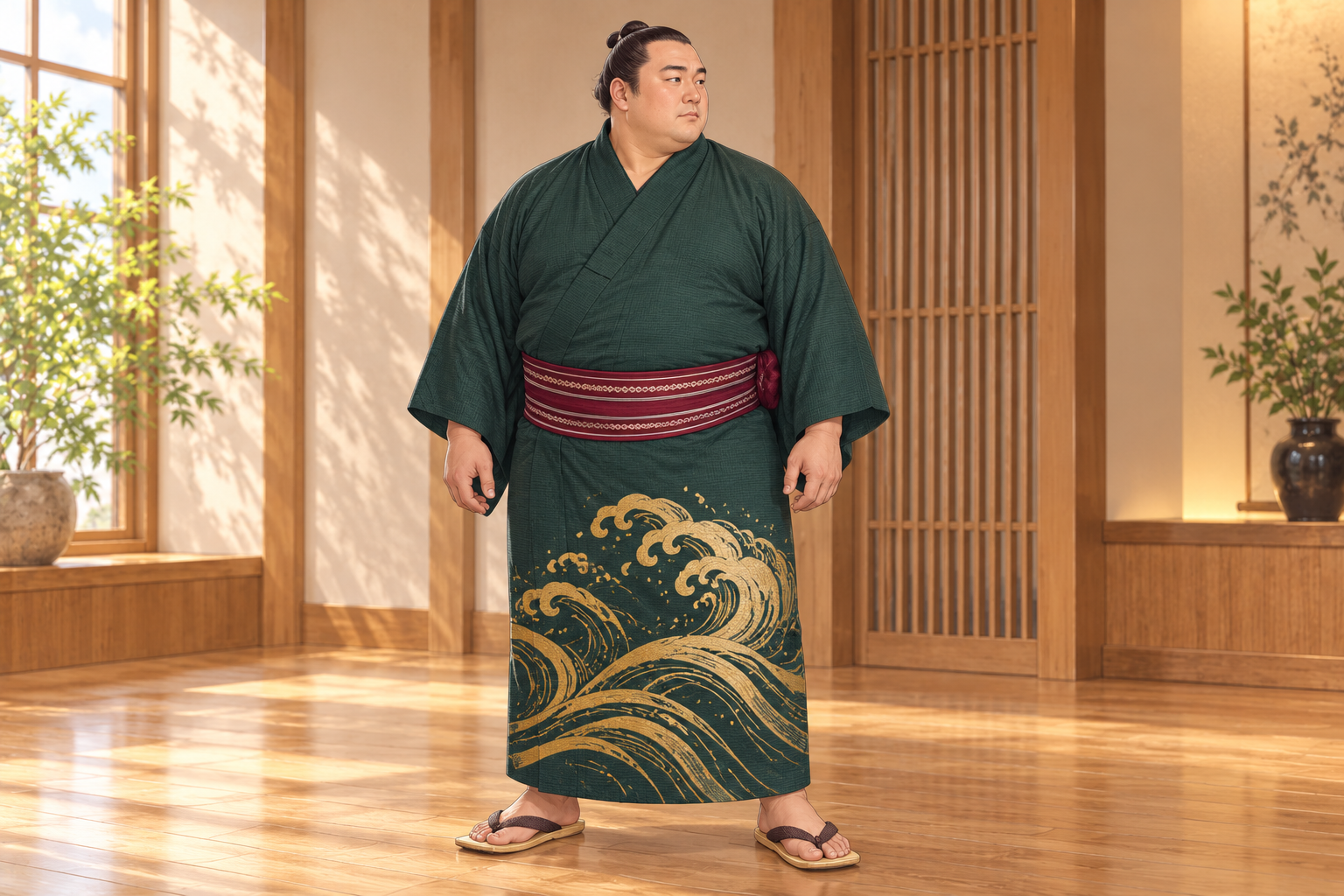
I thought I was looking at the kimono. Then my eyes stopped at the sash.
A band of burgundy crossing deep green. Large gold lettering near the hem. I followed it down, then looked back up at the face. Somehow, the whole figure seemed clearer this time.
On Sunday morning, after clearing away breakfast, I opened a column Sadanoumi had written about clothes. The photographs were published last year. Today, I wanted to spend a little time with that outfit.

Green and gold, at first.
The colours caught me first in the photograph of Sadanoumi in his somenuki kimono: deep green and gold at the hem. Beside him stood a life-size panel showing him dressed for a ring-entering ceremony. I found myself following the lines of the real kimono, from shoulder to hem.
Another of his columns has a photograph of him sitting on a sofa in a pale yukata with white flowers. Looking at that one, I feel my own shoulders relax a little. The same Sadanoumi, with such a different impression.
The clothes are not the only difference, of course. He is standing in one photograph and sitting in the other; the surroundings change too. Still, I keep going back to the green outfit because of that burgundy sash. Even when I think I am looking at the kimono alone, I am taking in what surrounds it.
From the topknot back to the face.
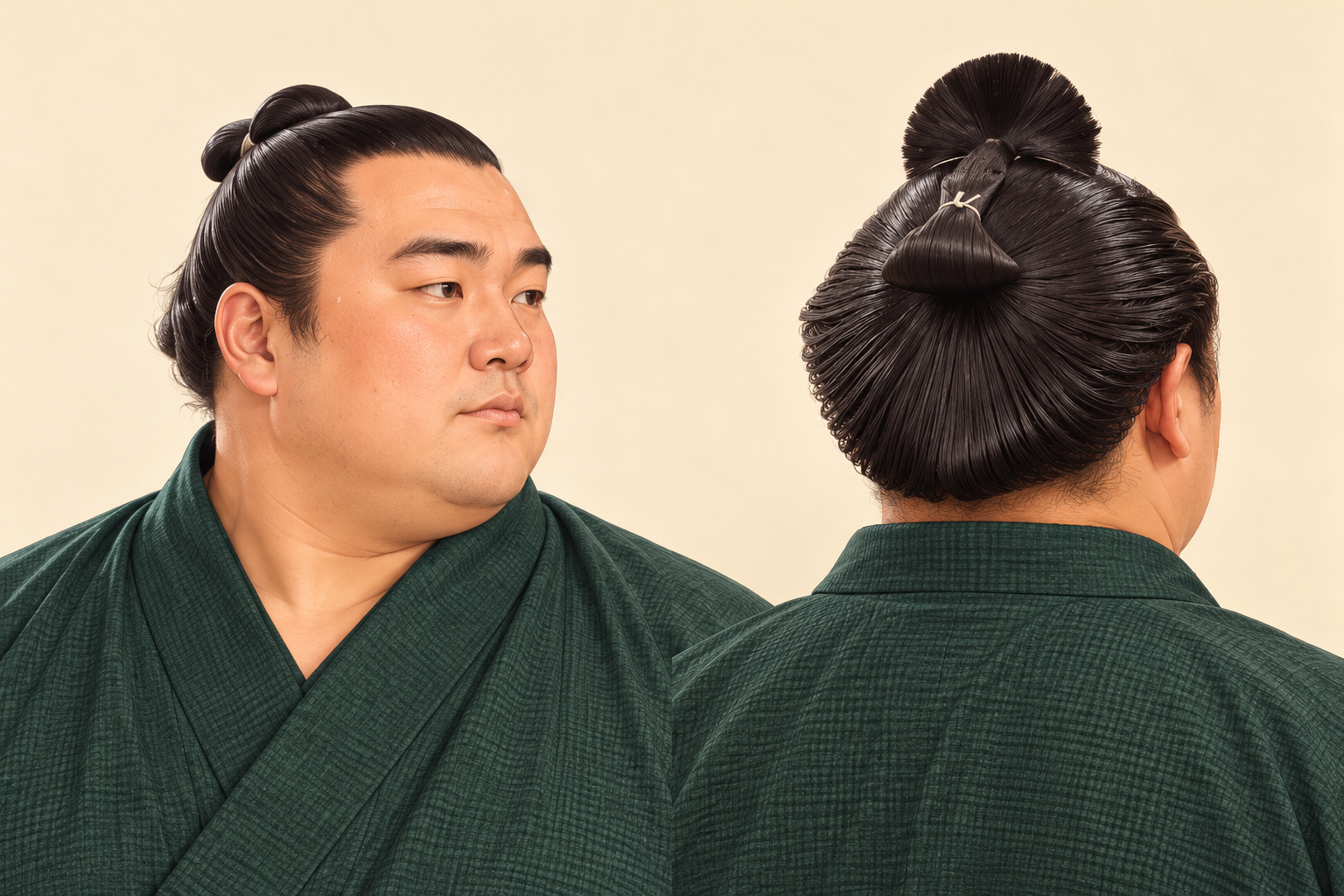
I let my eyes travel up from the colours to his hair. When I picture a sekitori in the ring, I think of the spreading shape of the ōichō topknot. I know its name and shape, yet I may have been treating every topknot in a kimono photograph as much the same.
The Japan Sumo Association explains that sekitori wear a chonmage for training and everyday life. An ōichō is required for their tournament appearances and is also customary for official appearances. The fan-shaped ōichō is not their all-day hairstyle. [3]
I opened the Association’s rear-view photograph of an ōichō, then looked back at a profile. Once I paid attention to the shape just above the face, I became curious about the line from the face down to the shoulders too.
Rank alone does not settle everything. A makushita wrestler facing a jūryō opponent, and wrestlers performing the bow-twirling ceremony or shokkiri demonstration, may also wear an ōichō. I need to look at who is there and what they are doing, rather than read a whole situation from the hair alone. [3]
Someone chose those colours.
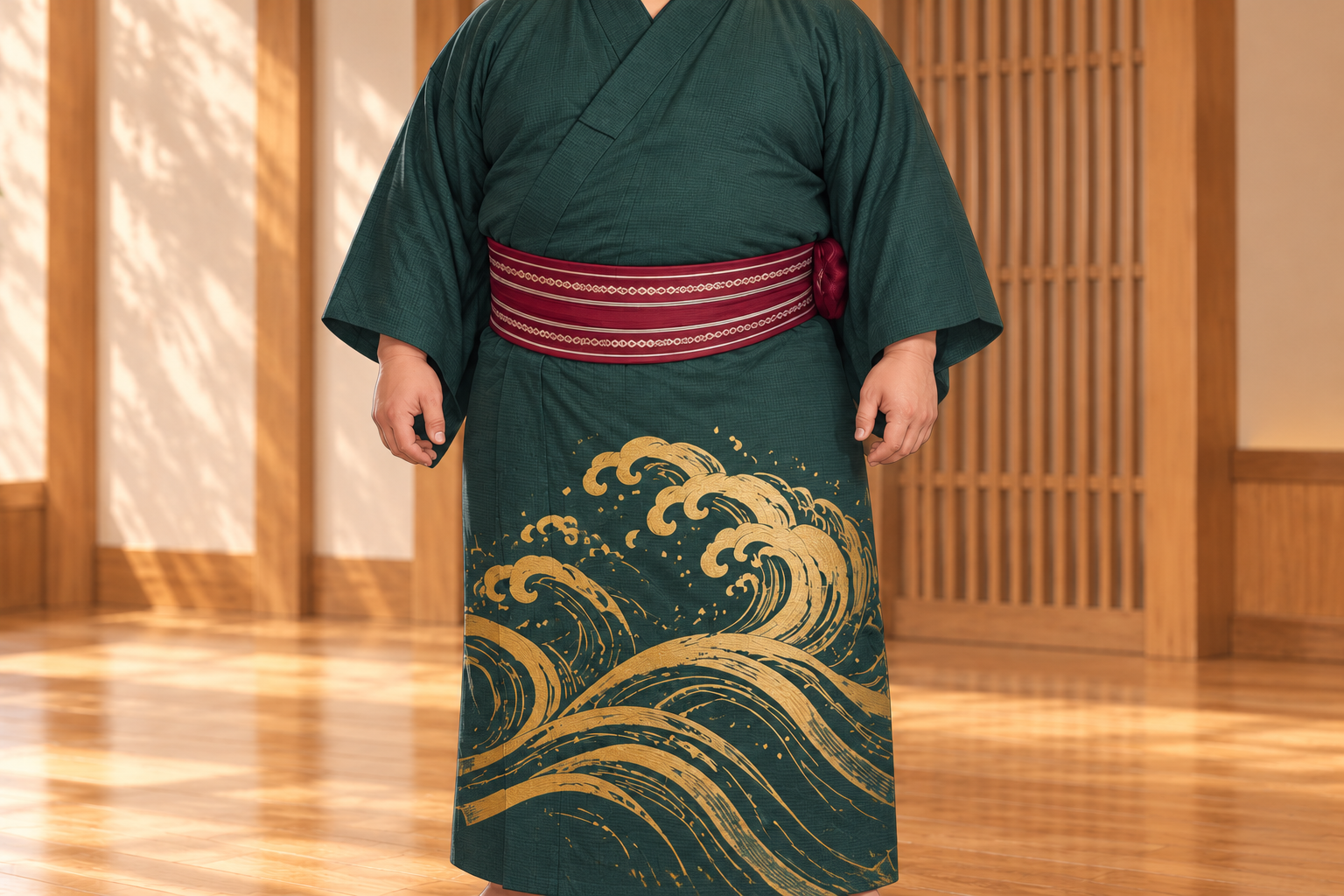
From the hair, my eyes returned to the collar and the cloth. A yukata and a somenuki kimono: if I simply admire them both as colourful traditional clothing, I can miss what makes them different.
The Sumo Museum describes somenuki as lightweight kimono worn by makuuchi wrestlers when arriving at the May, July and September tournaments. The Association’s explanation of seasonal dress also mentions summer weaves such as ro and sha. I looked at the photograph again with the season and occasion in mind. [4][5]
Reading Sadanoumi’s column again, I learned that he had requested the green and gold himself. Back in the photograph, those striking colours now carried a little of the wearer’s taste. [1]
His interest in Marimekko yukata began with a friend’s suggestion. That is his own choice, rather than a rule for how wrestlers choose their clothes. I wanted another look at the photograph, with those flowers sitting so comfortably on his broad frame. [2]
Knowing a preference does not mean knowing everything about someone. But there was time spent choosing behind those colours and patterns. I was glad to have caught a glimpse of it.
Lunch, then my own sleeves.
I put the tablet away for lunch. After eating and washing the dishes, I got ready to go shopping. Today I was wearing a muted teal sweater and cream trousers.
At the mirror by the door, I straightened a cuff. Usually that would be enough. Today, though, I found myself looking further down, from the hem to my feet.
I may choose one colour, but what follows beneath it changes how I see the whole outfit. I had not changed either the sweater or the trousers. I simply liked them together a little more than I had that morning.
I smoothed the sleeve once more and picked up my bag. A small shift in where I looked had made that last glance in the mirror more enjoyable.

Following the outfit to the feet.
After I came home and put the shopping away, I opened the green kimono photograph again. This time I enlarged it and started at the sash.
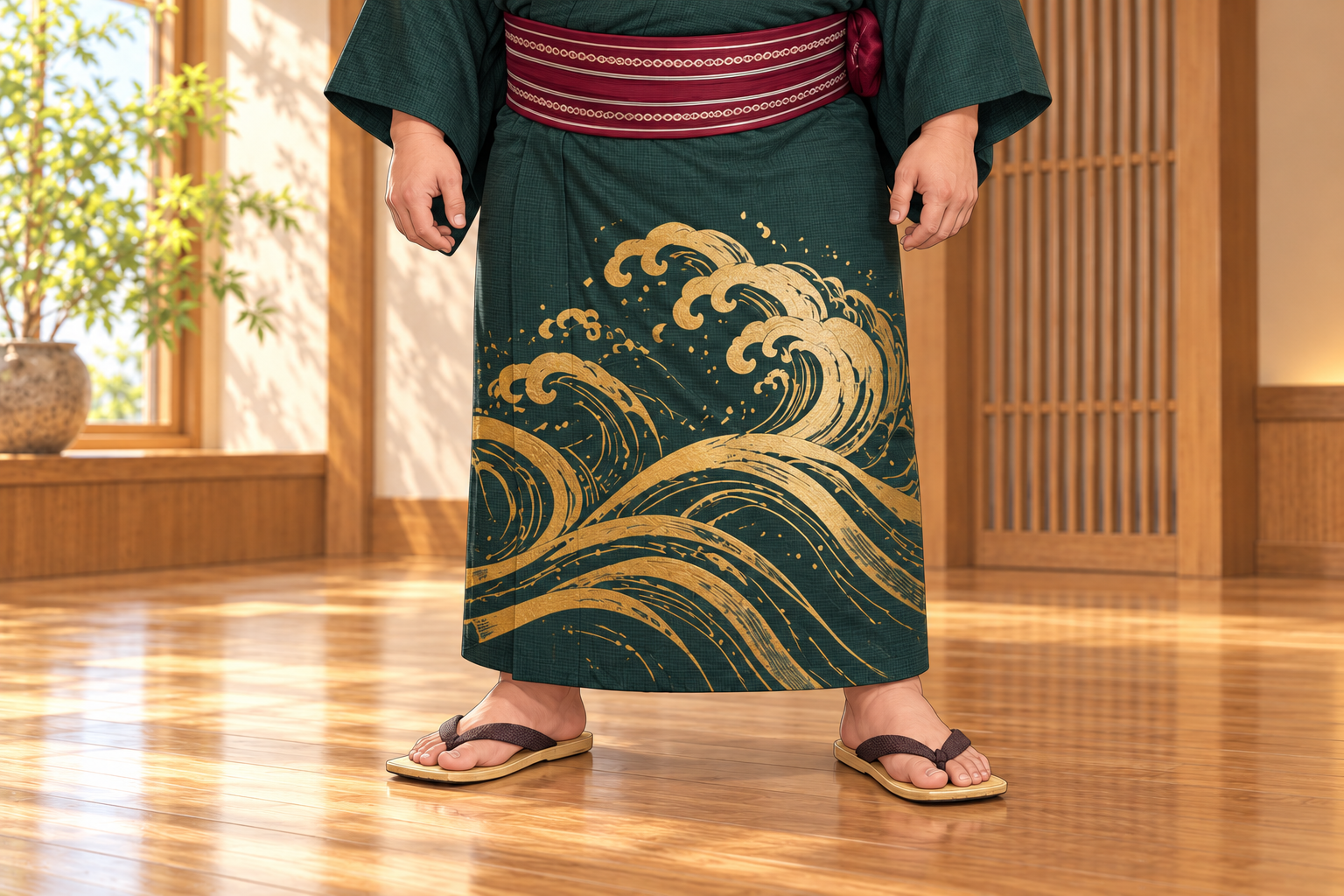
Fine pale lines and a pattern cross the burgundy obi. Below it, folds darken parts of the green cloth. Further down are light-coloured soles and dark sandal straps. Earlier, my eyes had stopped at the large lettering. Now they followed the outfit all the way to the feet.
Footwear has its own rank-related distinctions. The Association explains that wrestlers in jonidan and below wear wooden geta, while sandanme wrestlers and above may wear enamel-finished setta sandals. For formal events, sekitori wear tatami-faced setta with crested haori and hakama. The occasion matters as well as the rank. [6]
I also read that Hakata obi and tabi socks are permitted from makushita. That does not let me identify the sash in this photograph as a Hakata obi from its pattern alone. With the footwear, too, seeing a colour or shape is different from knowing the material. [7]
Once I start looking closely, I want to put a name to everything. But what I like here is the change of colour at the waist, and the way the outfit continues below it. I do not want collecting names to mean I have finished looking.
The same photograph, once more.
After dinner, I returned to the desk and brought the full-length photograph back to roughly the size it had been that morning.
Green and gold. The burgundy sash. From topknot to collar, shoulders, hem and feet. The large lettering had drawn me in at first. Now I noticed the fine lines in the sash as well.
The photograph had not changed. I was simply looking at different parts of it. Yet I wanted to stay with it a little longer.
I opened the flowered-yukata photograph beside it. I still liked its softer feeling too. I did not need to choose which suited him better. Looking at the same person in different clothes was enjoyable in itself.
I was about to put the tablet down when I went back to the green kimono once more. Ah. That sash, again.

Shiori