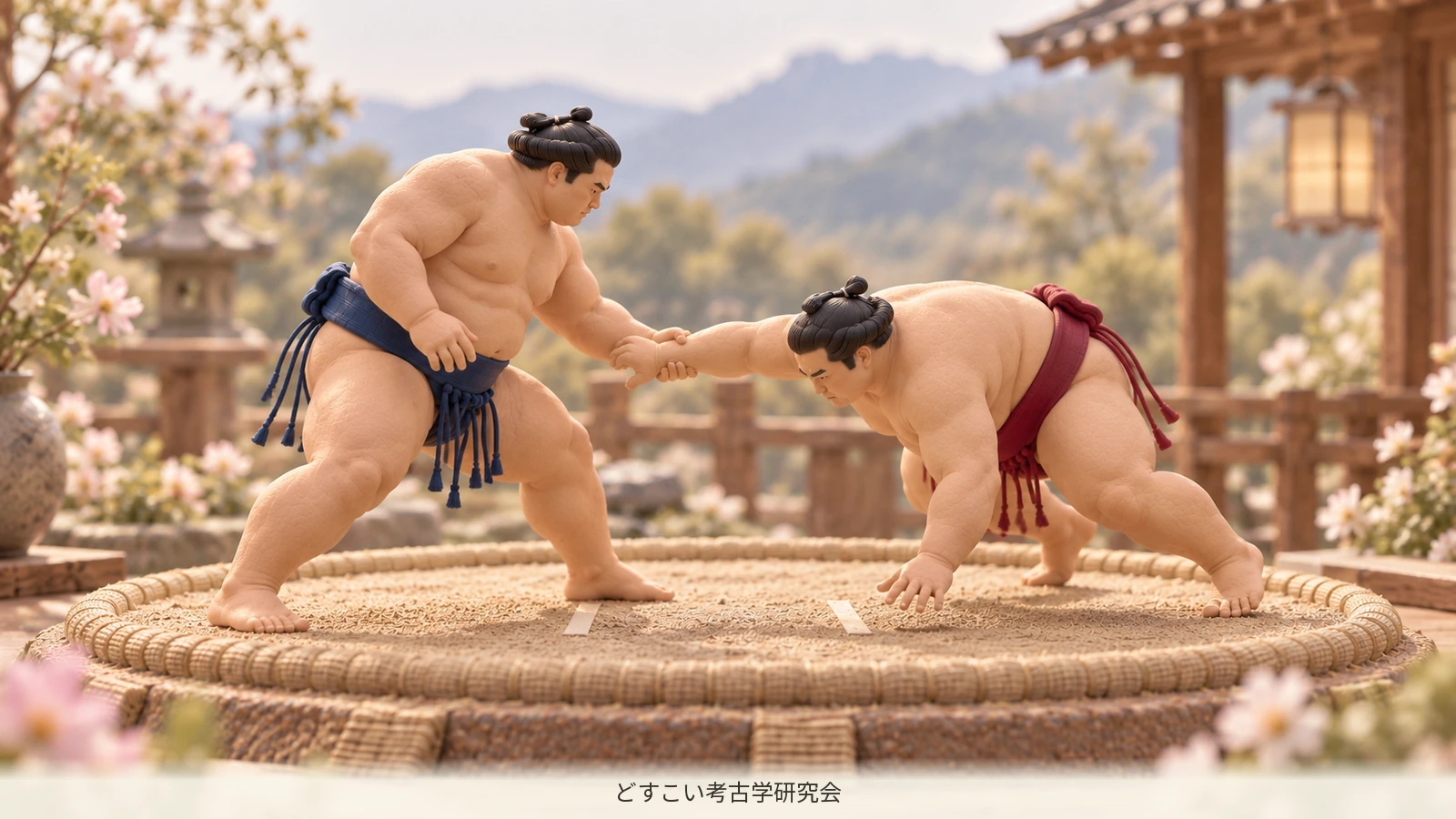
Both finishes can leave an advancing wrestler falling forwards, but the official hand actions differ. In hikiotoshi, the winner pulls the opponent’s arm or shoulder towards himself; he may also pull a front mawashi grip. In hatakikomi, the winner opens his body away from a low, advancing opponent and slaps down at the shoulder, back or arm. In the next bout, follow one winning hand: did it draw something in towards the torso, or work down as the body moved aside?
One wrestler attacks, touches the clay and hears “hikiotoshi.” In another bout, the final position looks nearly identical, but the announcement is “hatakikomi.” English labels such as hand-pull-down and slap-down help, yet the fall itself may not. The difference is hiding in the direction created just before it.
Hikiotoshi draws the opponent towards the winner
The Japan Sumo Association defines hikiotoshi as pulling an opponent’s arm or drawing his shoulder in towards the winner, causing him to fall. Its official explanation also says the winner may take the front of the mawashi and pull it.
The contact point is therefore not limited to one body part. Arm, shoulder and front belt can all supply the connection. The useful common feature is direction: the winner draws the captured part towards his own side of the space.
From a broadcast angle, look for a hand that catches rather than merely brushes and then travels back towards the winner’s torso. Do not demand certainty when the bodies hide the grip. The official announcement can tell you which obscured action the judges identified.
Hatakikomi opens the body and works down
For hatakikomi, the Association describes a low opponent coming forwards. The winner opens his own body away from that line and uses one or both hands to slap down at the shoulder, back or arm.
This gives us a cluster of clues: the advancing posture, the winner moving off the line, and a downward hand action against the upper body. A touch on the back alone does not prove hatakikomi. Nor does a touch on the shoulder prove hikiotoshi, because the official pages mention the shoulder in both definitions. Contact point and direction must be read together.
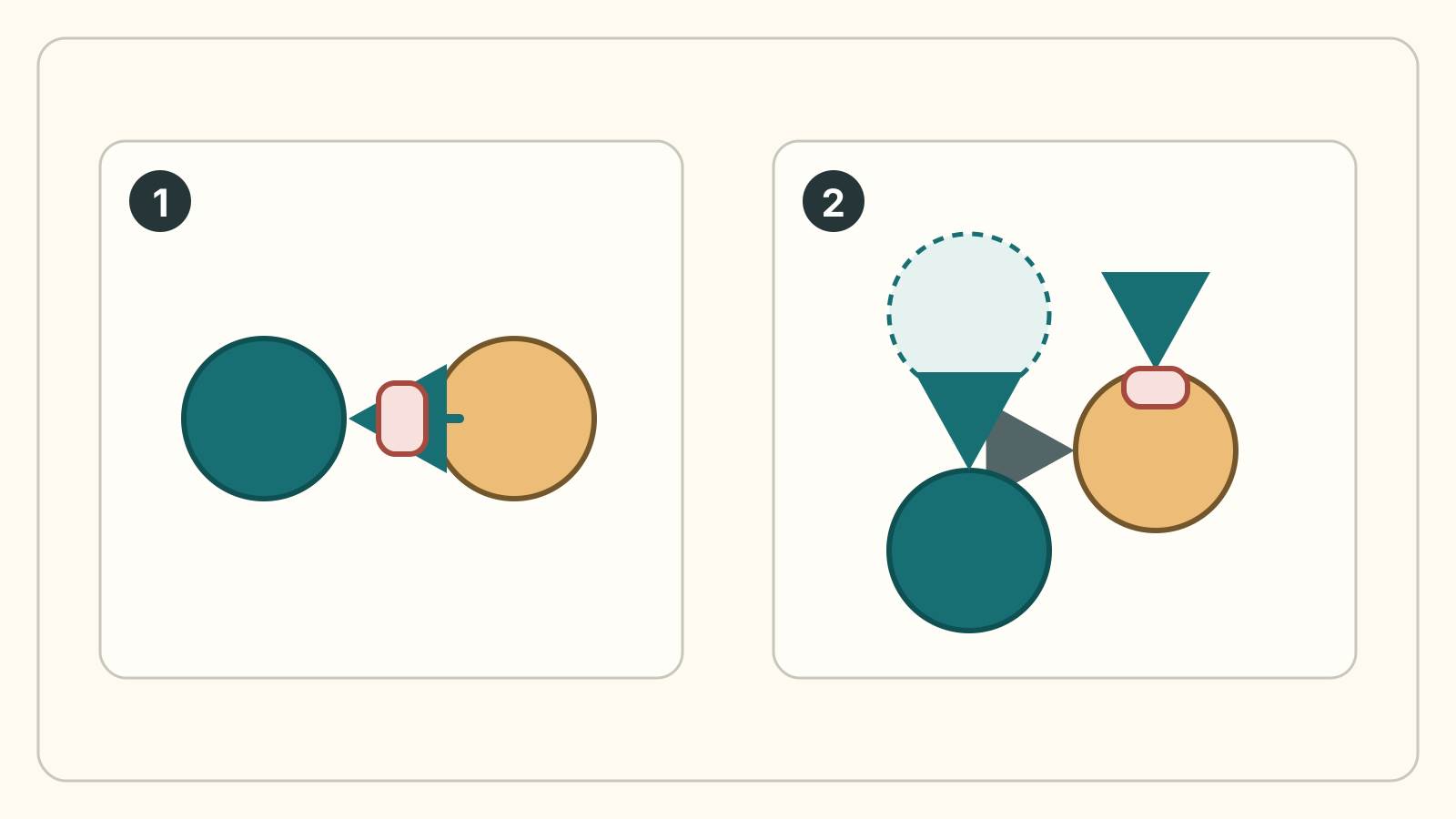
Detailed description of this diagram
Card 1 puts the blue winner token left and the gold opponent token right, with an arrow from gold toward blue and a small contact symbol, representing only the official draw-toward-self relation of hikiotoshi. Card 2 gives the gold opponent an advance arrow, moves a blue token off that line, and separately points down towards the gold token, representing the official open-body and slap-down sequence of hatakikomi. Up, down, left and right on the page are not dohyo or camera directions. Arrow length, contact and token position encode no angle, force, timing or judging test.
Graphic: SUMO ARCHAEOLOGY CLUB · Figure source 1 · Figure source 2
“He pulled” is a tactical impression, not the full kimarite
Fans may describe several backward-moving finishes as “pulling.” That is a useful summary of the tactical risk, but it does not automatically supply the official technique name. A wrestler can retreat and still finish with the specific downward slap and body opening of hatakikomi. Another can take an arm, shoulder or front belt and draw the opponent in for hikiotoshi.
Likewise, whether the action began at the tachiai does not by itself separate the pair. Hatakikomi can follow an opening sidestep or emerge later in an ordinary exchange. The kimarite identifies the decisive action; it does not certify a moral judgement about whether the winner attacked “properly.” You can dislike the choice and still investigate it accurately.
The same shoulder can belong to two different techniques
The shoulder appears in both official descriptions, which is precisely why a body-part flashcard fails. In hikiotoshi, the shoulder is drawn towards the winner. In hatakikomi, it can receive the downward slap while the winner opens his body.
Imagine a small arrow attached to the winning hand. Does it point back towards the winner’s chest or hip as he pulls a connected part? Or does it point down across the advancing upper body while his torso shifts sideways? A single camera angle may not reveal that arrow, but asking the question keeps you from inventing a certainty that the picture cannot support.
One thing to watch in the next bout
When an advancing wrestler begins to pitch forwards, choose only one of the winner’s hands. If it seems to draw an arm, shoulder or front belt back towards his own body, predict hikiotoshi. If his body opens away and the hand works down at a shoulder, back or arm, predict hatakikomi. Then listen and, if possible, revisit just that hand in the replay.
Even a wrong answer changes the bout. Your eyes have moved from the dramatic landing to the quieter action that created it. Next time the attacker recovers his feet, you may notice the pull or slap that failed. Kimarite do more than label victories: they make the almost-technique, and the one stubborn saving step, visible too.
Sources
- Japan Sumo Association, kimarite explanation for hikiotoshi (checked 2 September 2026)
- Japan Sumo Association, kimarite explanation for hatakikomi (checked 2 September 2026)
Source links used for verification
Each link was used for the corresponding claim in this article; inclusion is not a blanket endorsement of the whole page.
Article verified:
- Japan Sumo Association kimarite: hikiotoshiPrimary source (as checked for this article)
- Japan Sumo Association kimarite: hatakikomiPrimary source (as checked for this article)