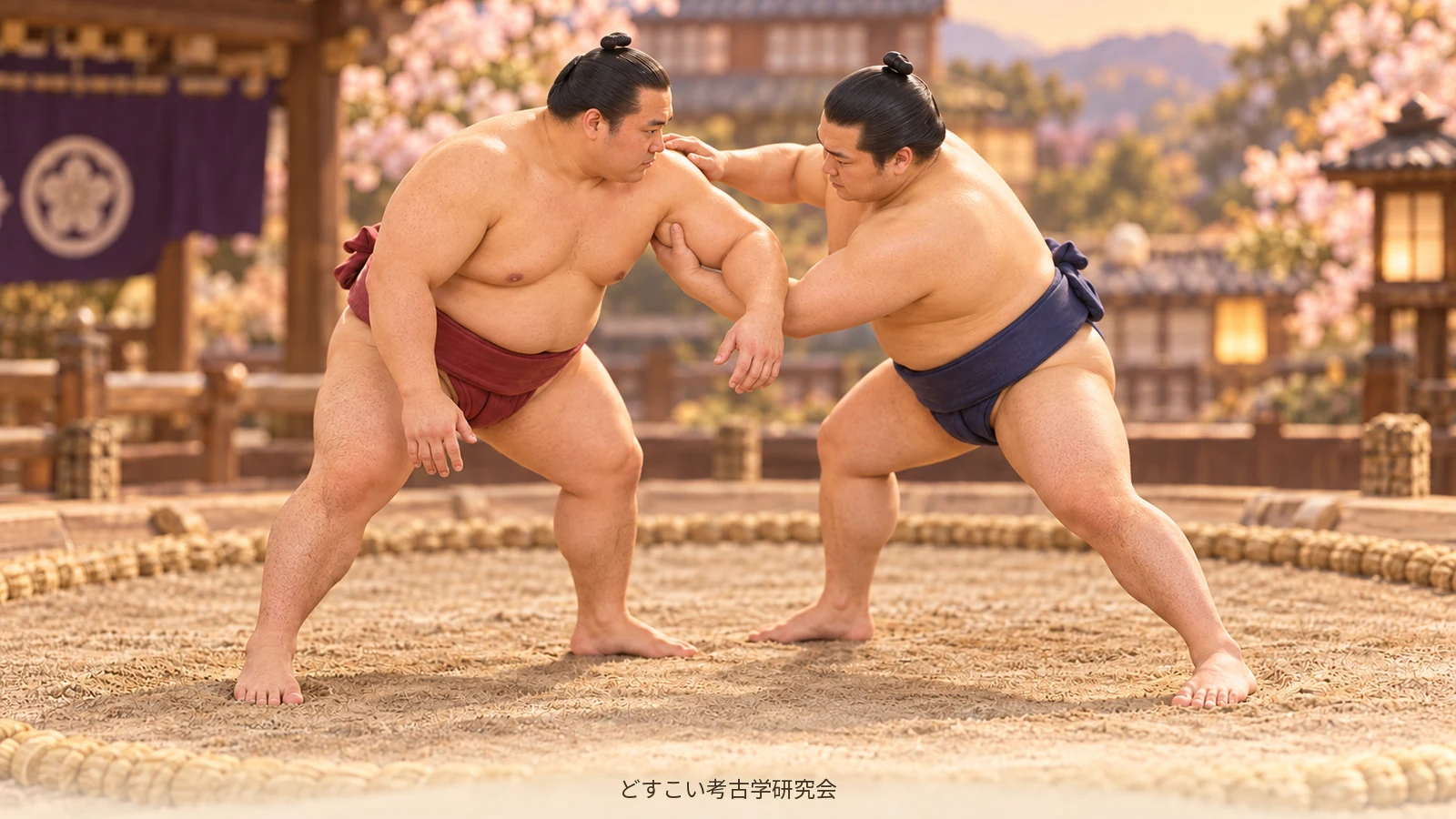
Katasukashi uses two arms in different roles. The winner’s inserted inside arm encloses the base of the opponent’s arm, or catches it at the armpit, and pulls forwards. As the winner opens his body, the other hand works at the opponent’s shoulder and helps pull him down. A touch at the shoulder alone does not separate it from hatakikomi. In the next bout, watch the opposite arm: did an inside elbow remain beneath the armpit and pull before the shoulder hand descended?
The English-language viewer may hear a long Japanese name after a fall that looked like a simple slap-down. The official description hides a lovely piece of teamwork inside it. One arm establishes a route beneath the opponent’s shoulder; the other closes the finish from above. Once you find those two jobs, the fall stops looking sudden.
Read the official definition as a sequence
The Japan Sumo Association describes katasukashi through linked actions:
- The winner’s inserted arm encloses the base of the opponent’s arm or catches at the armpit.
- That inside arm draws the opponent forwards.
- The winner opens his own body.
- His other hand works at the opponent’s shoulder or a nearby area and pulls him down.
An inserted arm, often called *sashite* in sumo, is the arm that has travelled inside beneath an opponent’s armpit. The two winning hands are not interchangeable. The inserted arm creates forward control from below; the opposite hand adds the action at the shoulder.
From a distant seat, fingers may disappear, but elbows remain useful landmarks. Find one winning elbow inside the opponent’s arm. Then see whether the hand on the other side reaches the shoulder as the torso turns away.
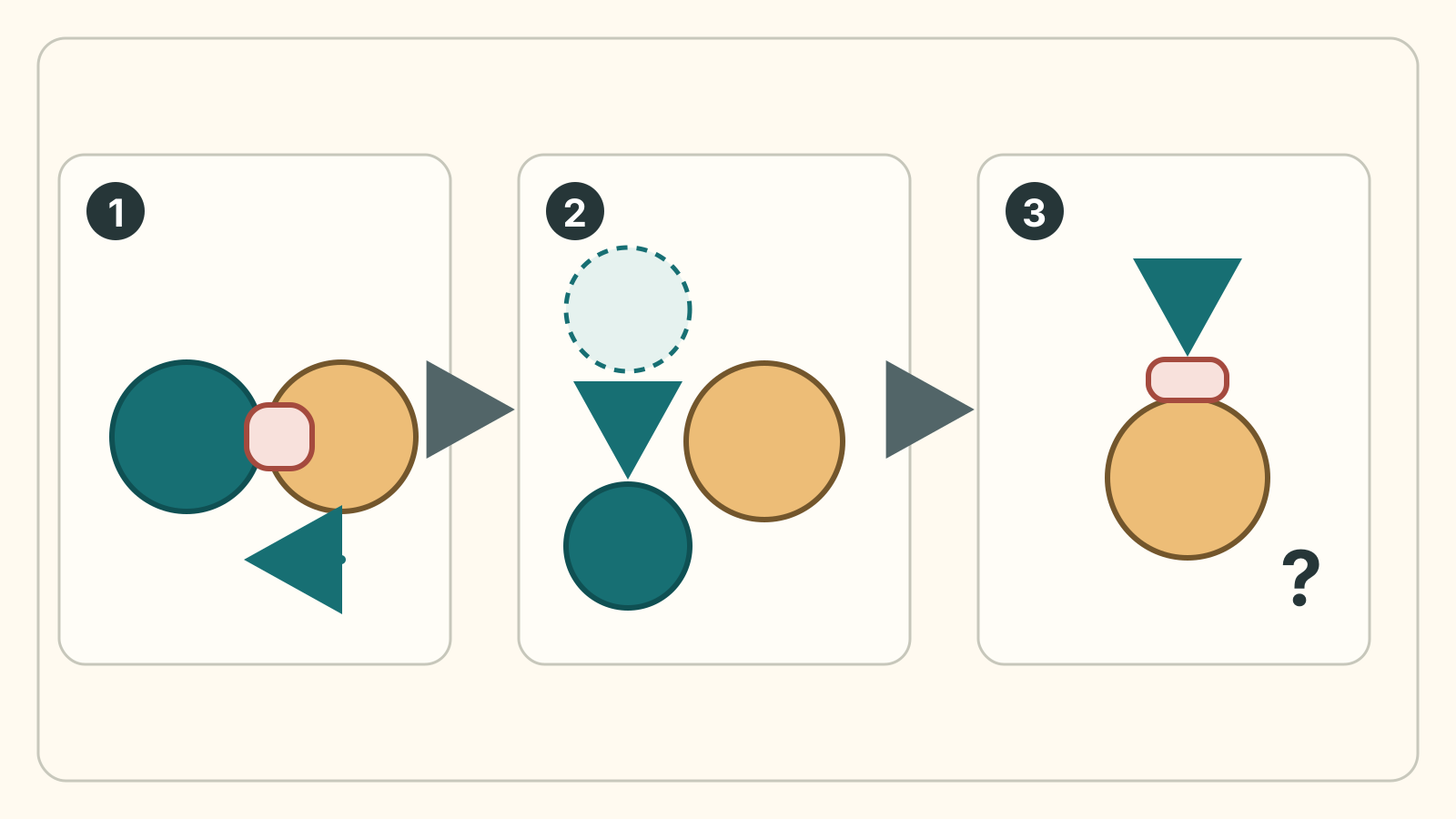
Detailed description of this diagram
Card 1 uses a contact band between blue and gold competitor tokens and an arrow drawing the gold token towards the blue side, representing the inserted-arm role. Card 2 keeps the gold token on its line and moves a blue token off that line. Card 3 adds a separate contact band above the gold token and a downward cue, representing the other-hand action at the shoulder area. Bar location, arrow direction and token placement encode no arm, shoulder, hand shape, dohyo direction, force, timing or fall path.
Graphic: SUMO ARCHAEOLOGY CLUB · Figure source 1 · Figure source 2 · Figure source 3
Katasukashi vs hatakikomi: look before the shoulder contact
Hatakikomi can also involve a hand at the shoulder. In the Association’s definition, an opponent comes forwards low, the winner opens his body and one or both hands slap down at the shoulder, back or arm.
Katasukashi adds the distinct inside-arm role: the inserted arm catches the arm base or armpit and pulls forwards while the other hand acts at the shoulder. “Shoulder means katasukashi; back means hatakikomi” would therefore be a misleading shortcut. The contact site overlaps. Rewind one beat and look beneath the opponent’s arm.
If bodies hide that inside connection, do not manufacture certainty from the final pose. Make a provisional guess, listen to the official announcement and keep the hidden elbow as the question you want another angle to answer.
Katasukashi vs hikiotoshi: two roles or one pull?
The Association defines hikiotoshi by drawing an opponent’s arm or shoulder towards oneself and pulling him down. A front mawashi grip can also be used for that pull. The opponent may pitch forwards in both techniques.
For katasukashi, look for two coordinated roles specified on its official page: the inserted arm draws from the base of the arm or armpit, and the other hand works at the shoulder as the winner opens. For hikiotoshi, the key action is the pull towards the winner from an arm, shoulder or front belt grip.
The landing direction alone cannot decide between them. Ask whether you saw a paired inside-arm-and-shoulder action or one contact being drawn towards the winner.
The name does not make the shoulder the only clue
Because the name contains “shoulder,” it is natural to begin with the hand that lands there. The official definition begins earlier. The inserted arm first encloses the arm base or catches it at the armpit and draws the opponent forwards. The shoulder hand has the second role.
Treat the name as a destination, not a complete replay. Follow the inserted arm, the opening torso and then the other hand. The delightful surprise is that the shoulder becomes easier to understand when you look beneath the opposite arm first.
One thing to watch in the next bout
When a clinch forms, choose one inside elbow belonging to the wrestler under pressure. Keep that elbow in view. Does it stay beneath the opponent’s armpit and draw the arm base forwards while the free hand reaches the shoulder? If so, store a katasukashi prediction.
The opponent may free the arm and face squarely again. No named technique will appear, but you will have seen its route close. What once looked like a single downward touch now contains a miniature relay: one arm passes the moving body forwards, the other completes the change of direction. Katasukashi can make the apparently quiet space beneath an armpit the most interesting patch of the next bout.
Similar Motion Does Not Set the Official Technique
A hand action or fall may look similar while the recorded kimarite differs according to the decisive action, sequence of balance loss and whether a body part touched down or crossed the ring first. Do not settle the difference between a similar technique, non-technique or foul from one camera angle; use the official result for that bout. A schematic marks viewing cues, not a substitute judges’ decision.
Sources
- Japan Sumo Association, kimarite explanation for katasukashi (checked 2 September 2026)
- Japan Sumo Association, kimarite explanation for hatakikomi (checked 2 September 2026)
- Japan Sumo Association, kimarite explanation for hikiotoshi (checked 2 September 2026)
Source links used for verification
Each link was used for the corresponding claim in this article; inclusion is not a blanket endorsement of the whole page.
Article verified:
- Japan Sumo Association kimarite: katasukashiPrimary source (as checked for this article)
- Japan Sumo Association kimarite: hatakikomiPrimary source (as checked for this article)
- Japan Sumo Association kimarite: hikiotoshiPrimary source (as checked for this article)