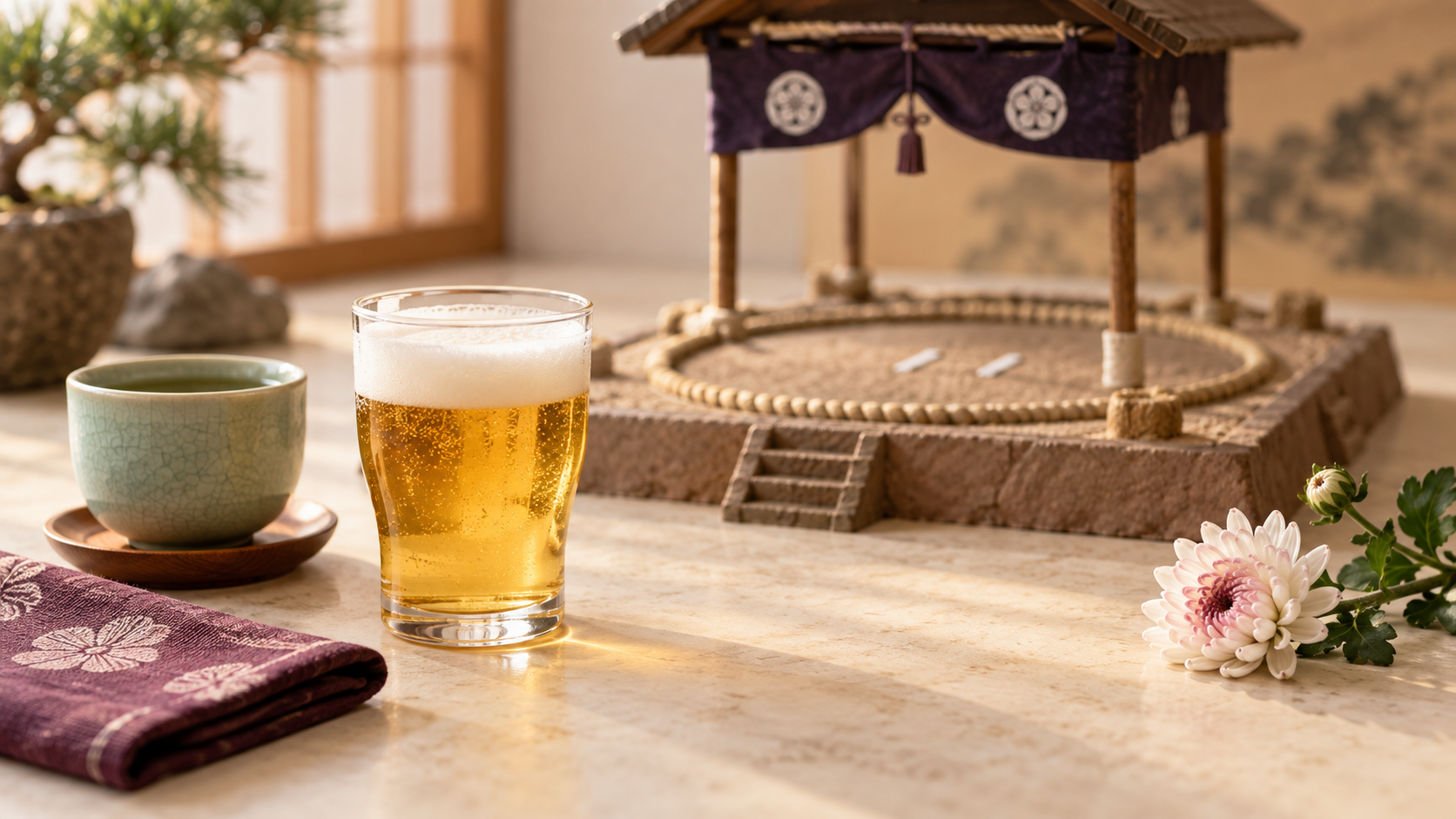
Yes, beer and other alcoholic drinks are listed for sale inside Ryogoku Kokugikan. That does not mean every ticket holder may drink at their seat. Food and drink are permitted at ordinary chair and masu seating, while tamari—the floor-level seats nearest the ring—has a strict no-food-and-drink rule. Check the seat type printed on your ticket before buying a drink.
This sounds like a small piece of trip planning. It becomes a surprisingly inconvenient one if you queue, buy a cup and only then learn that it cannot go to your seat. The useful distinction is not “Does the arena sell alcohol?” It is “Where may the holder of this particular ticket consume it?”
What the September venue page lists
The Japan Sumo Association’s food page for the September 2026 tournament lists draft beer at ¥600 for medium and ¥800 for large. It names Kokugikan Cafe, Sushi Raiden and Meat Raiden as sales points. Store listings on the same page also include sake, wine, highballs and sours at some counters.
Treat those details as current planning information, not a guarantee of stock. Menus, prices and opening hours can change on the day. There is also an important source-quality warning: the top of the official page still says that the information is for the May 2026 tournament, even though its body contains clearly September-specific items, including the new Aonishiki lunchbox. We therefore mark the page PRIMARY_WITH_CONFLICT and recheck individual products immediately before the basho.
Tamari has a separate restriction
The current September spectator notice says that visitors may eat and drink at their seats, but expressly excludes tamari. These are the seats on the floor closest to the dohyo, where a wrestler or official can fall from the ring. They also carry special rules for phones, photography, movement and objects brought into the seating area.
Do not use the existence of a venue bar, or another spectator’s behaviour, as evidence that a drink is allowed in tamari. If your ticket says tamari, finish food and drink in an authorised area and follow arena staff instructions.
Ordinary seating still calls for a little planning
Chair and masu spectators may eat and drink at their places. A masu box, however, is compact, and some boxes are shared by several people. Keep cups away from feet and bags, stay within your allocated area and do not place anything in an aisle or evacuation route.
Alcohol also changes the practical shape of a long sumo day. Locate the restrooms before the upper-division programme becomes busy, stay hydrated, and plan to use public transport. Re-entry rules differ by venue and tournament, so do not assume you can leave to buy a drink and return whenever you like. This article does not set a safe amount or decide alcohol’s compatibility with medication, pregnancy or a health condition; ask the appropriate clinician or pharmacist when an individual decision is needed.
You do not need alcohol to “do sumo properly”
Beer and Kokugikan yakitori are a familiar pairing, but they are not an entry requirement. Chanko, lunchboxes, sweets and coffee offer other ways into the venue’s food culture. You can also skip the queue entirely.
Here is the small discovery we would keep: during the repeated pre-bout crouches, the arena’s sound seems to narrow as the wrestlers approach the charge. Put the cup down for one bout and follow it from the first ritual movement through the final bow. A visitor who arrived only wanting to check the beer rule may leave having noticed the silence around a tachiai. That is a useful trade.
Sources
- Japan Sumo Association, September 2026 Kokugikan food and drink guide (checked 2 September 2026)
- Japan Sumo Association, September 2026 Tokyo spectator notice (checked 2 September 2026)
Source links used for verification
Each link was used for the corresponding claim in this article; inclusion is not a blanket endorsement of the whole page.
Article verified:
- Japan Sumo Association September 2026 Kokugikan food and drink guidePrimary source (conflicting details noted)
- Japan Sumo Association September 2026 Tokyo spectator noticePrimary source (as checked for this article)