Research Note #032 | Sumo in Numbers · November special
“Was November’s champion also the wrestler who spent the most days in the lead?”
Onosato and Wakamotoharu both finished 13–2. Those final totals do not tell me who led for how long along the way. Was the eventual champion also the wrestler who led on the most days? That was the question that made me want to count all fifteen days.
I counted the wrestlers with the most wins at the end of each day’s regular bouts. Ties for the lead count; the playoff is separate. I wanted to find who spent the longest at the front, and when the eventual finalists drew level again.

Wakamotoharu spent the most days in the lead.
Counting all 42 wrestlers on the Makuuchi banzuke, Wakamotoharu led on 11 days, the most of anyone. Atamifuji followed with ten. The eventual champion, Onosato, led on seven.
| Wrestler | Days in the lead | Of those, sole leader |
|---|---|---|
| Wakamotoharu | 11 | 2 |
| Atamifuji | 10 | 2 |
| Onosato | 7 | 0 |
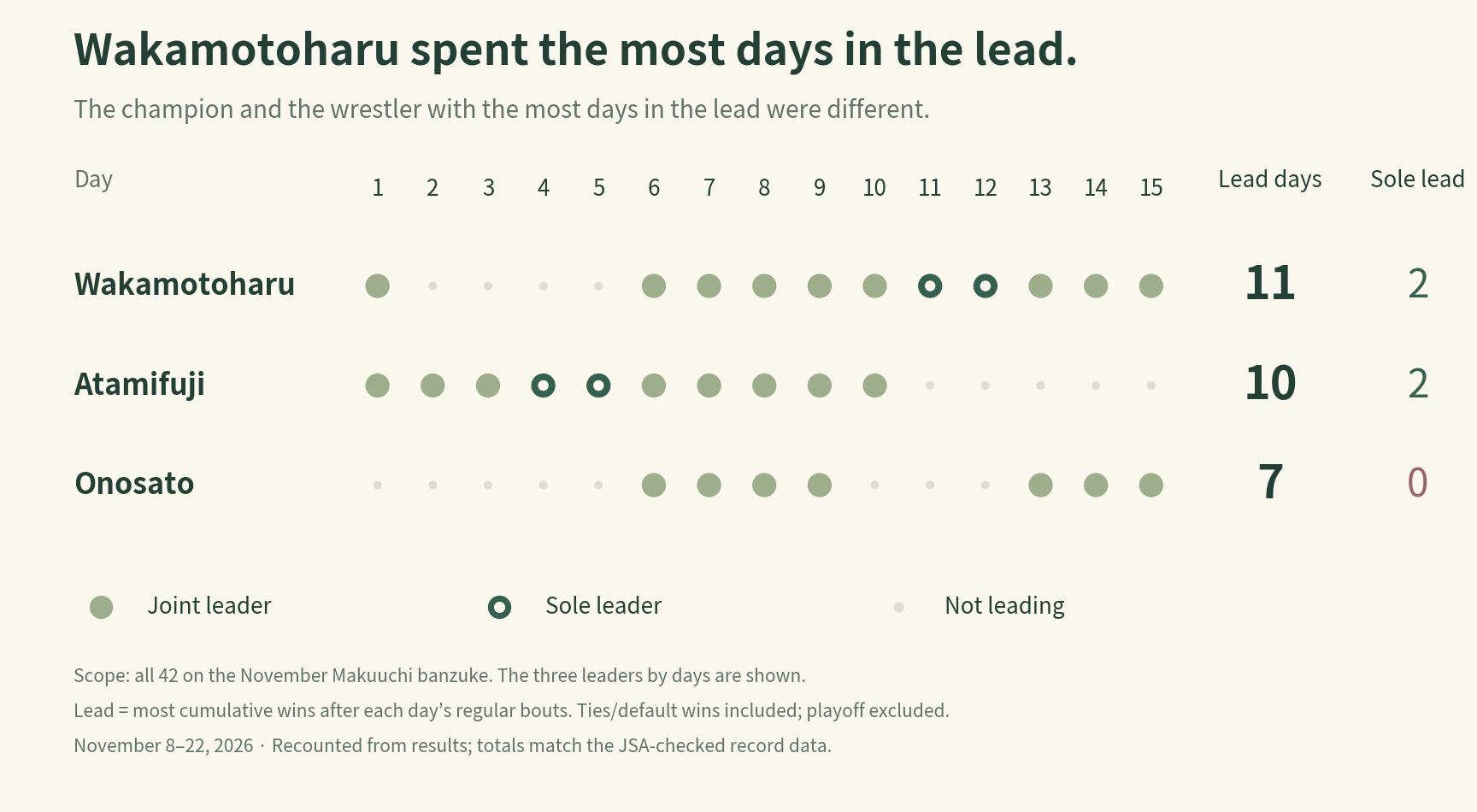
Onosato won the title without ever being the sole leader at the end of a day’s regular bouts. That was the surprise for me. Where, then, did the eventual finalists draw level again?
The Day 13 head-to-head brought them level again.
Onosato lost on Days 1 and 10. Wakamotoharu lost on Days 2 and 13. Each had two losses, but their positions in the sequence mattered.
Five men shared the lead at 7–1 after Day 8. By Day 10, the lead belonged to Atamifuji and Wakamotoharu, both 9–1. Wakamotoharu was the sole leader after Days 11 and 12. At that point Onosato stood at 10–2, one win behind.
| After Day | Onosato | Wakamotoharu | Joint leaders |
|---|---|---|---|
| 8 | 7-1 | 7-1 | 5 |
| 10 | 8-2 | 9-1 | 2 |
| 11 | 9-2 | 10-1 | 1 |
| 12 | 10-2 | 11-1 | 1 |
| 13 | 11-2 | 11-2 | 2 |
| 14 | 12-2 | 12-2 | 2 |
| 15 | 13-2 | 13-2 | 2 |
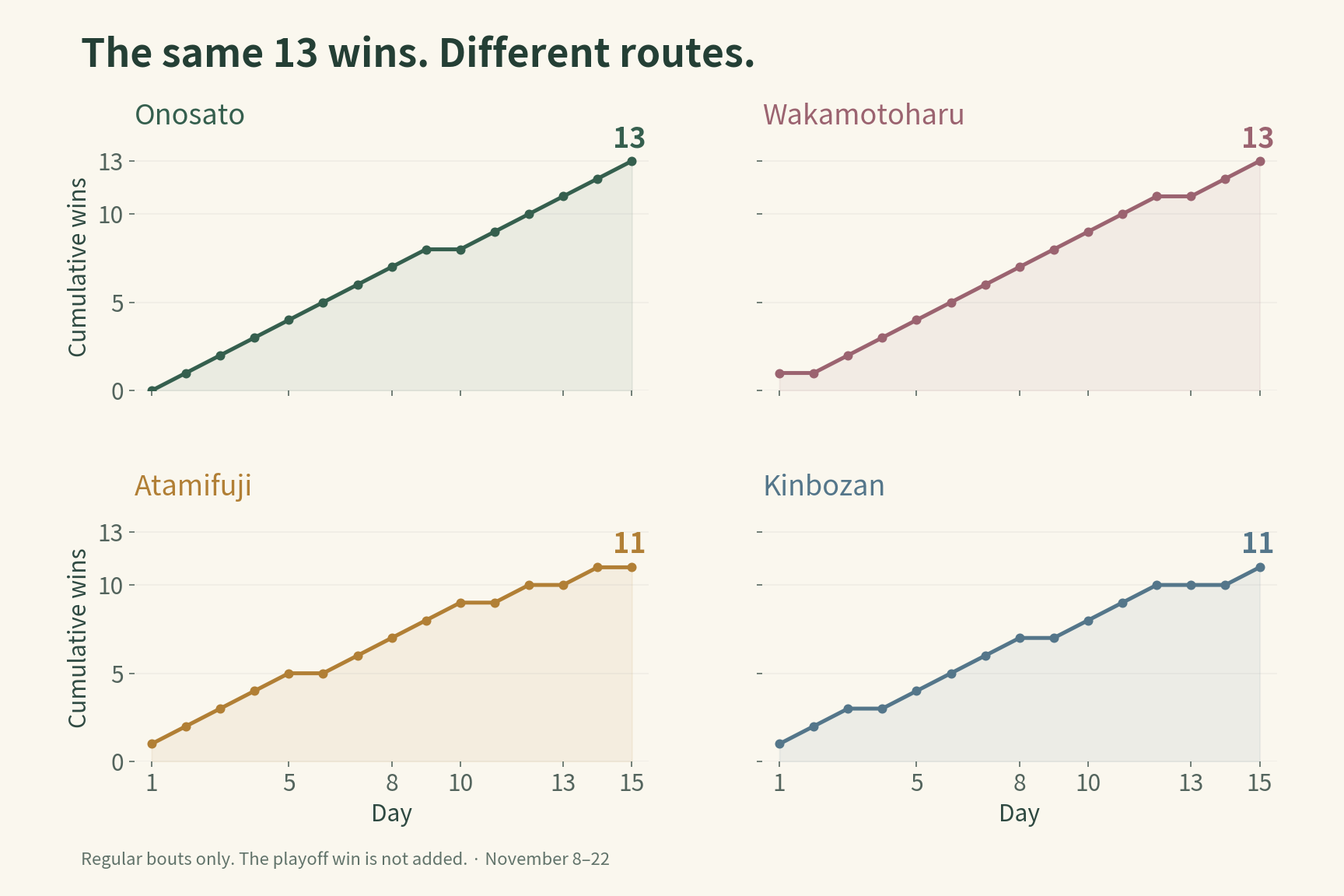
The gap closed in their head-to-head meeting on Day 13. Onosato won, leaving both men 11–2. Each won on the final two days, so both reached 13–2 and a championship playoff.
Onosato won his last five regular bouts, then the playoff. Wakamotoharu had built his lead with ten straight wins from Days 3 through 12, and won twice more after his Day 13 defeat. A run that builds a lead and a run that catches it can end with the same total.
The playoff is separate: Onosato’s regular record remains 13–2, not 14 wins. Keeping that extra bout apart lets us compare the same fifteen-day schedule.
Split the tournament into fives, and a 10-win record changes shape.
That comparison made me curious about another matching record. Kirishima and Asanoyama both finished 10–5. Did they collect their wins at similar times? I grouped the days into three blocks of five to look closer.
| Wrestler | Days 1–5 | Days 6–10 | Days 11–15 | Final record |
|---|---|---|---|---|
| Onosato | 4 | 4 | 5 | 13-2 |
| Wakamotoharu | 4 | 5 | 4 | 13-2 |
| Atamifuji | 5 | 4 | 2 | 11-4 |
| Kirishima | 4 | 4 | 2 | 10-5 |
| Asanoyama | 1 | 5 | 4 | 10-5 |
| Dewanoryu | 4 | 4 | 0 | 8-7 |
| Kotoeiho | 1 | 1 | 5 | 7-2; 6 absent |
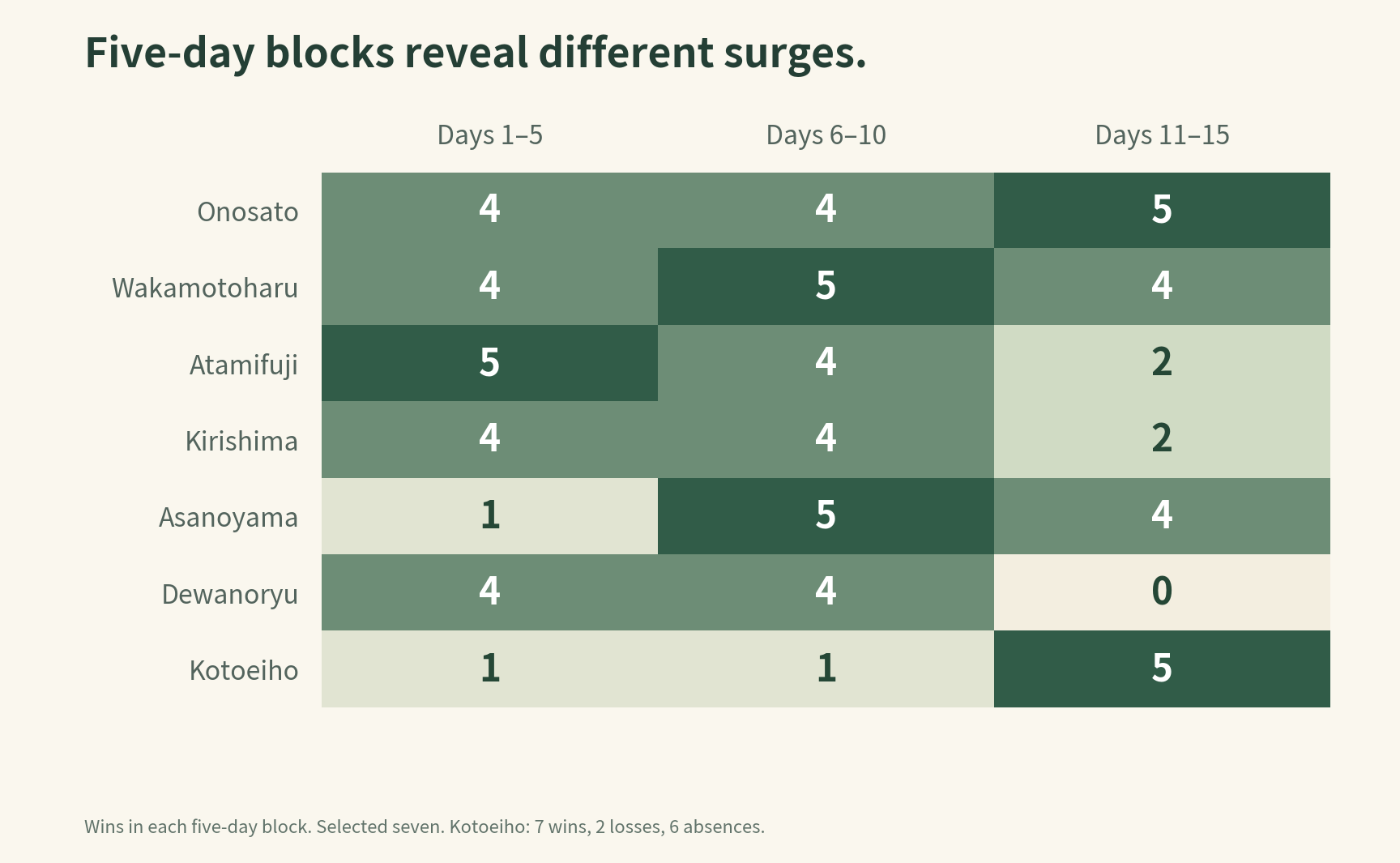
Kirishima and Asanoyama both finished 10–5. Their splits were 4–4–2 and 1–5–4. Asanoyama stood at 1–4 after five days, then won nine straight bouts from Day 6 through Day 14. His opening record was a poor summary of his whole tournament.
Dewanoryu reached eight wins on Day 10, then earned none in the final five days. Kotoeiho won all five closing-day bouts, but his overall record was 7–2 with six absences. His strong finish should not be turned into a fifteen-bout winning percentage.
These are changes in results, not proof of changes in technique, health or confidence. They do give us useful places to begin a replay: Asanoyama on Day 6, for example, or Onosato on Day 13.

My answer: the champion and the wrestler who led on the most days were different people.
For this tournament, the answer to my opening question is no. Wakamotoharu led on 11 days, Onosato on seven. Onosato never held the sole lead at a day’s close: he caught up in their Day 13 meeting and ultimately won the playoff.
The same 13–2 record concealed two different positions: spending longer at the front, and closing the gap late. I am glad I counted the days instead of stopping at the champion’s name. The bout I want to revisit first is Onosato–Wakamotoharu on Day 13. These records show when the gap closed, not why he won that bout. That is something to check against the footage next.

A side question: how often had the playoff’s finishing technique appeared?
A separate curiosity for my notebook: how many times had watashikomi appeared before the playoff? I counted the techniques in all regular Makuuchi bouts to find out.
Yorikiri led the regular-bout list with 86 occurrences, followed by oshidashi with 75. Together they accounted for 161 finishes: 52.3% of the 308 contested bouts, or 53.0% when only the 304 technical finishes are counted.
| Winning technique | Regular-bout count |
|---|---|
| Yorikiri | 86 |
| Oshidashi | 75 |
| Hatakikomi | 23 |
| Tsukiotoshi | 19 |
| Uwatenage | 17 |
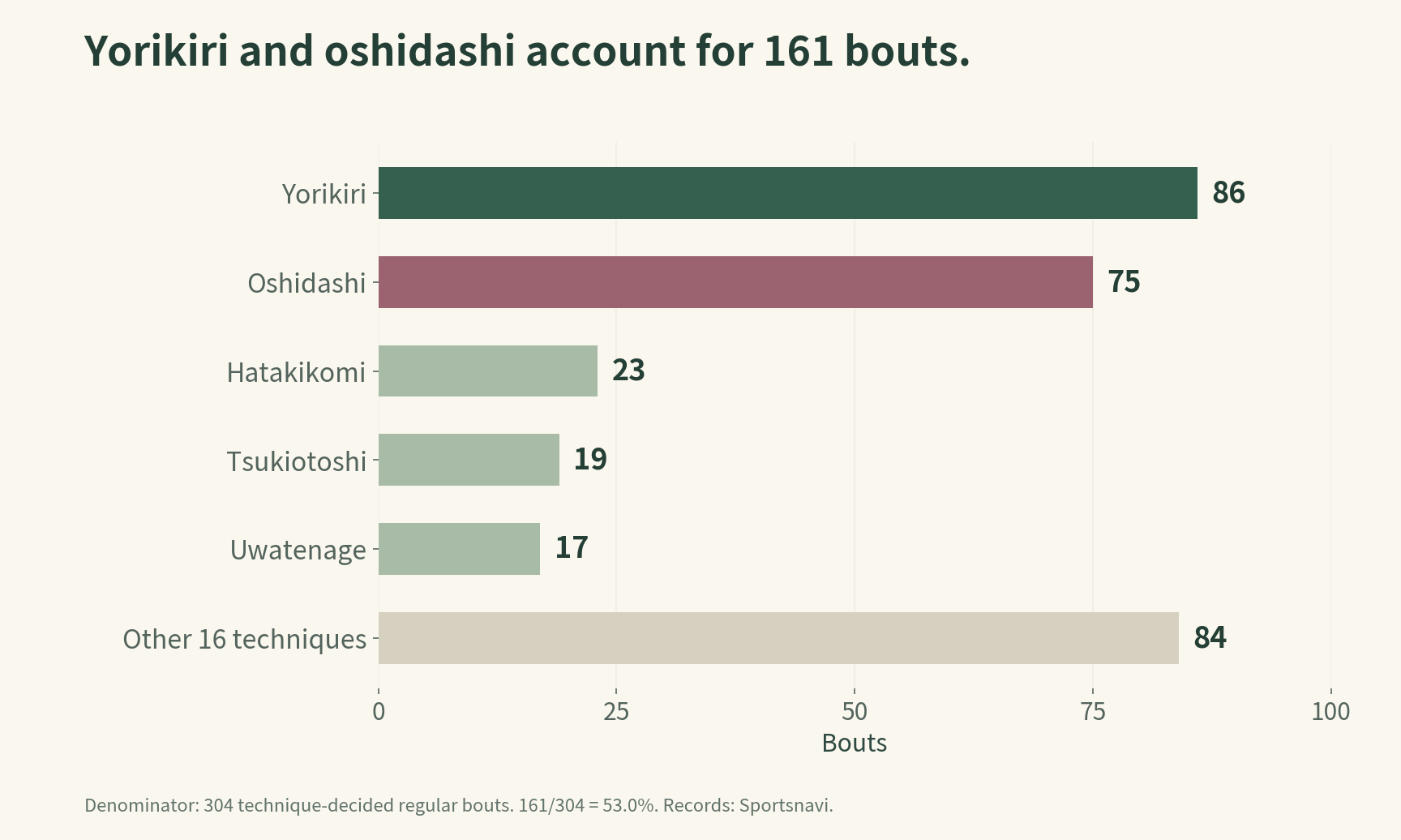
There were 21 distinct winning techniques in the regular bouts. Four appeared just once: uchimuso, tottari, shitatedashinage and okurinage. “Once” means once in this November Makuuchi regular-bout dataset, not once in sumo history.
The very last bout added something new. Watashikomi had not appeared in any of the 311 regular bouts, but Onosato used it to win the championship playoff against Wakamotoharu. Include the playoff, and the number of distinct techniques rises from 21 to 22.
One extra line on the technique list, right at the end: a small statistical reason to revisit the Japan Sumo Association’s playoff video.
Counting notes: why 311, 308 and 304 are different totals.
The Makuuchi regular schedule contained 311 bouts, including appearances by Juryo visitors. There were 21 per day on Days 1–11 and 20 per day on Days 12–15.
Three were defaults. That leaves 308 bouts actually contested. Of those, two ended in tsukite, one in fumidashi and one in disqualification. Separating these non-technique results leaves 304 technical finishes.
| Result type | Count |
|---|---|
| Technical finish | 304 |
| Tsukite | 2 |
| Fumidashi | 1 |
| Disqualification | 1 |
| Default | 3 |
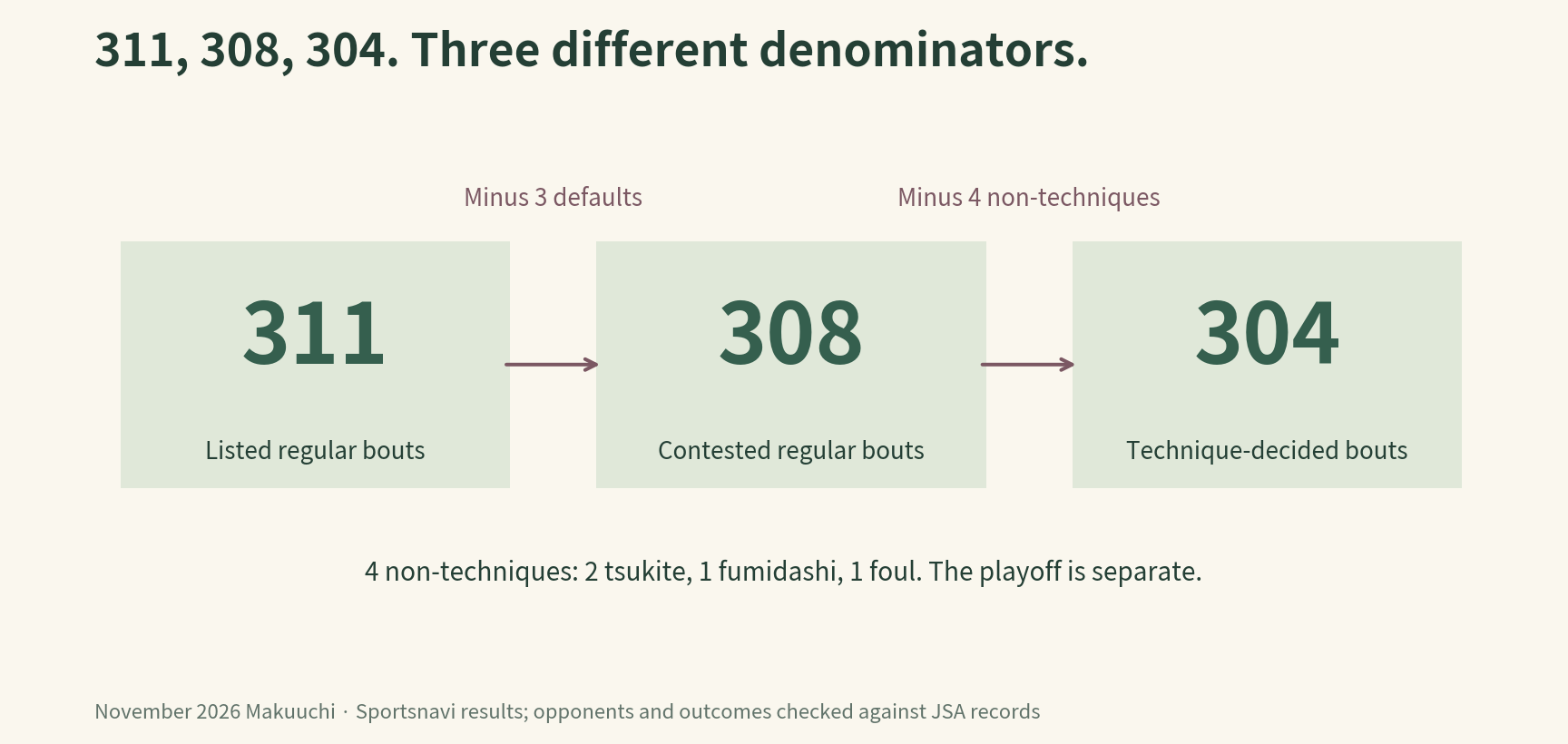
“How many bouts?” and “How many winning techniques?” are different questions. The denominator stays beside each percentage so the answer remains clear.
Another notebook page: the field beyond the title race.
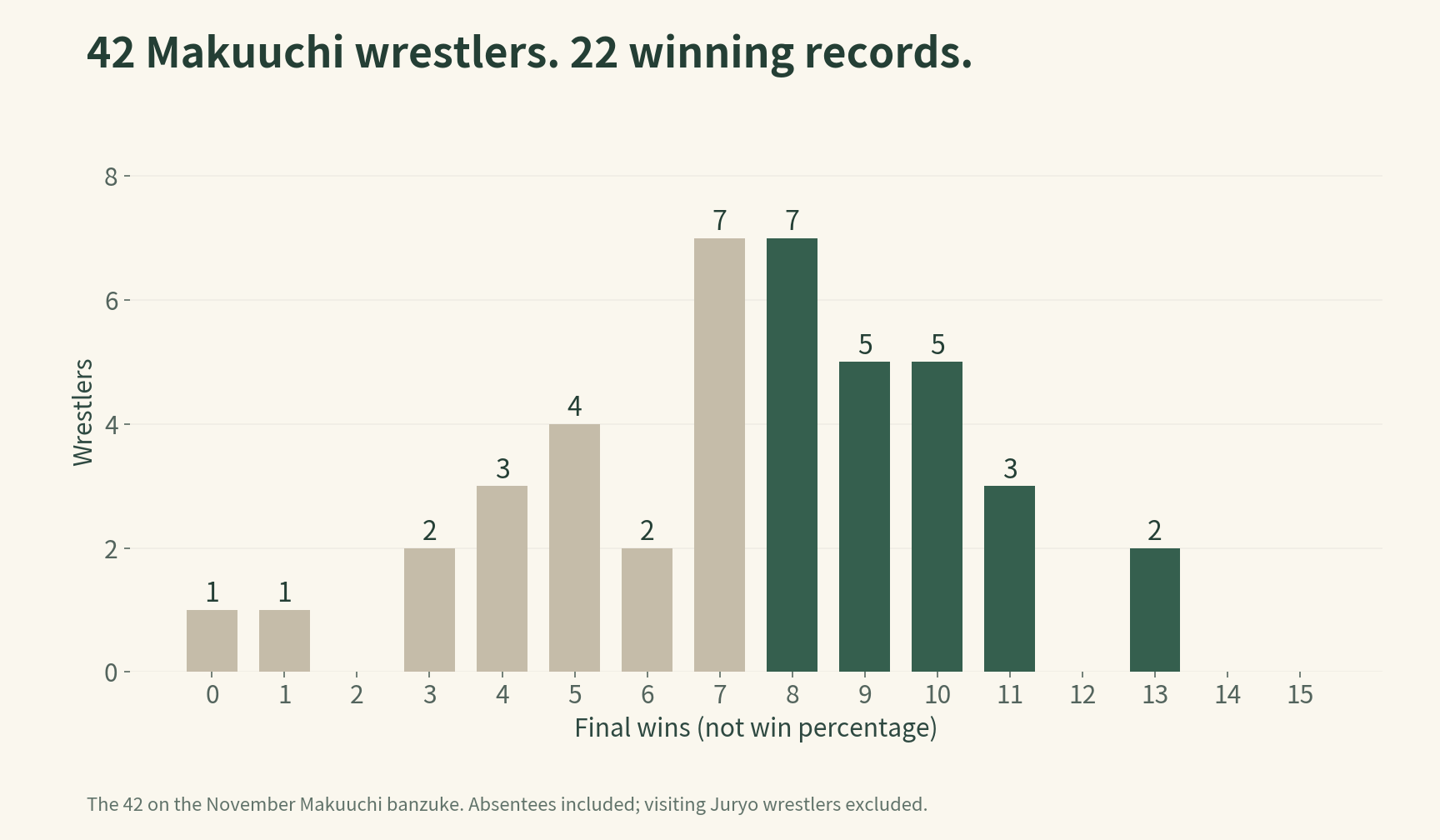
Of the 42 wrestlers ranked in Makuuchi for November, 22 reached at least eight wins and ten reached double figures. Seven finished on seven wins, and seven on eight. One win separates two well-populated groups outside the championship race.
For the September comparison, I used a narrower group: the 30 men who were in Makuuchi in both tournaments and had a win or loss recorded on all fifteen days in each. Ichiyamamoto had the largest gain, from four wins to nine, an increase of five. Roga followed, rising from six to ten, an increase of four.
Hoshoryu returned from a completely missed September tournament to win nine in November. Takanosho moved from 4–9 with two absences to 10–5. Those are significant changes, but different opportunities to compete make them unsuitable for the same 30-man comparison. Rankings and opponents changed too, so an increase in wins is not a direct measurement of improved ability.
Sources and data for checking the numbers
Scope: regular Makuuchi bouts from November 8–22, 2026. Compiled and checked November 25. Opponents and results were checked against the Japan Sumo Association’s individual wrestler record pages. The full winning-technique count was compiled from Sportsnavi’s daily bout records. The playoff is kept in a separate table, and its technique is also confirmed by the Association’s own video post.
- JSA: Onosato’s records
- JSA: Wakamotoharu’s records
- JSA: Atamifuji’s records
- JSA: Asanoyama’s records
- JSA: Kotoeiho’s records
- Sportsnavi: November results, with links to each day
- JSA-posted championship playoff
- Days in the lead and dates for all 42 Makuuchi wrestlers (CSV)
- All 311 regular Makuuchi bouts (CSV)
- Records and five-day splits for all 42 Makuuchi wrestlers (CSV)
- Daily leaders and cumulative wins (CSV)
- Championship playoff (CSV)
All 21 regular-bout winning techniques
| Winning technique | Count |
|---|---|
| Yorikiri | 86 |
| Oshidashi | 75 |
| Hatakikomi | 23 |
| Tsukiotoshi | 19 |
| Uwatenage | 17 |
| Yoritaoshi | 13 |
| Oshitaoshi | 13 |
| Hikiotoshi | 9 |
| Okuridashi | 9 |
| Sukuinage | 7 |
| Kotenage | 7 |
| Tsukidashi | 7 |
| Shitatenage | 5 |
| Kimedashi | 3 |
| Uwatedashinage | 3 |
| Uwatehineri | 2 |
| Sotogake | 2 |
| Tottari | 1 |
| Shitatedashinage | 1 |
| Uchimuso | 1 |
| Okurinage | 1 |