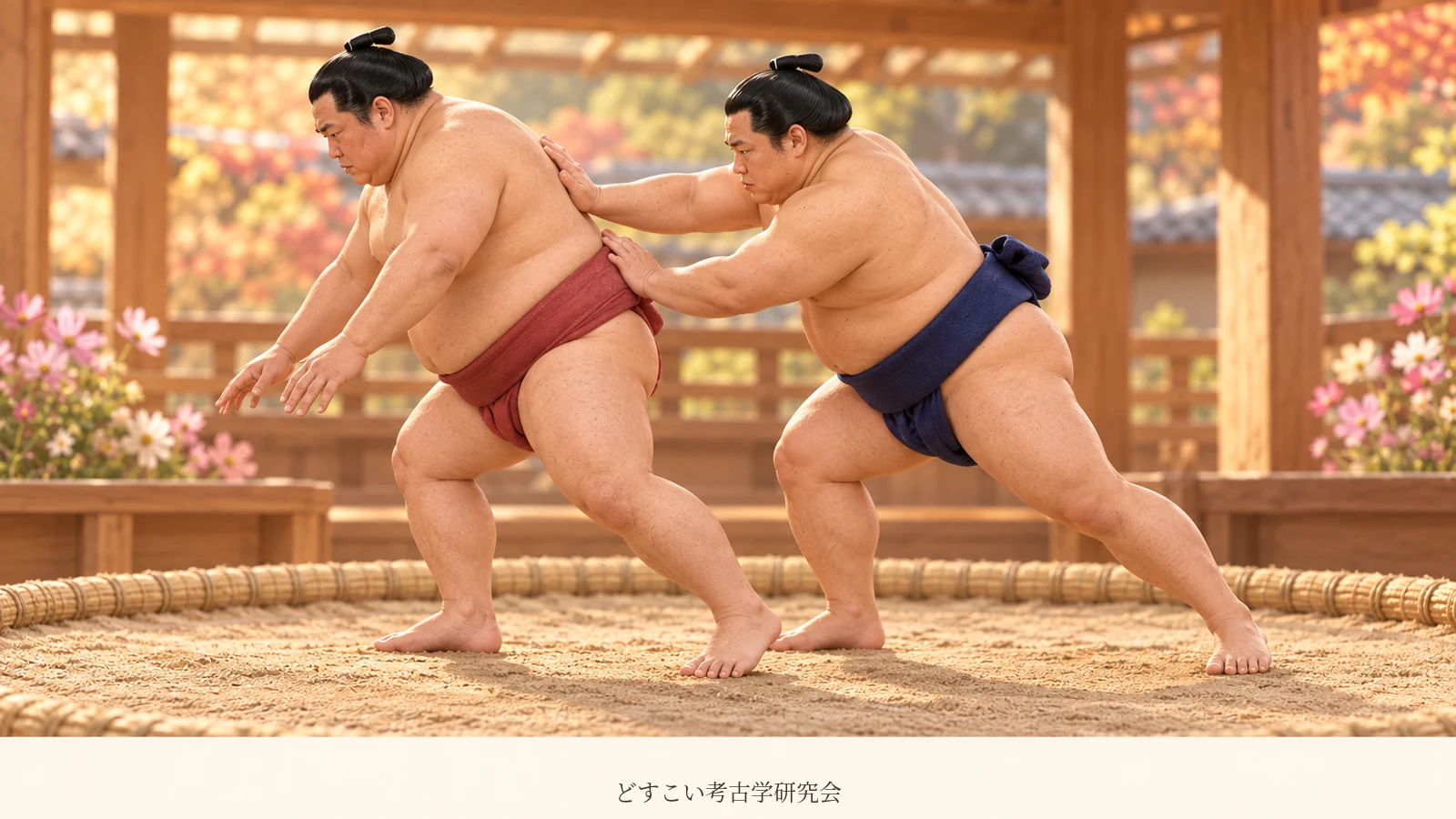
Use position before hand action. If the winner has moved behind the opponent and pushes or thrusts him out from the back while he remains upright, think okuridashi. If they are still facing each other, a hazu-shaped hand or hands applied at the armpits or chest points towards oshidashi, while strong palm thrusts to the chest or shoulders point towards tsukidashi. In the next bout, watch only the decisive contact: were the two wrestlers facing each other, or looking in roughly the same direction?
To an English-speaking newcomer, “push out,” “thrust out” and “rear push out” can feel like labels added after the same event. The opponent crosses the boundary on his feet in each picture. Trying to classify every flying hand at once makes the finish faster, not clearer. One positional question turns three candidates into two.
First question: was the winner in front or behind?
The Japan Sumo Association defines okuridashi as moving behind the opponent and pushing or thrusting him out of the ring. You do not have to decide “push or thrust?” first. The official definition allows either action and makes rear position the essential opening clue.
A glimpse of the opponent’s back is not enough. A wrestler being driven towards the tawara may turn sideways at the last instant. Follow the decisive action: had the winner actually reached the rear and applied the force from the back as the opponent went outside?
If yes, keep okuridashi in mind. If the wrestlers remained in a frontal relationship, compare oshidashi with tsukidashi. This order reduces the amount of motion you need to process at one time.
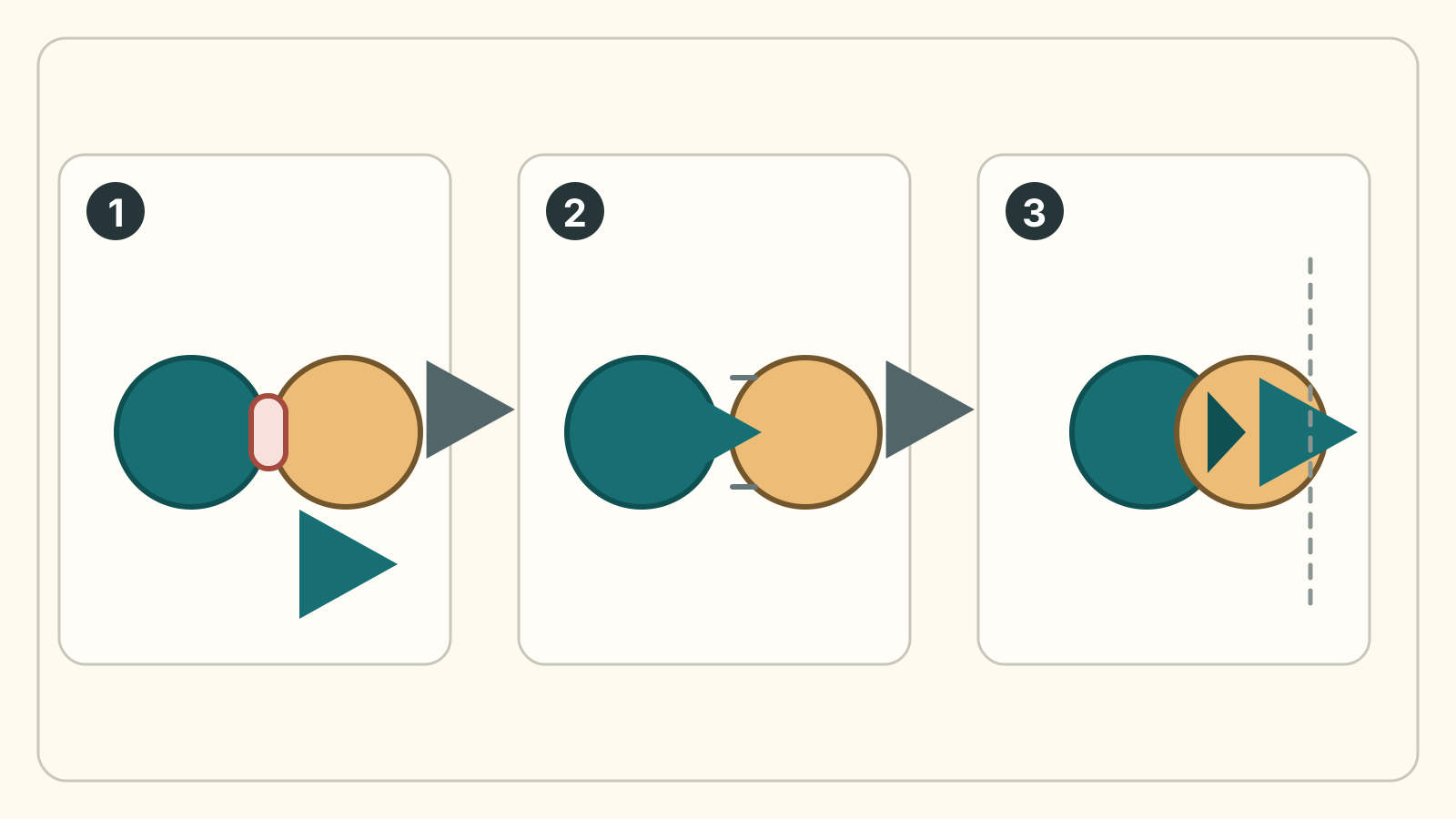
Detailed description of this diagram
Card 1 uses facing competitor tokens, a contact bar and an outward arrow for the front hazu-push-out relation of oshidashi. Card 2 keeps the front relation but uses a separated impulse arrow and accent lines for the strong palm-thrust-out category of tsukidashi. Card 3 places the blue winner token behind the gold opponent token and adds an outward-boundary arrow for the final okuridashi relation. The cards are parallel categories, not stages. Bars, gaps and arrows encode no hand shape, force, number, duration, exact position, path to the rear, fall state or judging priority.
Graphic: SUMO ARCHAEOLOGY CLUB · Figure source 1 · Figure source 2 · Figure source 3
Oshidashi: apply a hazu push at the torso
For oshidashi, the Association says one or both hands form *hazu*—a Y-like shape with the thumb opened from the other four fingers—and are applied beneath the opponent’s armpit or at the chest to push him outside.
Individual fingers may be impossible to see from an arena seat. Use the larger relationship as a provisional clue: the hands stay connected with the upper body and the winner advances through a push. Do not invent an absolute rule such as “the hands never separated.” Camera angle and speed can hide what happened. Your observation is a hypothesis; the official announcement remains the answer.
Tsukidashi: strong palm thrusts supported by sharp footwork
The Association defines tsukidashi as strongly thrusting with the palms at the chest, shoulders or similar targets until the opponent goes outside. Its page adds that hand strength is not enough; sharp forward footwork is needed at the same time.
Do not count thrusts. The official page gives no minimum number that converts oshidashi into tsukidashi. Instead, examine the decisive phase. Were strong palm thrusts striking the chest or shoulders, with the winner’s feet carrying that attack forwards? Or were hazu hands applied at the torso to push the opponent out?
An opening exchange can contain several thrusts and still finish with oshidashi if the decisive action is the push. Kimarite name the winning action, not the wrestler’s entire tactical plan.
A two-question field guide
When the finish is fast, use this order:
- Did the decisive action come from behind? If yes, compare it with okuridashi.
- If it came from in front, was it a hazu push or strong palm thrusts? The first points towards oshidashi; the second towards tsukidashi.
This is not a substitute for official judging. The boundary between front, side and rear can change within a step, and a torso can hide the hands. The guide gives you a place to return after the announcement: “I thought he was behind, but at the decisive touch he was still beside the shoulder,” for example.
That correction is more valuable than a lucky guess because it improves the next view.
If the opponent falls, check the related “down” techniques
These three *dashi* techniques end by sending the opponent outside. If he is knocked down, related names may apply.
The Association defines tsukitaoshi as knocking the opponent down with strong palm thrusts, whether the fall occurs inside or outside; if he stays upright and exits, it is tsukidashi. Oshitaoshi similarly uses a hazu push to knock the opponent down and can occur inside or outside; an upright exit is oshidashi. The okuritaoshi page describes moving behind, pushing or thrusting and knocking the opponent down inside, while an upright exit is okuridashi.
Begin with the visible result—upright exit or fall—then examine position and hand action. For a genuinely marginal boundary decision, leave who touched first to the gyoji, judges and official result.
One thing to watch in the next bout
As the wrestlers approach the tawara, ignore the hands for one second and compare their chests. Is the winner’s chest facing the opponent’s chest, or has it moved towards the opponent’s back so both bodies point broadly the same way? The second picture gives you an okuridashi prediction. In the first, return to the hands afterwards to compare oshidashi and tsukidashi.
You do not need to name all three in real time. “Not from behind” has already removed one candidate. Kimarite stop being a vocabulary test and become coordinates placed on moving bodies. The next time a wrestler almost loses his back but turns square again, you may even see the okuridashi that never received a name.
Sources
- Japan Sumo Association, kimarite explanation for tsukidashi (checked 2 September 2026)
- Japan Sumo Association, kimarite explanation for tsukitaoshi (checked 2 September 2026)
- Japan Sumo Association, kimarite explanation for oshidashi (checked 2 September 2026)
- Japan Sumo Association, kimarite explanation for oshitaoshi (checked 2 September 2026)
- Japan Sumo Association, kimarite explanation for okuridashi (checked 2 September 2026)
- Japan Sumo Association, kimarite explanation for okuritaoshi (checked 2 September 2026)
Source links used for verification
Each link was used for the corresponding claim in this article; inclusion is not a blanket endorsement of the whole page.
Article verified:
- Japan Sumo Association kimarite: tsukidashiPrimary source (as checked for this article)
- Japan Sumo Association kimarite: tsukitaoshiPrimary source (as checked for this article)
- Japan Sumo Association kimarite: oshidashiPrimary source (as checked for this article)
- Japan Sumo Association kimarite: oshitaoshiPrimary source (as checked for this article)
- Japan Sumo Association kimarite: okuridashiPrimary source (as checked for this article)
- Japan Sumo Association kimarite: okuritaoshiPrimary source (as checked for this article)