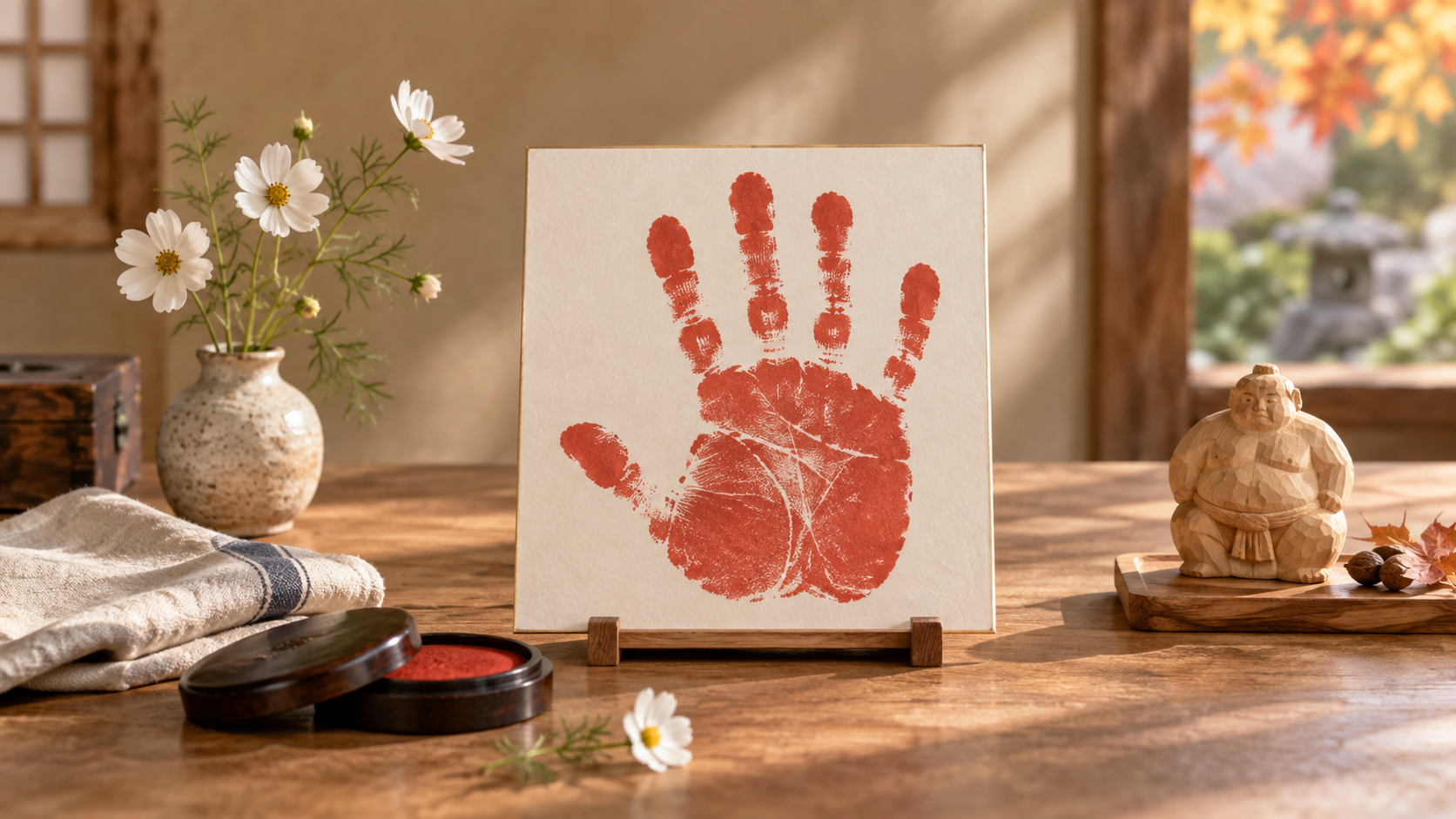
A Sumo Museum exhibition published in 2017 said that a wrestler became eligible to make handprints after promotion to sekitori and presented the print as evidence of becoming fully fledged. That is a dated historical explanation; whether the same formal eligibility applies today remains unconfirmed until a current rule or notice establishes it. Do not derive precise body dimensions from a print—carry one shape, such as the thumb spread, back to observing a bout.
A red or black palm on a square board can look almost too simple to be an archive object. Yet it contains a rank boundary and the outline of the tools used to thrust, push and grip. When you return from the print to the contest, a souvenir becomes an invitation to look at technique.
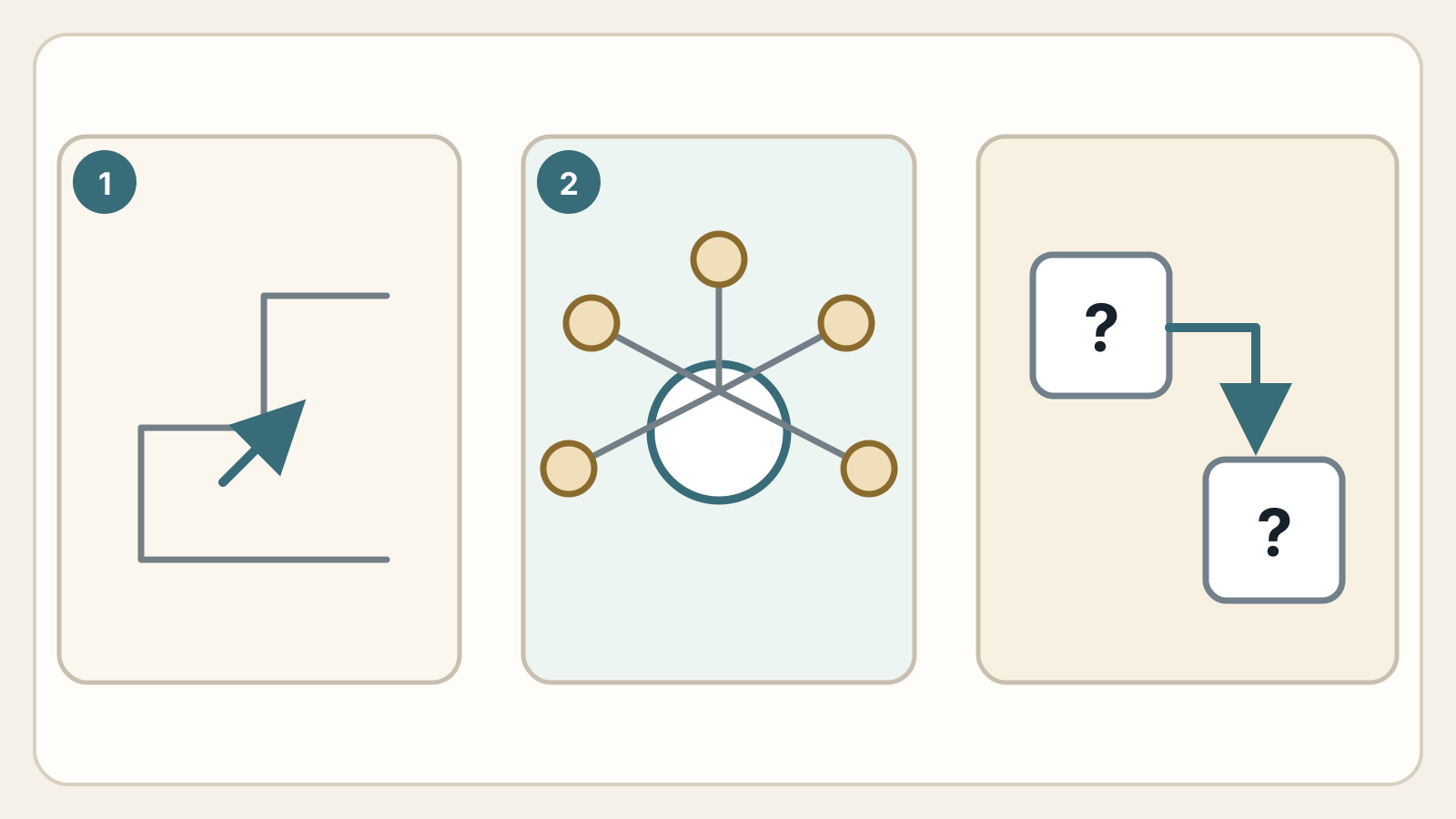
Detailed description of this diagram
The left card uses an arrow crossing a two-level boundary for the Museum's statement that promotion to sekitori allows a wrestler to press a handprint. A central circle with five radiating lines and dots is a deliberately non-anatomical category token, not a palm, print or copied outline. Two question cards then separate whether an item is an actual pressed impression or a reproduction, and which writing, if any, is autograph; those must be checked in the item or event description. It does not claim that every sekitori made one. Hand dimensions, finger ratios, palm lines, ink, signature, shikona, person identity, authenticity verdict, price and stock are absent.
Graphic: SUMO ARCHAEOLOGY CLUB · Figure source 1 · Figure source 2
Not every wrestler automatically makes an official handprint
The Sumo Museum’s 2017 exhibition explanation said that a wrestler could press handprints after promotion to sekitori. That source does not establish the full 2026 eligibility, exceptions or uses. At minimum, the exhibition did not describe official handprints as something every recruit made on entering a stable; current conditions require a current rule or event notice.
The 2017 exhibition directly links handprint eligibility with the sekitori boundary. It does not establish every rule about salary, bout scheduling, hairstyle, belts or ceremonial appearances, which need their own sources. Because current handprint eligibility is also unconfirmed here, a print is not treated as a necessary-and-sufficient test of present status.
Do not turn the print into a precision body measurement. Pressure, ink coverage, paper and the condition of an old object can affect the outline. Enjoying scale is reasonable; calculating a wrestler’s exact height or strength from the impression alone is not.
Why did the hand become a symbol?
The Museum points to the hand’s work. A wrestler uses it to strike and push an opponent and to grip the mawashi powerfully. Its exhibition text says people regarded trained, large hands with awe and sought their impressions with wishes for health and protection from evil.
That is the Museum’s historical account of the custom. It should not be expanded into a claim that every recipient in every period held an identical belief. What the collection does establish is longevity: the exhibition brought together handprints left by yokozuna and unusually large wrestlers from the Edo period through modern times, and called the handprint a symbol of the wrestler alongside the topknot and ceremonial apron.
After studying a palm, a pushing bout looks different. The open hand contacting the chest, the fingers searching for cloth, and the palm that nearly touches the clay at the edge are all versions of the flat shape on the board. One hand performs several jobs within seconds.
A handprint and handwriting are separate evidence
Rikishi handprint boards often include a ring name or a short written phrase. The Sumo Museum notes that wrestlers have frequently been asked for calligraphy together with their handprints and has exhibited poems, single characters and paintings by prominent wrestlers. Its 2025 centenary exhibition included a collective yokozuna handprint work arranged around the character *wa*, written by a senior gyoji.
None of that means every name beside a palm was personally brushed by the wrestler, or that every item on the market is an original hand impression. “Handprint,” “hand-signed,” “reproduction” and “printed” answer different questions. Appearance alone cannot settle provenance. Before obtaining one, check exactly which element is original, who produced it and what documentation accompanies it.
Official offers can be temporary
An official Grand Sumo Fan Club notice for the July 2026 tournament listed a *sekitori tegata shikishi*—a handprint presentation board—as the top prize in a venue activity. That is evidence of one official distribution event, not proof of permanent availability or a current retail price.
If this site ever links to a handprint offer, it should first use current outlets identified by the Japan Sumo Association or a current official fan-club notice. The link must state whether the object is an original or reproduction, whether any writing is hand-signed, and whether membership, attendance or a prize draw is involved. Availability and price belong on the live seller’s page, not frozen into an evergreen cultural article. High prices on an unofficial marketplace are not evidence of authenticity.
One thing to watch next time
At a museum display or official handprint presentation, choose one feature rather than trying to measure everything. Notice the angle of the thumb. Then, in that wrestler’s next bout, watch only the first hand action: a palm driving forward, fingers reaching inside, or a hand redirecting an arm.
On paper, the hand is a milestone showing that a wrestler reached sekitori. On the dohyo, it is a tool changing shape every instant. Seeing it in both places makes “That hand is huge” the beginning rather than the end of the thought. Soon you may find yourself comparing a pusher’s first contact with a belt wrestler’s grip—and a single palm has quietly taught you where to look.
Sources
- Sumo Museum, “Rikishi’s palm print,” exhibition held 21 February–21 April 2017 (checked 2 September 2026)
- Sumo Museum, exhibition of works by sumo wrestlers, held 21 June–10 August 2016 (checked 2 September 2026)
- Sumo Museum, “100 Years of Professional Sumo,” exhibition held 13 May–30 July 2025 (checked 2 September 2026)
- Official Grand Sumo Fan Club, July 2026 tournament booth notice, published 12 July 2026 (checked 2 September 2026)
- Japan Sumo Association, directory of official sumo merchandise outlets (checked 2 September 2026)
Source links used for verification
Each link was used for the corresponding claim in this article; inclusion is not a blanket endorsement of the whole page.
Article verified:
- Sumo Museum exhibition: Rikishi’s palm printHistorical primary source (record from that period)
- Sumo Museum exhibition: works by sumo wrestlersHistorical primary source (record from that period)
- Sumo Museum exhibition: 100 years of professional sumoHistorical primary source (record from that period)
- Official Grand Sumo Fan Club booth notice for July 2026Historical primary source (record from that period)
- Japan Sumo Association directory of official merchandise outletsPrimary source (as checked for this article)