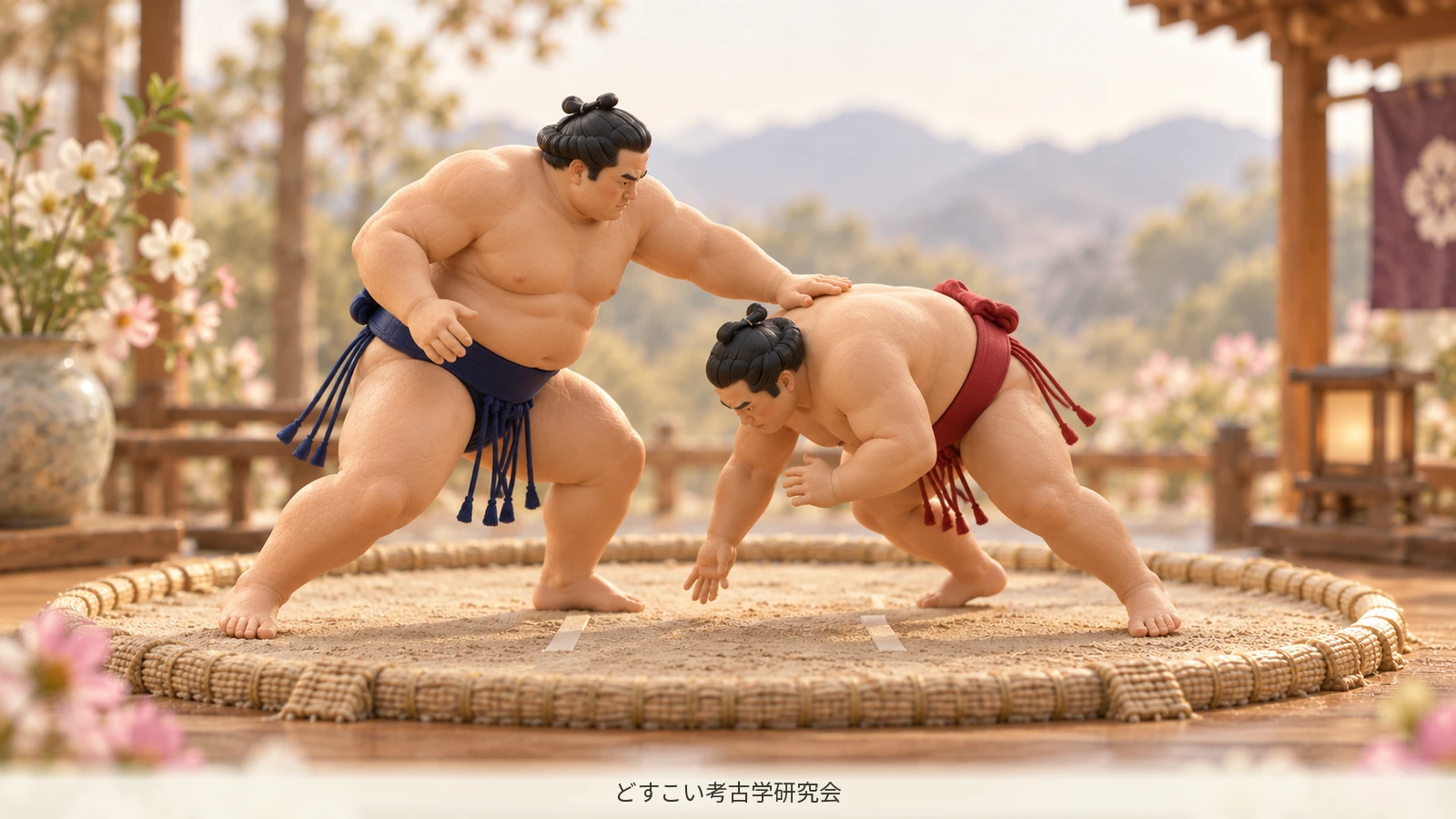
Sokubiotoshi brings the opponent down by striking the neck or back of the head with the wrist or arm. Hatakikomi answers a low, advancing opponent by opening the body and using one or both hands against areas such as the shoulder, back or arm. Both can end with a wrestler falling forward, so the final pose is not the test. Ask two questions: where did the decisive contact land, and was it the wrist or arm rather than the hand? In the next bout, follow the contact point—not the hand that hits the clay.
After the announcement, both techniques may look like “he was slapped down.” That English summary erases the detail the Japanese names preserve. Shrink the picture from the dramatic fall to a small patch of contact. Was it the neck, the back of the head, the shoulder or the back? Which surface of the attacker’s limb supplied the action?
Sokubiotoshi targets the neck or back of the head
The Japan Sumo Association’s definition is compact: in sokubiotoshi, the winner strikes down the opponent’s neck or the back of his head with his wrist or arm.
Both halves matter. A forearm can appear to lie across the upper back when the actual contact is near the base of the neck. Conversely, a hand may pass close to the head while the decisive action lands on a shoulder. A side-on broadcast angle may hide the boundary between hand and wrist or between neck and shoulder. If the surface is not visible, keep the identification tentative and use the official call to check your reading.
The word *kubi* (“neck”) can make a replay sound like a medical statement. It is not. A kimarite identifies the winning action; it does not establish an injury. Treat any claim about the wrestler’s condition separately and wait for verifiable information.
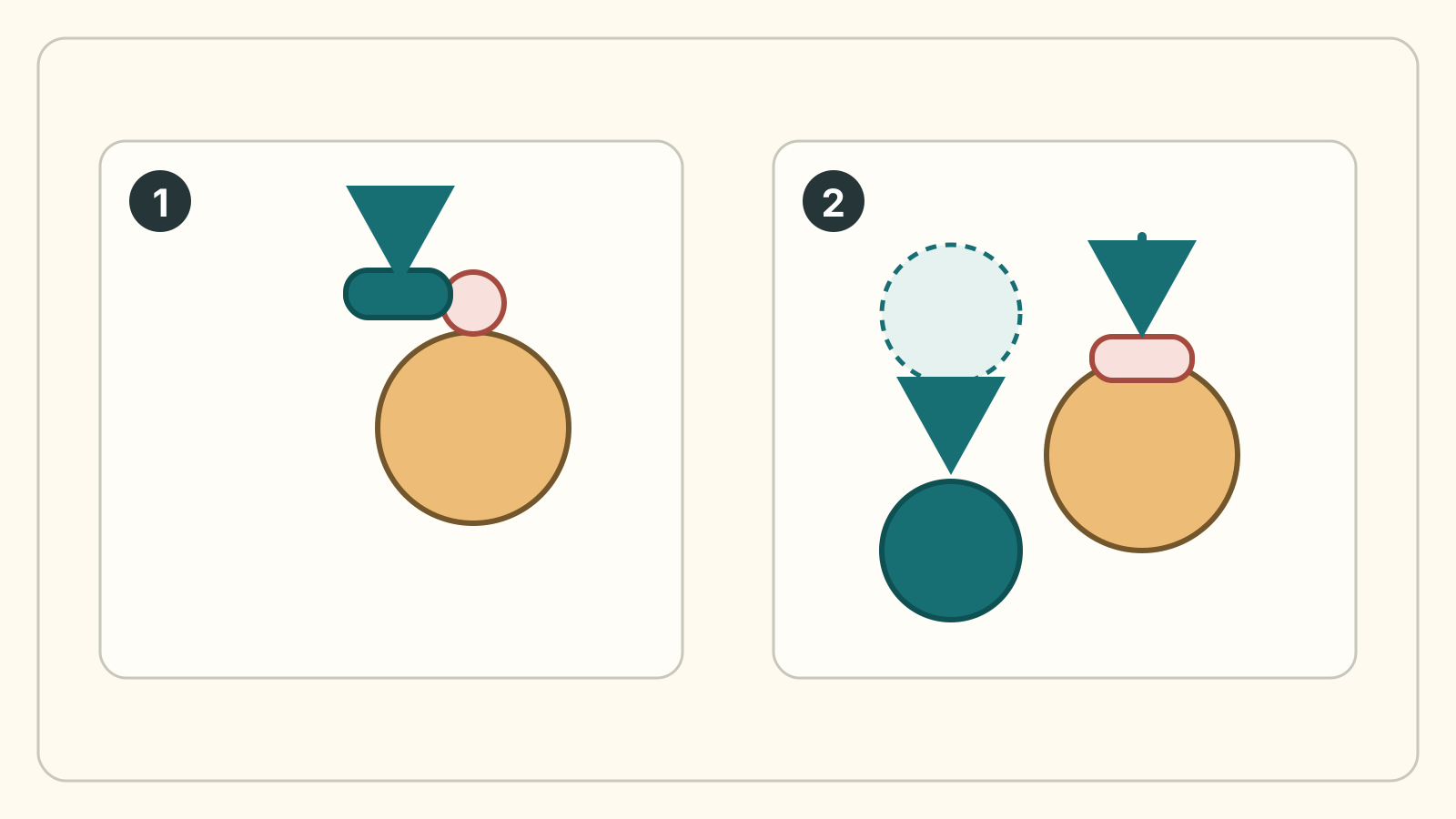
Detailed description of this diagram
Card 1 puts a small contact dot above the gold opponent token, a horizontal blue action bar and a downward arrow, encoding only wrist-or-arm action at the neck or back-of-head relation. Card 2 moves the blue winner token off the advance line and uses a broader contact band above the gold token with a downward arrow, preserving hatakikomi's preceding sequence. Dot and band size or position encode no head, neck, shoulder, back, arm or wrist anatomy, legal tolerance, impact, posture, force, timing or injury mechanism.
Graphic: SUMO ARCHAEOLOGY CLUB · Figure source 1 · Figure source 2
Hatakikomi adds a low advance and an opened body
For hatakikomi, the Association describes the opponent coming forward low. The winner opens his own body and uses one or both hands to knock down areas such as the shoulder, back or arm.
Compared with sokubiotoshi, the target and the attacking surface give the quickest clues. If the action is on the neck or back of the head with the wrist or arm, consider sokubiotoshi. If the wrestler moves away from the direct line and a hand works down on the shoulder, back or arm of a low opponent, consider hatakikomi.
Do not reduce hatakikomi to “two hands” or sokubiotoshi to “one arm.” The official hatakikomi definition allows one or both hands. Count contact locations before counting hands.
Hikiotoshi moves the opponent towards the winner
Hikiotoshi can produce another forward fall. Its official explanation has the winner pull an opponent’s arm, shoulder or front of the mawashi towards himself to bring him down.
That creates a three-question guide:
- Neck or back of the head struck down by the wrist or arm? Consider sokubiotoshi.
- Shoulder, back or arm knocked down as the winner opens his body? Consider hatakikomi.
- Arm, shoulder or front belt drawn towards the winner? Consider hikiotoshi.
The shoulder appears in more than one definition, so target alone cannot always decide it. Combine target, contact surface and direction.
Contact near the neck is not automatically sokubiotoshi
Arms pass around heads and shoulders during forceful, compact exchanges. A single frame of proximity does not establish the kimarite. The wrist-or-arm contact on the neck or back of the head must be the action that brings the opponent down.
Judges see a continuous sequence from ringside. Viewers may have an obstructed seat or one broadcast angle. If your prediction differs from the announcement, return to the moment before the opponent starts falling. Ask whether the “neck” was actually the shoulder and whether the visible forearm or the hidden hand provided the decisive pressure.
One thing to watch in the next bout
When an advancing wrestler lowers his upper body, choose one target point on him. If the decisive contact is at the neck or back of the head and the winner’s wrist or arm drives down, predict sokubiotoshi. If a hand acts on the shoulder, back or arm as the winner opens his body, consider hatakikomi.
You do not need to get the call right. A bout that once ended with the single thought “slap-down” now contains a target, a contact surface and a movement off the line. That is the quiet pleasure of learning kimarite: not collecting obscure labels, but discovering that one hurried second held more structure than you knew to look for.
Similar Motion Does Not Set the Official Technique
A hand action or fall may look similar while the recorded kimarite differs according to the decisive action, sequence of balance loss and whether a body part touched down or crossed the ring first. Do not settle the difference between a similar technique, non-technique or foul from one camera angle; use the official result for that bout. A schematic marks viewing cues, not a substitute judges’ decision.
Sources
- Japan Sumo Association, kimarite explanation for sokubiotoshi (checked 3 September 2026)
- Japan Sumo Association, kimarite explanation for hatakikomi (checked 3 September 2026)
- Japan Sumo Association, kimarite explanation for hikiotoshi (checked 3 September 2026)
- Japan Sumo Association, kimarite explanation for katasukashi (checked 3 September 2026)
Source links used for verification
Each link was used for the corresponding claim in this article; inclusion is not a blanket endorsement of the whole page.
Article verified:
- Japan Sumo Association kimarite: sokubiotoshiPrimary source (as checked for this article)
- Japan Sumo Association kimarite: hatakikomiPrimary source (as checked for this article)
- Japan Sumo Association kimarite: hikiotoshiPrimary source (as checked for this article)
- Japan Sumo Association kimarite: katasukashiPrimary source (as checked for this article)