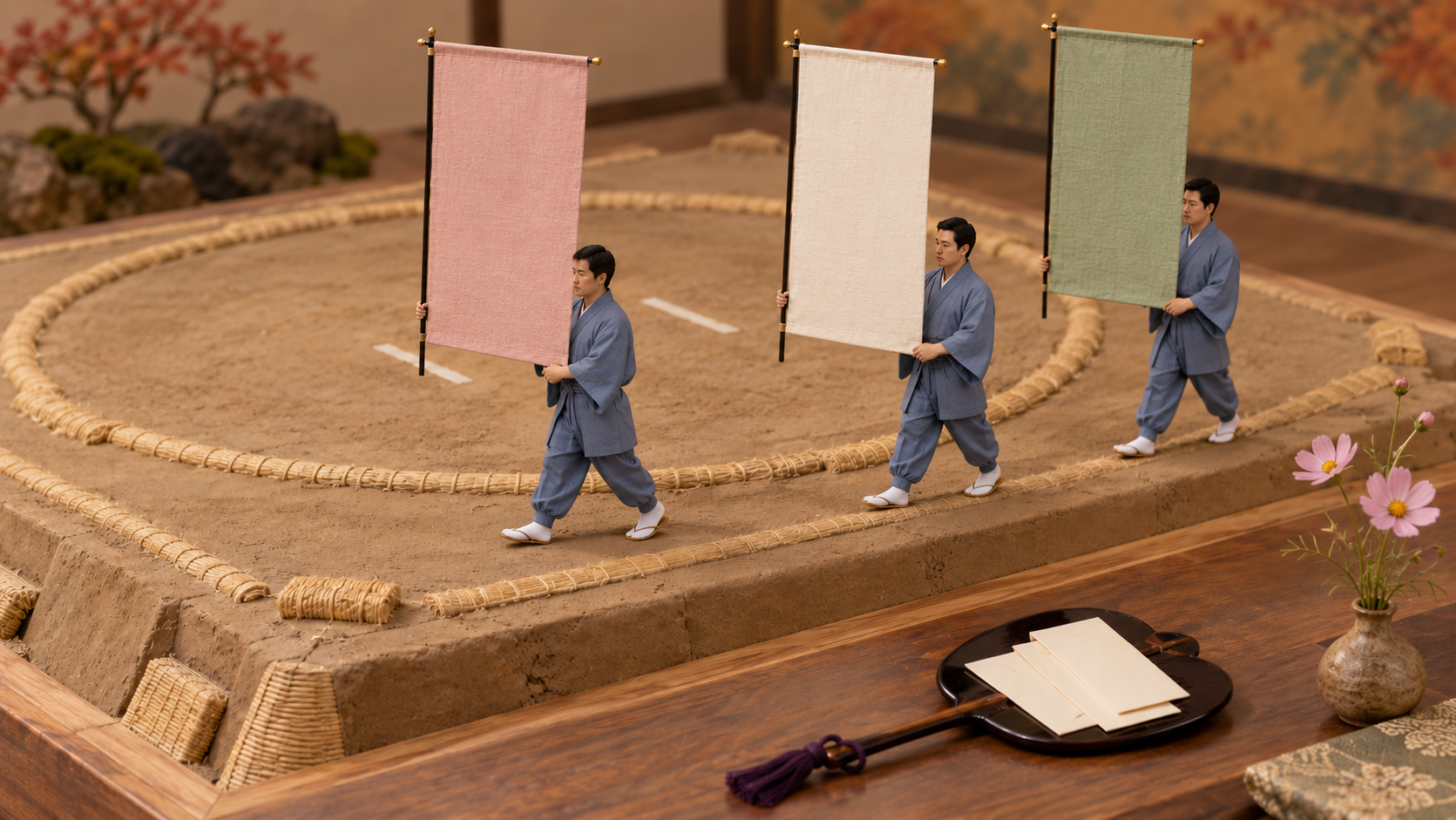
Kensho sponsorship is available only for makuuchi bouts. After the wrestlers complete chiri-chozu, callers carry the sponsor banners once around the dohyo, and the sponsor copy is announced just before the match. As checked on 2 September 2026, one kensho unit costs the sponsor ¥70,000 including tax: ¥60,000 is allocated to the winner and ¥10,000 is an Association fee.
A long parade of bright banners makes an arena hum before anyone has collided. It is tempting to treat every flag as “a ¥70,000 envelope”. That skips three different numbers: what a sponsor pays, what the winner earns and what is handed over in cash at that moment. Separating them lets you enjoy the pageantry without passing on a misleading fact.
Detailed description of this diagram
Graphic: SUMO ARCHAEOLOGY CLUB · Figure source 1 · Figure source 2
The banners appear after chiri-chozu
The Japan Sumo Association allows sponsors to apply for a preferred makuuchi match or a bout involving a wrestler they support. The provider’s name and short promotional wording appear on the day’s bout sheet and are read over the public-address system. The banner procession follows the wrestlers’ *chiri-chozu* gesture and precedes the bout.
The callers—not the referee—carry the banners. If the spoken advertisement is difficult to follow in Japanese, you lose nothing essential. Watch the last banner complete its circuit, then notice how attention contracts from a colourful walking line back to two still wrestlers. The commercial pause and competitive silence meet at that exact transition.
Each banner is a large physical object
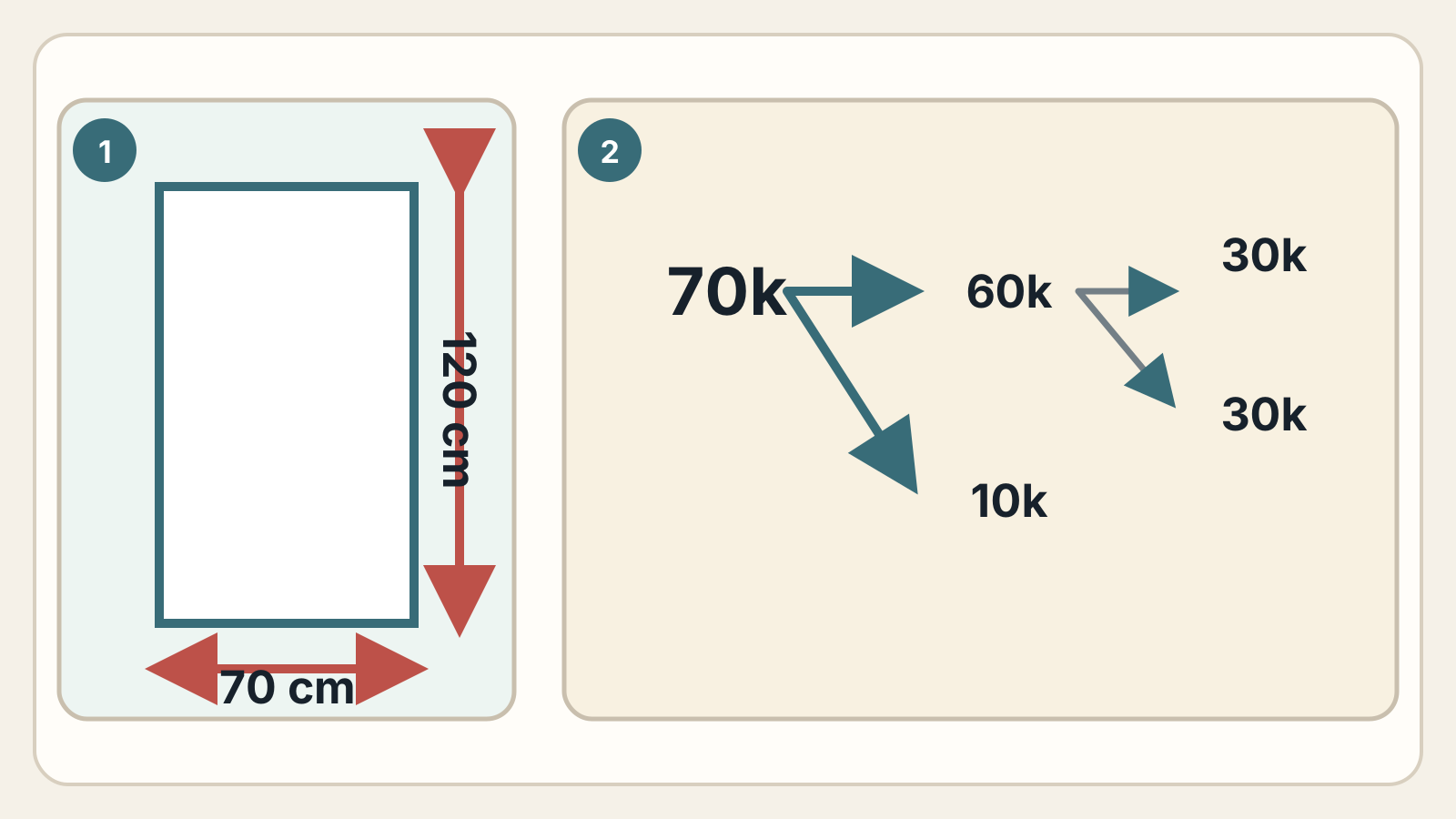
The Association specifies a kensho banner measuring 70 centimetres wide by 120 centimetres high. The sponsor arranges its production and brings it in, while the design must satisfy restrictions appropriate to an object displayed above the dohyo.
Several banners before one match can indicate that sponsors are interested in the matchup, but they are not an official popularity table or power ranking. Sponsors choose bouts or wrestlers under the scheme. A match with fewer flags is not less meaningful, and a large parade says nothing about who will win.
If a scheduled bout becomes a walkover, the Association says its kensho is withdrawn. The parade is tied to a contest that actually takes place; it is not simply awarded because one name remains on the programme.
¥70,000, ¥60,000 and ¥30,000 answer different questions
The Association’s current kensho page gives the per-unit sponsor price as ¥70,000 including tax. It divides that into ¥60,000 for the winning wrestler and a ¥10,000 fee covering the bout-sheet listing and arena announcement.
An Association explainer gives the next layer. Of the winner’s ¥60,000, ¥30,000 is handed over in cash at the victory announcement. The other ¥30,000 is held by the Association in the winner’s name as a reserve for tax obligations. In compact form:
- sponsor payment: ¥70,000;
- winner’s total allocation: ¥60,000;
- cash received at the dohyo: ¥30,000;
- tax reserve in the winner’s name: ¥30,000; and
- Association fee: ¥10,000.
These amounts can be revised, which is why this article has an early review date before the September tournament rather than treating the 2026 figures as eternal.
The winner’s hand moves left, right, centre
The referee presents the kensho envelopes on the face of his gunbai. Before taking them, the winner makes a cutting gesture called *tegatana* with the fingers held together. The order is left, right and centre.
A common folk explanation calls this “spirit, technique and body”. The Association explicitly gives a different meaning: thanks to three deities associated with the protection of the five grains—Kamimusubi, Takamimusubi and Ame-no-Minakanushi. Its official feature says the gesture became a formal rule in July 1966.
The more envelopes there are, the easier it is to stare only at the stack. Try watching the empty hand instead. Three short movements transform the end of an advertisement-funded match into a gesture of thanks before the money is touched.
One thing to follow in the next sponsored bout
When the banners emerge, pick one caller and follow him for a single circuit. Let the advertisements pass without trying to decode every logo. After the bout, keep your eyes on the winner’s hand: left, right, centre, then the gunbai.
You have now seen four different jobs join one match. Sponsors fund the kensho, callers carry the visible banners, a referee indicates the result and offers the envelopes, and a wrestler accepts them through a prescribed gesture. The parade is not a distraction pasted onto sumo. It is the place where modern commercial support and the sport’s formal manners remain visibly, sometimes rather wonderfully, side by side.
Keep More Than One Interpretation Open
We separate what the official or collection source establishes from our observation. A ritual, object or posture may have another interpretation or theory across periods, regions and explainers. When primary evidence does not establish a single origin or meaning, we leave it unknown or contested rather than turn visual resemblance into historical fact.
Sources
- Japan Sumo Association, “About kensho sponsorship” (checked 2 September 2026)
- Japan Sumo Association, Sumo Quiz No. 1084 on the banner procession, published 27 December 2024 (checked 2 September 2026)
- Japan Sumo Association, Sumo Quiz No. 486 on cash and tax reserve, published 9 May 2023 (checked 2 September 2026)
- Japan Sumo Association, Sumo Quiz No. 820 on tegatana, published 7 April 2024 (checked 2 September 2026)
Source links used for verification
Each link was used for the corresponding claim in this article; inclusion is not a blanket endorsement of the whole page.
Article verified:
- Japan Sumo Association: About kensho sponsorshipPrimary source (as checked for this article)
- Japan Sumo Association Sumo Quiz No. 1084: when banners circlePrimary source (as checked for this article)
- Japan Sumo Association Sumo Quiz No. 486: cash and tax reservePrimary source (as checked for this article)
- Japan Sumo Association Sumo Quiz No. 820: the tegatana gesturePrimary source (as checked for this article)