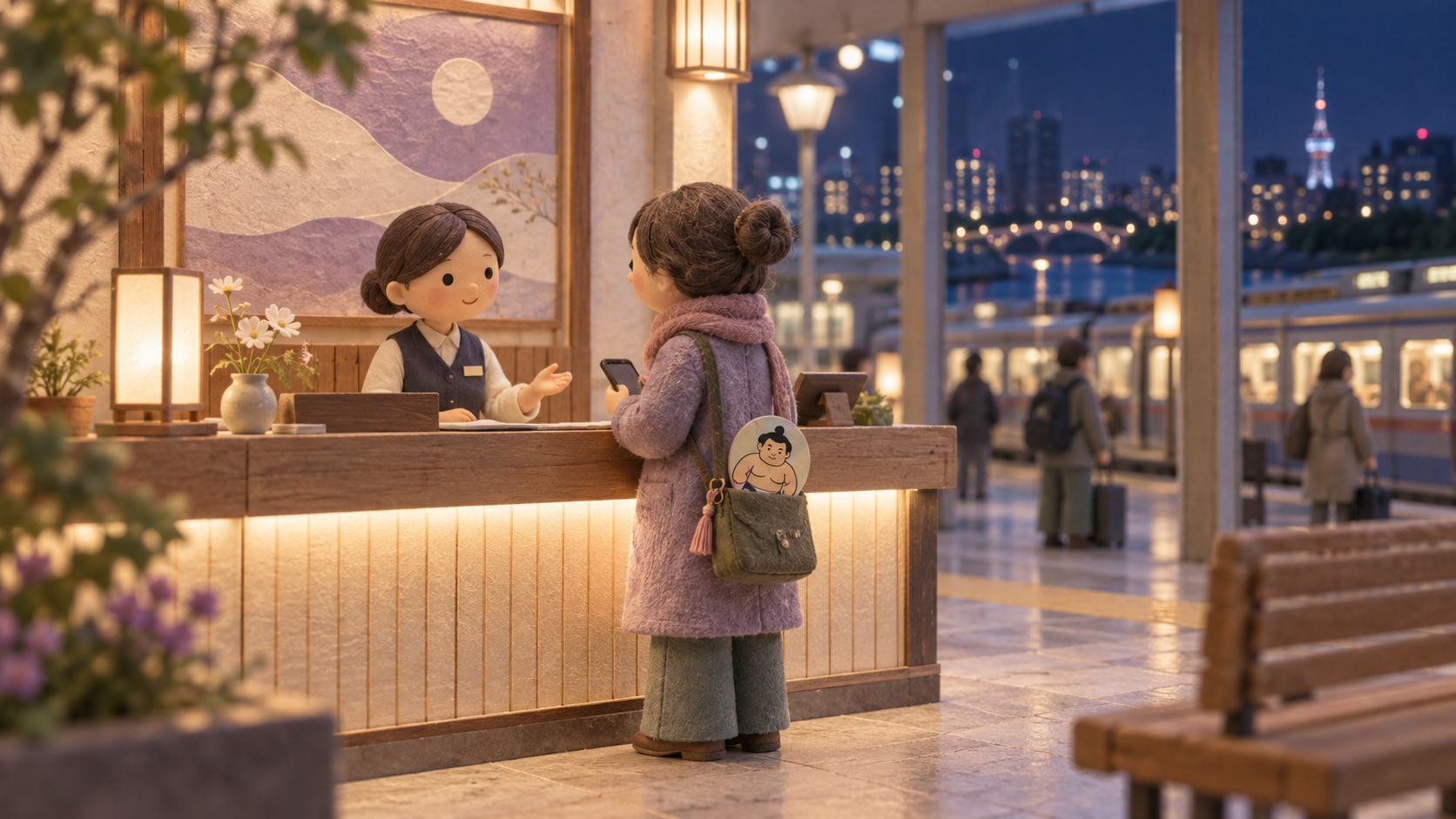
If the last service has gone, stop somewhere lit and staffed before making another hurried move. Confirm your location and group, check each operator’s official service status, and contact tonight’s accommodation about its reception deadline. Then compare another public route, a licensed taxi, a nearby room or the next morning’s service. Missing a train is not a reason to call 110 or 119; use Japan’s emergency numbers only for danger, accident or illness.
Sumo’s finish is not a railway departure. The Japan Sumo Association’s Tokyo day schedule labels its end time and ceremony times as approximate. Prevention matters, but once a connection has failed, the useful task is not to defend the old itinerary. It is to build a safe night from your actual position.
Minute 0: stop in a staffed place
Move to a station gate, an open hotel reception or another legitimate staffed facility where you can check directions. Count the people in your group and do not split up casually. Check phone power, money, identification, medication and the device carrying your bookings.
Do not flag down an unidentified private vehicle or solicit a stranger’s lift through social media. If someone is injured, seriously ill, being followed or otherwise in danger, separate that emergency from the transport problem and call the appropriate emergency service.
Minute 5: establish what has actually stopped
Do not rely on one route-planning screenshot. Open the official timetable and live service information for every railway, subway or bus company in the proposed route. A delayed final service may no longer connect; another operator may still run. An unfamiliar “one stop in the opposite direction” workaround is only useful when station staff or official journey information confirms the complete route.
GO TOKYO collects official transport-status links for JR, both Tokyo subway systems, private railways and airports. Fukuoka City’s official visitor guide lists transport operators and tourist-information locations. Contact details and service hours can change, so open the current official page rather than relying on a number copied into an old article.
Minute 10: choose a new destination for tonight
Compare four options in this order:
- Another public route to the booked hotel. Verify the final station, all transfers and the last walk—not merely the first train.
- A licensed taxi. Use an official rank or reputable dispatch channel. For a long ride, ask about the estimated cost and accepted payment before leaving. Availability is never guaranteed.
- Nearby accommodation. Confirm that reception is genuinely open tonight, the full price is visible, and the property can accept your identification. An online vacancy icon alone may not guarantee late check-in.
- Waiting for the first service. Stations and public facilities do not necessarily remain open overnight. Do not choose this unless staff confirm where you may safely stay.
Tell the hotel you already booked if you will arrive late; otherwise its own no-show rule may take effect. If a flight or shinkansen the next morning is now at risk, use the transport operator or airline’s official change process. An unofficial resale or a stranger offering a “special ticket” is not a recovery tool.
Support for international visitors
JNTO’s Japan Visitor Hotline currently operates 24 hours a day, 365 days a year, in English, Chinese and Korean. Its published scope includes assistance for accidents, illness and natural disasters, plus general tourist information. It is not a promise of taxi dispatch, translation for every private booking or free accommodation. In an immediate emergency, Japan’s police and fire/ambulance numbers remain 110 and 119.
Keep three records once you are safe
- a time-stamped official disruption or delay screen;
- receipts for changed travel, accommodation and transport;
- the new service, platform and check-in deadline to verify in the morning.
Do not assume reimbursement. Coverage depends on the cause and the individual ticket, insurance or booking contract. Keeping records simply preserves the possibility of asking the right provider later.
The planned early-departure guide can prevent this situation next time. For normal Fukuoka post-bout travel, use the Fukuoka return plan; for illness, disaster or on-site help, use the Fukuoka help and emergency guide.
After you have a safe place and a workable morning, recall one bout from the day. Missing a train can be a travel failure without erasing the sumo you saw. Remembering the final step at the edge of the dohyo can turn a panicked night into a better decision rule for the next trip.
Sources
- Japan Sumo Association, Tokyo tournament-day schedule; times are approximate; checked September 3, 2026.
- GO TOKYO, “Useful Disaster & Emergency Information”; official transport-status links; checked September 3, 2026.
- Fukuoka City Official Tourist Guide, “Useful Information”; operator contacts and visitor-information locations; checked September 3, 2026.
- Japan National Tourism Organization, “Japan Visitor Hotline”; hours, languages and service scope; checked September 3, 2026.
Source links used for verification
Each link was used for the corresponding claim in this article; inclusion is not a blanket endorsement of the whole page.
Article verified:
- Japan Sumo Association Tokyo tournament-day schedulePrimary source (as checked for this article)
- GO TOKYO Useful Disaster & Emergency InformationPrimary source (as checked for this article)
- Fukuoka City Official Tourist Guide Useful InformationPrimary source (as checked for this article)
- JNTO Japan Visitor HotlinePrimary source (as checked for this article)