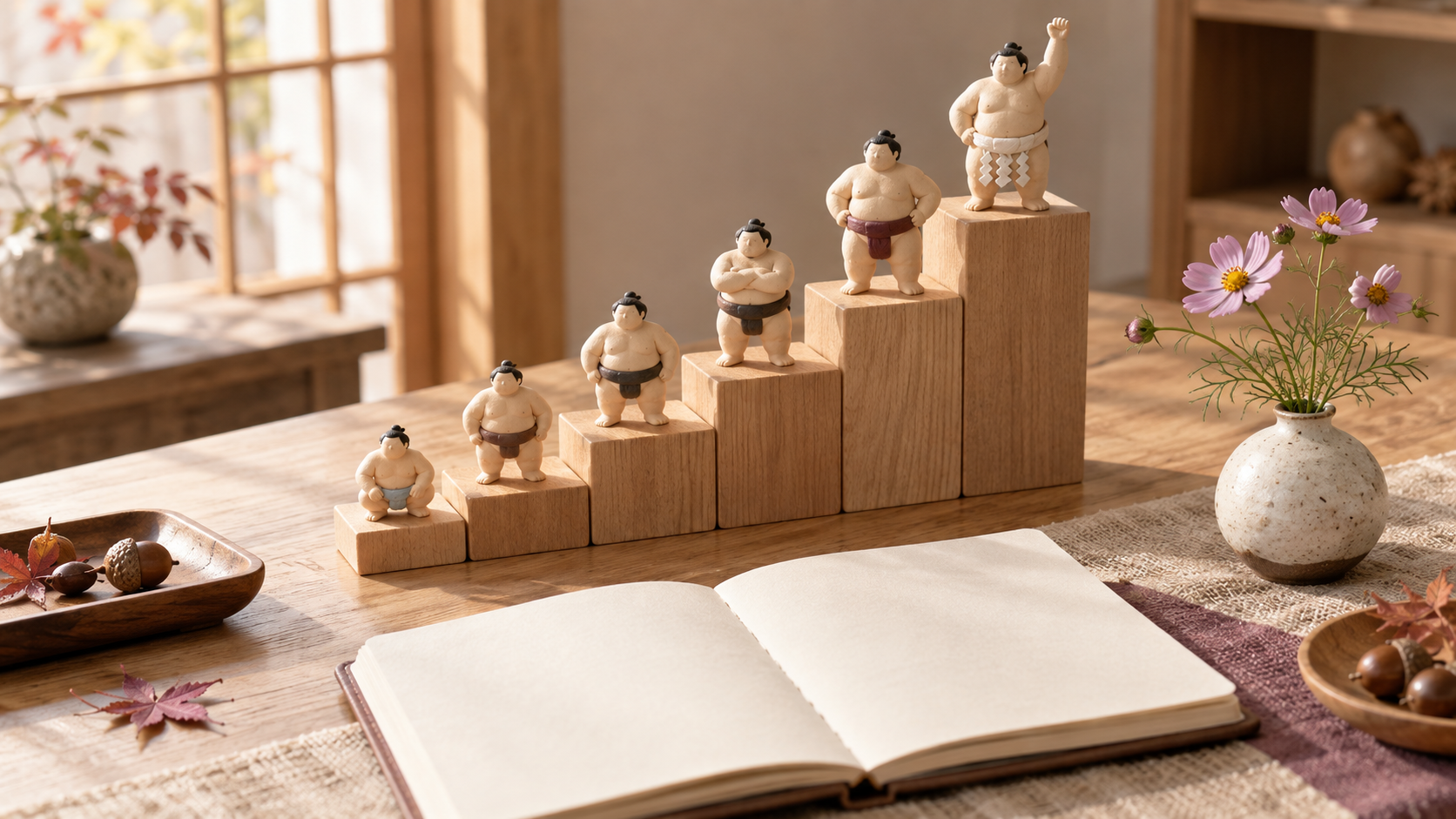
Professional sumo’s six divisions, from highest to lowest, are makuuchi, juryo, makushita, sandanme, jonidan and jonokuchi. Inside makuuchi, the rank order is yokozuna, ozeki, sekiwake, komusubi and maegashira. You do not need to memorise the whole banzuke. Find one wrestler, then read the east or west side, rank and number printed around his name. That is enough to begin.
The printed banzuke can look like a forest of calligraphy. A forest becomes a map as soon as one tree has a name. Follow a single wrestler from one tournament to the next, and the dense sheet begins to show distance, neighbours and movement.
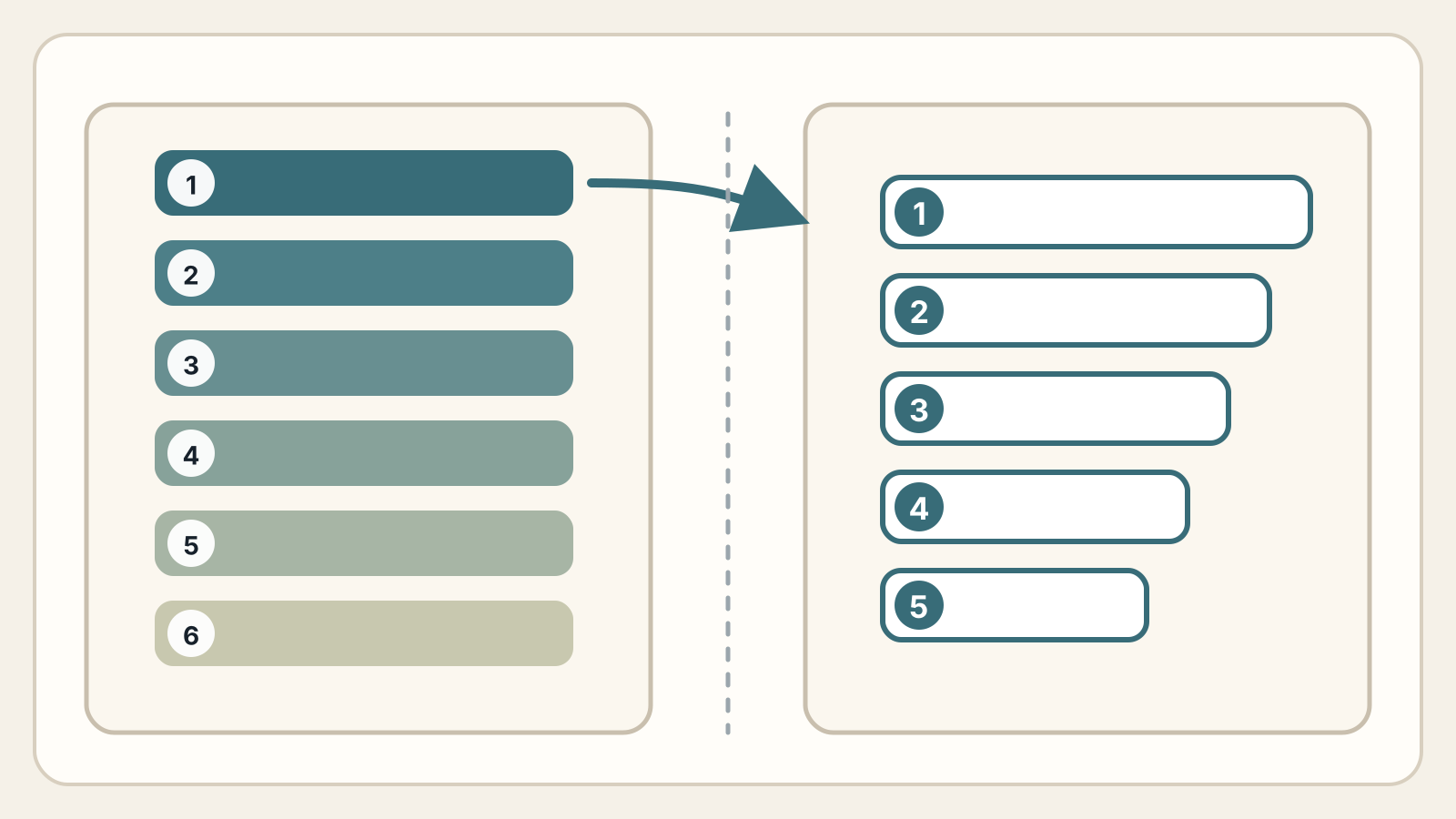
Detailed description of this diagram
The left panel stacks six numbered steps: makuuchi, juryo, makushita, sandanme, jonidan and jonokuchi. Only left step one connects to an expanded right panel of five steps: yokozuna, ozeki, sekiwake, komusubi and maegashira. Step height, width, colour and gap do not quantify population, pay, bout time, promotion distance or strength. East/West, rank numbers, current wrestlers and real banzuke placement are absent.
Graphic: SUMO ARCHAEOLOGY CLUB · Figure source 1 · Figure source 2 · Figure source 3
The six divisions
The official banzuke separates wrestlers into:
- makuuchi;
- juryo;
- makushita;
- sandanme;
- jonidan;
- jonokuchi.
Makuuchi and juryo wrestlers are known collectively as sekitori and take part in division ring-entering ceremonies wearing decorative kesho-mawashi. Many more wrestlers compete in the four divisions below. Arrive early at a tournament and the day itself climbs this ladder, from lower-division bouts towards the familiar top-division names.
The order within makuuchi
Makuuchi begins with yokozuna, followed by ozeki, sekiwake, komusubi and maegashira. Sekiwake and komusubi are the two named sanyaku ranks below ozeki; the term sanyaku can be used in broader ways in some contexts, so beginners are better served by reading each actual rank.
The September 2026 official list shows Onosato and Hoshoryu at yokozuna; Kirishima, Kotozakura and Aonishiki at ozeki; Atamifuji and Fujinokawa at sekiwake; and Hakunofuji and Daieisho at komusubi. Maegashira follows. This is a dated example, not a permanent cast. The next banzuke changes the map.
East, west and numbers work like an address
Because several wrestlers share a rank, the banzuke uses east and west positions and, particularly for maegashira and lower divisions, rank numbers. An English listing may therefore say “East Maegashira 15” or “West Sekiwake.” For a first reading, treat that phrase as the wrestler’s current address rather than an exam question about tiny differences in strength.
Fujinokawa’s September address is West Sekiwake; Asasuiryu’s is East Maegashira 15. The official banzuke topics add a story to the address: Fujinokawa reached sekiwake in 22 tournaments from debut, tied for tenth-fastest in the Association’s stated comparison excluding makushita-tsukedashi entrants.
A winning record matters, but the movement is not mechanical
Tournament results help shape the next ranking. A winning record generally points upwards and a losing record downwards, but there is no universal equation saying that eight wins always produce a fixed number of places. Available positions, other wrestlers’ results and special promotion or rank-retention conditions all matter.
That uncertainty gives banzuke day its fascination. When the final bow of one tournament is complete, the exact next address is not always known. Readers return to the new sheet to discover what the fifteen days became.
Follow one name vertically through time
Choose one wrestler. Record his present rank, his fifteen-day result and his position on the next banzuke. Terms such as “new sekiwake,” “new makuuchi” or “new juryo” then stop being vocabulary cards; they mark the first time a person has arrived at that level.
The point of learning rank is not to assign human worth. It is to add yesterday’s distance to today’s bout. When a newly promoted wrestler bows on opening day, the line on a dense sheet can make the moment feel a little more precarious—and a lot more alive.
Sources
- Japan Sumo Association, September 2026 banzuke (checked 2 September 2026)
- Japan Sumo Association, September 2026 banzuke topics (checked 2 September 2026)
- Japan Sumo Association, English wrestler finder (checked 2 September 2026)
Source links used for verification
Each link was used for the corresponding claim in this article; inclusion is not a blanket endorsement of the whole page.
Article verified:
- Japan Sumo Association September 2026 banzukePrimary source (as checked for this article)
- Japan Sumo Association September 2026 banzuke topicsPrimary source (as checked for this article)
- Japan Sumo Association English wrestler finderPrimary source (as checked for this article)