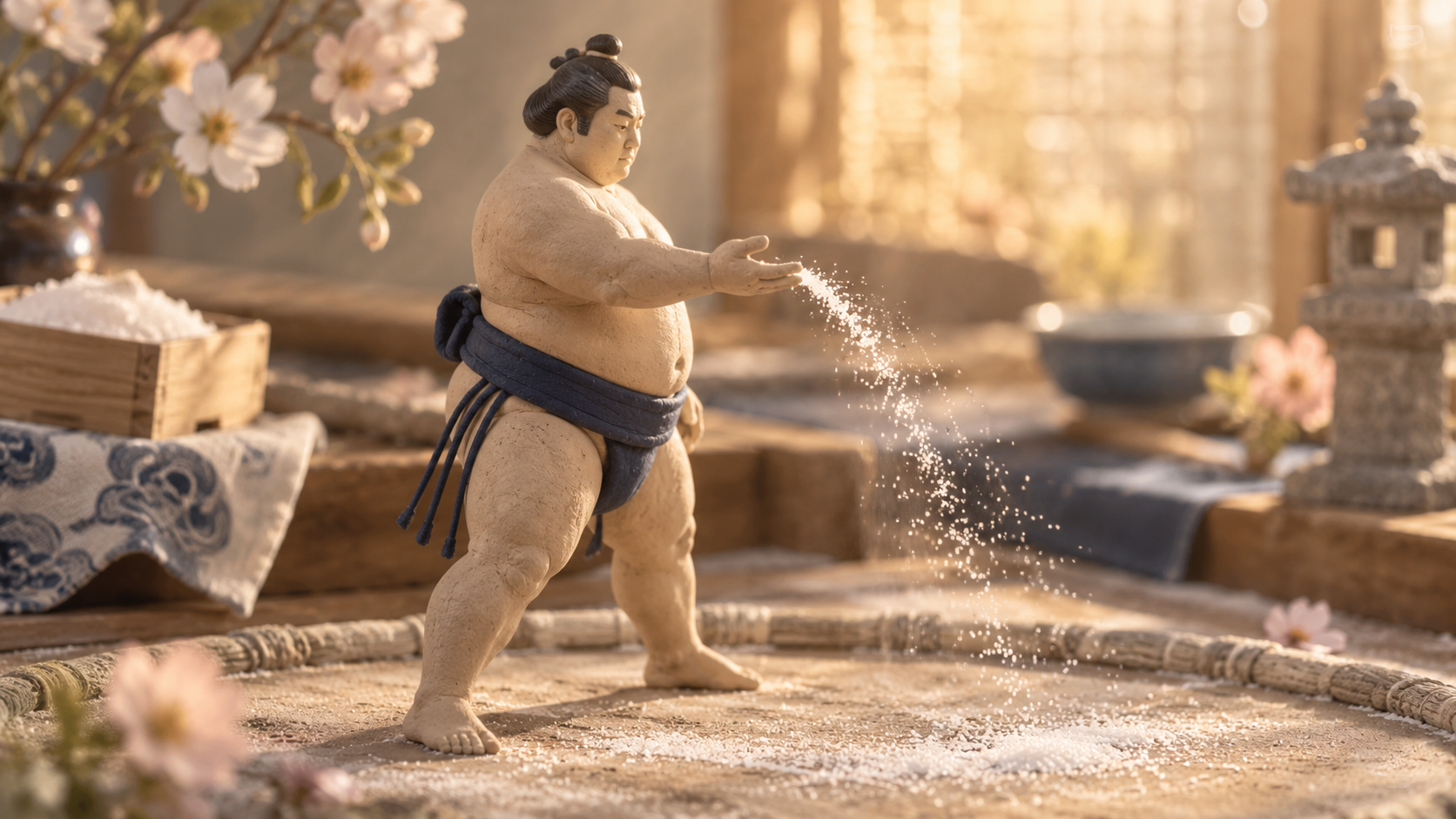
The salt thrown before a professional sumo bout is a form of purification. The Japan Sumo Association says it is used to cleanse the sacred dohyo, drive away harmful influences, purify the wrestlers in body and mind, and pray for their safety. The salt is coarse rather than refined, and an official estimate puts total use at about 45 kilograms during one tournament day.
A high white arc can earn an immediate cheer, so it is easy to treat the salt as pre-bout theatre. The official explanation makes the moment quieter and more interesting. Before two people collide at full force, they prepare the place of contact and express a hope that the contest will be safe. The throw is visible for a second; the meaning begins before it leaves the hand.
Detailed description of this diagram
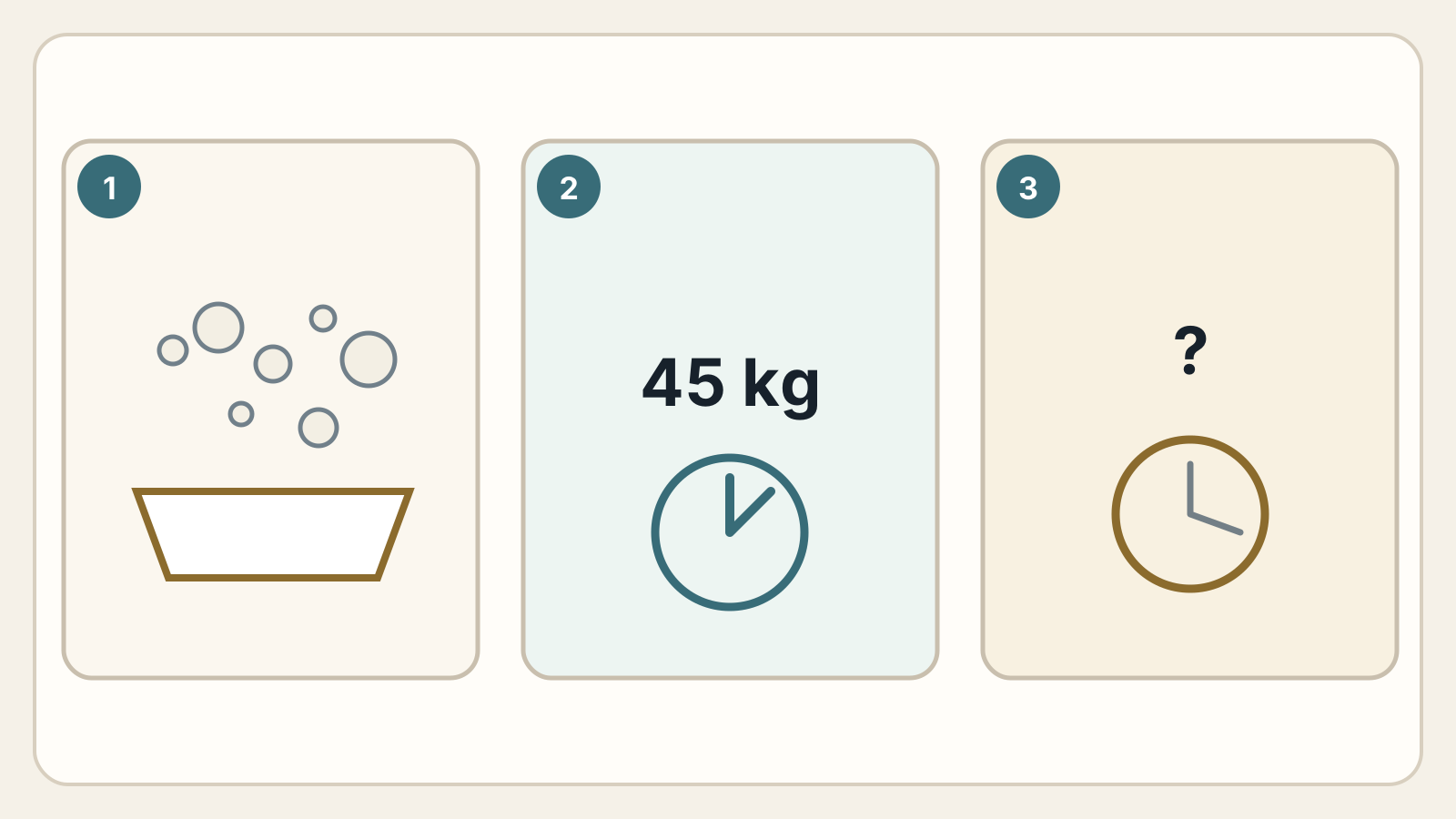
Card 1 places varied dots over a generic container token to mean the broad coarse-salt category, not a photographic grain sample. Card 2 displays 45 kg as the Association's approximate total across a whole tournament day; it is not a per-wrestler, per-bout or per-throw amount. Card 3 combines a question mark with an abstract timing dial for the documented possibility that a makushita wrestler may throw salt when the schedule is running unusually fast. Dot size, count, colour, container, mound height, hand, throw arc, ring location, stock and health effects are omitted.
Graphic: SUMO ARCHAEOLOGY CLUB · Figure source 1 · Figure source 2 · Figure source 3
Purifying the ring and the wrestlers
The Association calls it *kiyome no shio*, or purifying salt. Its explanation connects several ideas: cleansing the sacred ring, dispelling evil, purifying the wrestlers’ minds and bodies, and praying for safety.
That does not make every salt throw identical. Wrestlers take different amounts and produce very different arcs. What remains constant in the official account is the purpose of the salt within the preparation for a bout. Once you know that, the walk to the salt basket, the return to the starting lines and the brief pause before another attempt all become part of the same sequence.
Why coarse salt is used
The tournament does not use fine, free-flowing refined table salt. The Association identifies the material as coarse salt. It explains that the unrefined grains are less likely to run through a wrestler’s fingers and give the hand a moderate amount of moisture. That also makes it easier to hold a mound before throwing it.
The choice is practical as well as symbolic. The Association explanation supports the narrower points that coarse salt is less likely to spill between the fingers and that humidity helps it mound. It does not establish a hand size, fixed amount, throwing technique, trajectory or landing area, so do not derive those from a dramatic plume.
What “about 45 kilograms a day” actually means
Two official Association features state that a grand tournament uses approximately 45 kilograms of salt in a day. This is not an allowance for one wrestler or a fixed amount for each match. It is an approximate total across the tournament day.
The word “approximately” matters. The individual throws are not standardised scoops, and the figure should not be rewritten as a precise daily inventory. Its value is scale: the brief white throws add up to the Association’s approximate 45-kilogram whole-day figure. We do not turn that into a comparison with a person’s body weight or an amount per wrestler or bout. Something that seems weightless from the upper seats has a substantial material presence by the end of the programme.
A useful exception in the lower divisions
English introductions sometimes simplify the practice by saying that only wrestlers in the two salaried divisions throw salt. That is a useful expectation for a normal programme, but it is not an absolute rule for what a spectator might see.
In a January 2026 explanation, the Association said that a *makushita* wrestler may sometimes throw salt when the overall programme is running unusually quickly and time needs to be adjusted. It also made clear that appearing in the final five makushita bouts does not automatically grant a salt throw. If you arrive early and see salt during a lower-division match, you have not necessarily spotted a mistake; you may be seeing the day’s timing being managed.
Watch the return, not just the white cloud
The amount and style can help you recognise a wrestler, but they should not be used to invent a personality. A large throw does not prove that someone is extroverted, and a small one does not prove nervousness. We can enjoy the visible signature without pretending to know the person’s private thoughts.
From the view available to you, try following a possible cycle: taking salt, turning back, approaching the starting lines, crouching and withdrawing if the timing is not yet right. Do not treat that observation cue as a fixed sequence visible or used in every bout. Repetition gradually tightens the arena’s attention. The salt falls instantly, but the space between throws grows heavier as the start approaches.
At the next bout, notice where the salt appears to land, but do not use a photograph or broadcast frame to measure the spread. Let the crowd enjoy the plume—and take one second to see it as preparation for a dangerous contest, not merely decoration. A familiar white flash may become the moment when the dohyo changes from clay into a deliberately cleansed stage.
Keep More Than One Interpretation Open
We separate what the official or collection source establishes from our observation. A ritual, object or posture may have another interpretation or theory across periods, regions and explainers. When primary evidence does not establish a single origin or meaning, we leave it unknown or contested rather than turn visual resemblance into historical fact.
Where the Evidence Stops
A name, form or procedure confirmed by an official source is a fact; it does not automatically establish a person’s intention or a religious meaning. What the source does not state remains unknown. If an observation suggests a hypothesis, we label the inference, show what could contradict it and name the source that would resolve it.
Sources
- Japan Sumo Association, Sumo Quiz No. 979 on coarse purifying salt (published 13 September 2024; checked 2 September 2026)
- Japan Sumo Association, Sumo Quiz No. 1045 on approximate daily use (published 18 November 2024; checked 2 September 2026)
- Japan Sumo Association, Sumo Quiz No. 1466 on exceptional salt use in makushita (published 13 January 2026; checked 2 September 2026)
Source links used for verification
Each link was used for the corresponding claim in this article; inclusion is not a blanket endorsement of the whole page.
Article verified:
- Japan Sumo Association Sumo Quiz No. 979: purifying saltPrimary source (as checked for this article)
- Japan Sumo Association Sumo Quiz No. 1045: daily quantityPrimary source (as checked for this article)
- Japan Sumo Association Sumo Quiz No. 1466: salt in makushita boutsPrimary source (as checked for this article)