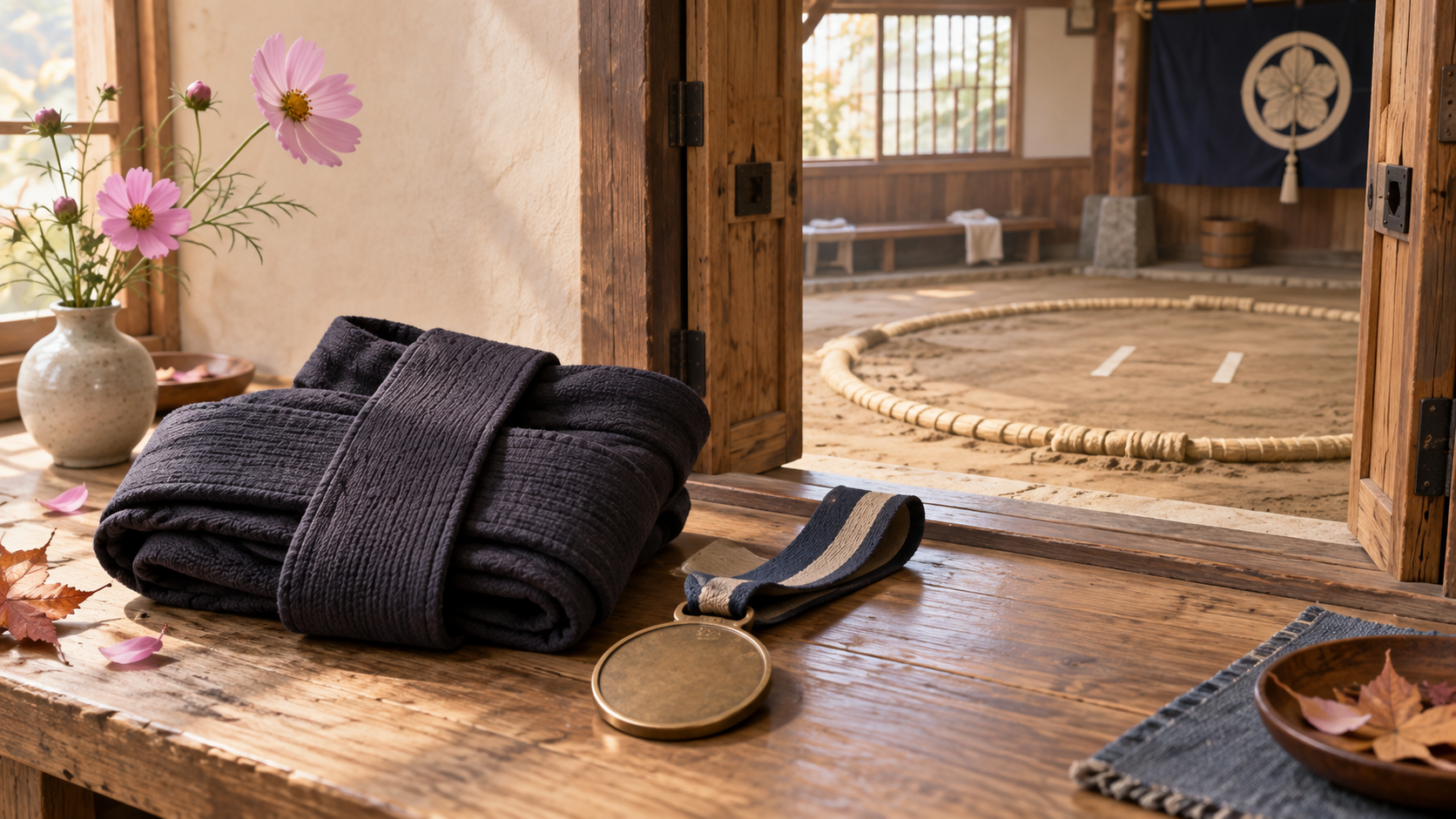
Tsukedashi is an exceptional entry treatment for a recruit whose amateur sumo record meets criteria set by the Japan Sumo Association. Instead of making his professional debut in maezumo, the unranked preliminary competition, he begins at a position that appears on the banzuke. An Association explainer dated February 2025 said the highest starting position then available was “makushita bottom-rank tsukedashi.” Exact qualifying events and positions can change, so a current Association decision must take precedence over an old list.
This matters whenever a wrestler is described as reaching juryo or makuuchi in a startlingly small number of tournaments. A person who began near the bottom of makushita and a person who began through maezumo did not travel the same distance on the professional rankings. The distinction does not make one path effortless or the other automatically nobler. It gives the speed statistic its proper starting line.
The ordinary starting point and the exception
Japan Sumo Association Sumo Quiz No. 1147 explains the contrast. Ordinarily, a new wrestler makes his debut in maezumo, outside the printed rankings. Tsukedashi is the exception that allows a debut at jonokuchi or above, with eligibility based on amateur results that reach standards defined by the Association.
It is not best translated as a commercial “wild card,” a fan vote or a team drafting a college athlete. The official explanation ties it to competitive achievement and Association criteria. We also should not invent the private deliberations behind an individual approval. The Association’s FY2025 activity report records board consideration of makushita tsukedashi approvals, reinforcing that this is an Association decision rather than a label added by the press. The governing decision, official announcement and wrestler profile are the evidence.
For international readers, the word itself can be confusing because older biographies use several combinations: *makushita tsukedashi*, *sandanme tsukedashi* and numbered starting positions. Those labels can all be historically genuine while belonging to different versions of the rules.
How tsukedashi appears in an official wrestler profile
Scroll to the first tournament in the Japan Sumo Association’s career table. For an ordinary ranked wrestler, you will eventually reach the transition from maezumo into jonokuchi. For a tsukedashi entrant, the first line may instead say 幕下最下位格付出—“makushita bottom-rank tsukedashi”—where another line would normally show an east or west numbered rank.
The current official profile for Hanahibiki, who competed under the name Hanaoka at entry, records that label for May 2025. The second current profile cited below records the same starting treatment for another wrestler in May 2026. These profiles are valuable because they do not merely call the wrestlers “former amateurs.” They preserve the precise professional entry status alongside the first win-loss record.
The *kaku* in “bottom-rank position” is worth noticing. The tsukedashi line is not a missing numbered rank or a website formatting error. It marks an additional entry position at the lower edge of the division. From the following tournament, the wrestler receives an ordinary east or west rank based on the usual ranking process.
Why an old official page may still mislead a current guide
Primary does not always mean current. An Association explainer published in August 2023 listed three tsukedashi starting categories then in use: makushita 10th-rank, makushita 15th-rank and sandanme bottom-rank. The later February 2025 Association explainer said that, at that time, the highest tsukedashi entry was the bottom of makushita.
The correct editorial response is not to hide the older page. It is to label it as a historical snapshot and decline to reuse its three-category menu as a 2026 rule. A page can remain on an official domain after the system it described has changed. Publication date, evidence state and a short review interval matter as much as the logo at the top.
This article therefore does not reproduce a list of currently qualifying amateur tournaments or title-validity periods. Prospective recruits need the latest Association rules and communication through the stable involved, not an evergreen fan article. For spectators, the reliable question is simpler: what entry status does the current official profile record for this wrestler?
A high start is not a guaranteed promotion
Tsukedashi recognises what happened before professional sumo. It does not pre-write what happens afterwards. The wrestler still receives a tournament record, and the profile continues with ordinary rises, falls, absences and changes of shikona. Two entrants with the same starting label can take very different paths.
This is why “he started in makushita, so juryo was automatic” is a poor explanation. The cited profiles show seven-bout tournament records at this level, and each result shapes the next rank. Beginning closer to the salaried divisions shortens the map; it does not remove the opponents.
Speed records need the same care. The Association sometimes publishes promotion lists with a condition such as “excluding makushita tsukedashi.” That is not a footnote to delete for a cleaner headline. It defines the comparison group. A record among wrestlers who started through maezumo answers a different question from a record across all entrants.
Follow one wrestler back to the first line
When a new star catches your attention, open the official profile and go all the way to the earliest tournament. Do not stop at the field labelled “professional debut.” Look for the actual first ranking line. Was it maezumo, sandanme tsukedashi under an earlier rule, or makushita bottom-rank tsukedashi?
That one line restores the part of the story that occurred before most fans met the wrestler. A tsukedashi entrant brought an amateur record to his first professional dohyo, but he still had to take his first seven bouts there, learn a new ranking rhythm and earn the next line. You are not subtracting from a rapid rise by naming its starting point. You are finally seeing the whole run-up.
The result is a better kind of excitement. “Only six tournaments” stops being an isolated number. It becomes six tournaments from here, achieved by this particular person after another competitive life had already brought him to the door.
Evidence limits and event-day fallback
Confirmed fact: A February 2025 Association explainer defines tsukedashi and the highest entry then available; a 2023 page records that year’s three categories. Current profiles show Hanahibiki and Honoikazuchi entered at makushita bottom-rank tsukedashi.
What remains unknown: Qualifying events, performance threshold, validity period, review material, approval reason, future starting position and promotion as of September 2026 are not settled by those dated explainers and two profiles.
Reasoned inference: Following an official profile to its earliest tournament is likely to align the starting point in speed comparisons. Confidence is high; it does not assess ability, future outcome or fairness.
Editorial suggestion: Separate maezumo and tsukedashi cohorts and place evidence date/exclusions near the comparison heading. This is not recruitment or eligibility advice.
Fallback: For current eligibility or application, do not act on an old list; verify the latest Association rule/approval through the intended stable. Spectators should return to the current official profile entry.
Sources
- Japan Sumo Association, Sumo Quiz No. 1147 (published 28 February 2025; checked 3 September 2026)
- Japan Sumo Association, Sumo Quiz No. 594 (published 25 August 2023; checked as a historical source on 3 September 2026)
- Japan Sumo Association, Hanahibiki profile and wrestler profile No. 4395 (checked 3 September 2026)
- Japan Sumo Association, FY2025 activity report (checked 3 September 2026)
Source links used for verification
Each link was used for the corresponding claim in this article; inclusion is not a blanket endorsement of the whole page.
Article verified:
- Japan Sumo Association Sumo Quiz No. 1147 on tsukedashiHistorical primary source (record from that period)
- Japan Sumo Association Sumo Quiz No. 594, a 2023 snapshot of tsukedashi categoriesHistorical primary source (record from that period)
- Japan Sumo Association Hanahibiki wrestler profilePrimary source (as checked for this article)
- Japan Sumo Association wrestler profile No. 4395Primary source (as checked for this article)
- Japan Sumo Association FY2025 activity reportPrimary source (as checked for this article)