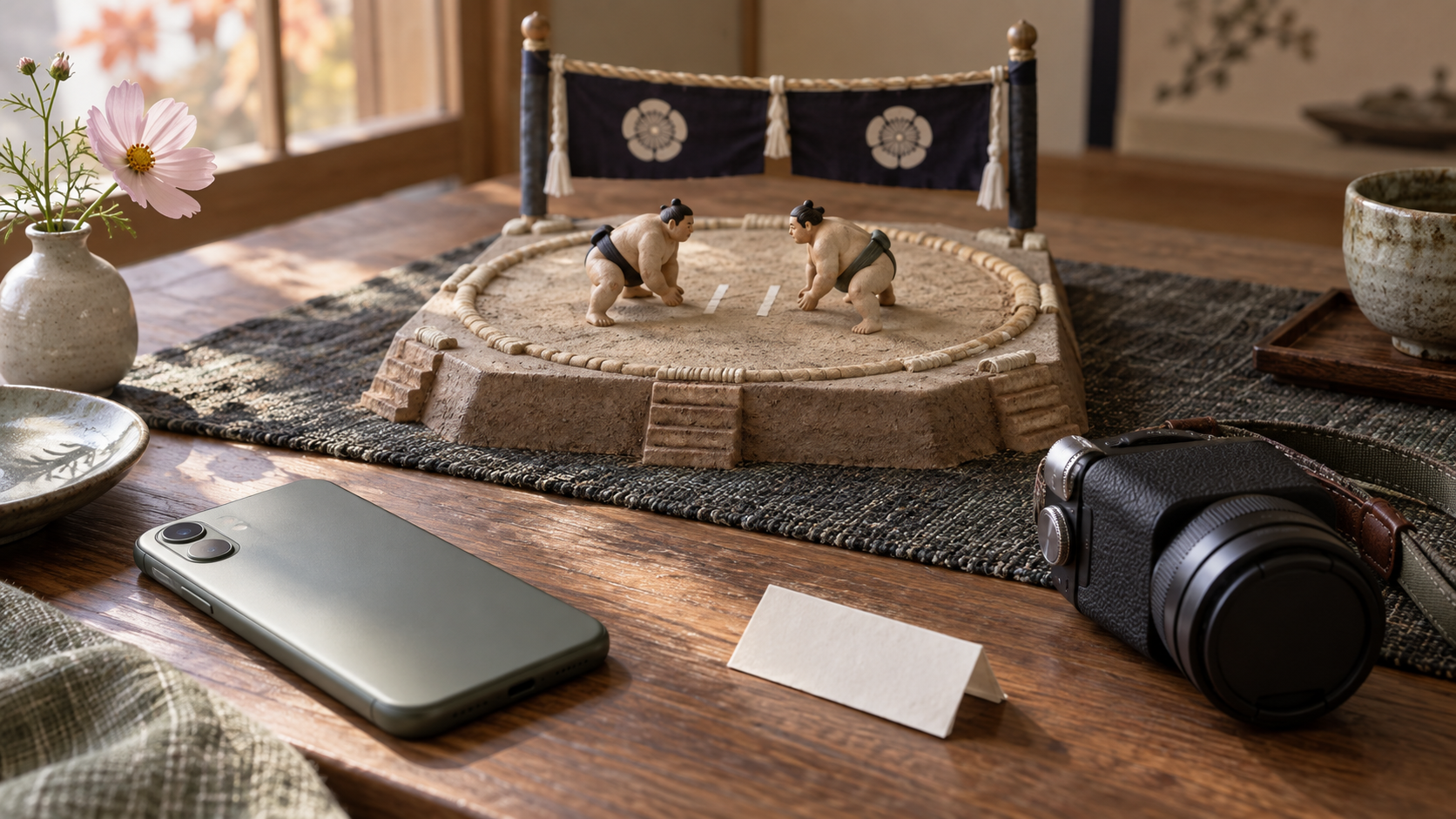
The current September 2026 spectator page does not give ordinary visitors explicit permission to live-stream tournament action. Recording a clip, keeping it privately, posting it, broadcasting it live and making money from it are different uses. Until the latest official notice or arena staff clearly confirms your intended use, do not live-stream the bouts.
A video seems to hold more of a sumo match than a photograph: the call, the charge, the crowd reacting half a second before a newcomer understands the danger at the edge. Yet the fact that a phone can transmit all of that instantly does not mean a ticket includes the right to retransmit the event.
Separate five decisions before pressing record
Ask five different questions. May I record from this seat? May I keep the recording? May I send it privately? May I publish it to an open social account? May I broadcast it live or use it commercially? A “yes” to one does not automatically answer the next.
The current September notice requires phones to be silent, discourages calls in the seating area and asks people not to move during bouts. The spectator contract prohibits watching from another seat or from aisles and evacuation routes, disruptive flash or beams, unauthorised advertising and conduct that obstructs the competition or another visitor’s view.
Those provisions clearly govern how a device is used in the arena. They do not appear on the reviewed September page as a simple, universal social-media licence.
Why we do not copy a rule from another event
For the March 2026 dohyo-matsuri ceremony, the Association issued a specific notice: photography had to be from the visitor’s own seat, while live streaming and commercial filming were prohibited. That is valuable primary evidence about how the organiser distinguishes filming from broadcasting. It was also a different ceremony, city and date.
We therefore do not rewrite it as “the September honbasho has exactly this clause.” Venue-scoped facts matter. The lesson is narrower and still useful: official notices can treat personal recording, live transmission and commercial use differently, so visitors should not collapse them into one permission.
A safe practical rule for an international visitor
Do not live-stream unless the organiser has explicitly authorised it. For long continuous recordings, a large rig or any uncertain use, ask an attendant before starting. If recording is allowed, stay in your assigned place, disable flash, keep the device below other people’s sightlines and stop if staff instruct you to stop.
Before any upload, check whether other spectators’ faces or conversations, a ticket QR code, seat details or private information are visible. This site cannot license sumo footage or promise that a platform upload complies with rights held by the organiser, broadcasters or people in the frame.
If the Japanese-only notice is difficult to understand, show the staff a short question such as “Live streaming?” rather than relying on a translated blog written for another tournament. Their current instruction wins over this article.
Some of the best evidence stays in memory
There is also permission to give yourself: permission not to record everything. Put the phone away for one complete bout. Notice how the arena narrows before the tachiai and seems to expand again at the bow. Official highlights can later show the technique. Only you can keep the peculiar feeling of being there when thousands of people inhaled together.
Classify the action in five seconds before recording
Confirmed fact: The Association’s spectator terms govern assigned seating and aisles, flash and compliance with posted or staff instructions. The reviewed contract text alone does not settle the permission boundary for each kind of video upload or transmission. A March 2026 dohyo-matsuri notice expressly prohibited live streaming and commercial filming for that ceremony only.
What remains unknown: A separate event notice cannot by itself define every boundary for short clips, private storage and social posts at a honbasho.
Reasoned inference: Comparing the terms with event-specific notices supports avoiding livestreaming while not importing another event’s clause into honbasho. Confidence is high; this concerns document scope, not inferred permission. New honbasho rules override it.
Editorial suggestion: Before pressing record, silently classify five actions: capture now, send now, post later, monetise, include other faces. This is not an official procedure; it stops the hand moving before the decision.
Fallback: Stop capture and sharing, put the device away and record the observed detail in your own words.
Sources
- Japan Sumo Association, spectator contract terms (checked 2 September 2026)
- Japan Sumo Association, September 2026 Tokyo spectator notice (checked 2 September 2026)
- Japan Sumo Association, March 2026 dohyo-matsuri notice (checked 2 September 2026; cited only as a past, event-specific example)
Source links used for verification
Each link was used for the corresponding claim in this article; inclusion is not a blanket endorsement of the whole page.
Article verified:
- Japan Sumo Association spectator contract termsPrimary source (as checked for this article)
- Japan Sumo Association September 2026 Tokyo spectator noticePrimary source (as checked for this article)
- Japan Sumo Association March 2026 dohyo-matsuri noticeHistorical primary source (record from that period)