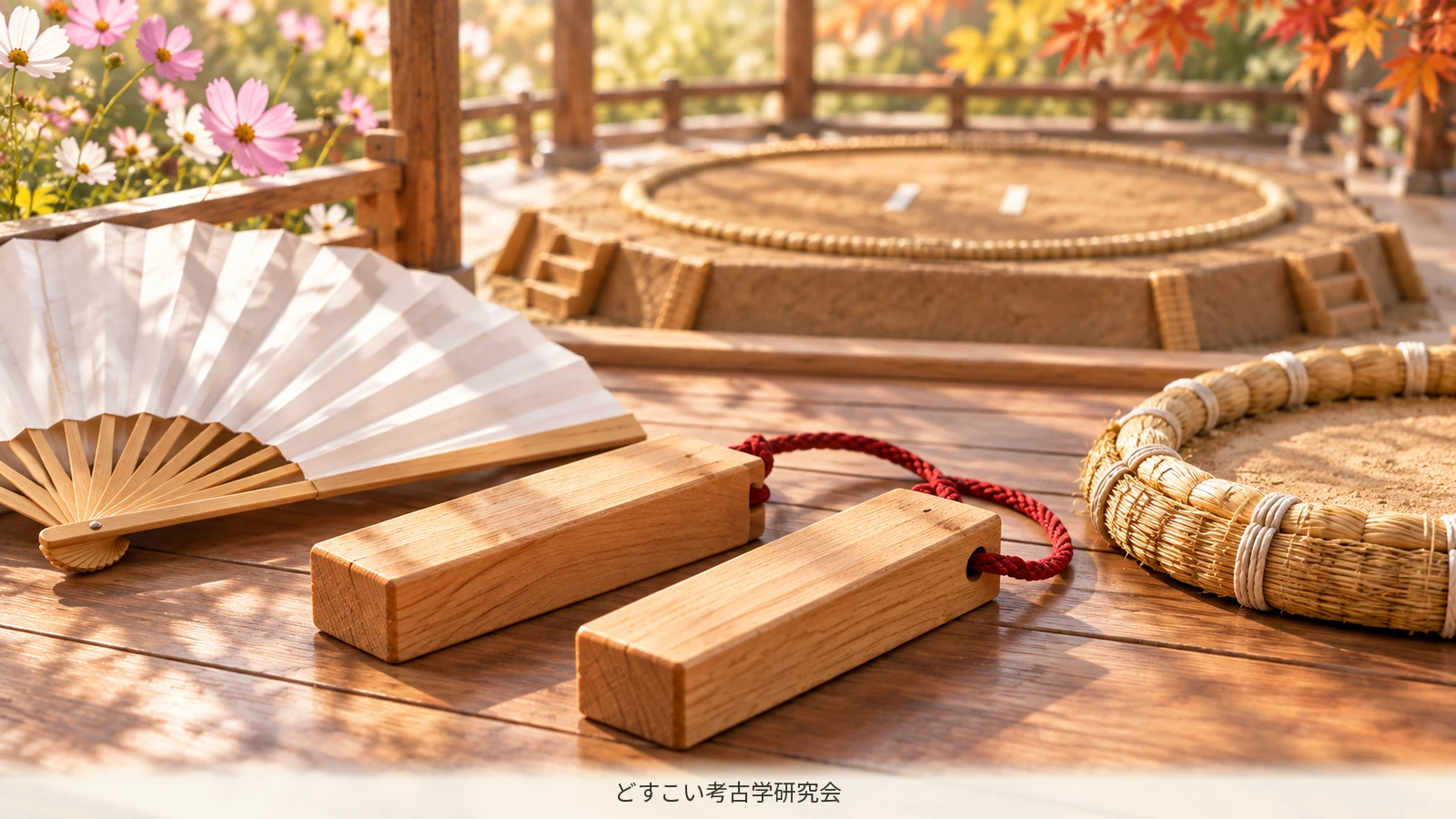
The *yobidashi* is the official who calls the two wrestlers onto the dohyo, marks parts of the programme with wooden clappers and also participates in building the ring. He is not simply an announcer. Most surprisingly, the white fan he looks towards while calling is blank: neither wrestler’s name is written on it.
There is a moment before the next athletes appear when the arena already begins to change. One voice stretches a ring name towards the east, then answers it with a name towards the west. If you start recognising that voice across several bouts, the person who seemed to occupy the gap between matches becomes one of the people holding the whole day together.
The white fan is not a script
The Japan Sumo Association explains that the yobidashi opens a plain white fan and directs his gaze towards its upper edge while calling the wrestlers. The names are not written there. The gesture is a courtesy intended to avoid soiling the dohyo or directing breath towards the wrestlers.
The official feature also says the fan is the same broad type used in Japanese dance and is larger than an ordinary folding fan. What looks from a distance like someone reading a card is therefore something more delicate: a posture that places a clean object between the caller’s lowered face and the sacred fighting space. At the next introduction, watch the small distance maintained between mouth, fan and ring.
The first side changes with the date
The call does not always begin in the same direction. According to the Association, the east wrestler is called first on odd-numbered days of a tournament and the west wrestler first on even-numbered days. The printed daily bout sheet follows the same alternation, placing east on top on odd days and west on top on even days.
This is an easy detail to test without understanding every syllable of Japanese. On Day 1, listen for the call to begin towards the east; on Day 2, expect west. One change of date reverses the vocal starting point of the same arena.
The wooden clappers are called ki
At several points in a sumo programme, the yobidashi strikes wooden clappers. The ordinary Japanese name for the instrument is *hyoshigi*, but the Association says callers commonly call the sumo pair *ki*. The clappers are made from cherry wood; using the heartwood of a fairly thick piece produces a clear tone. Sumo clappers are also larger than those used in theatre.
Different functions produce expressions such as *ichiban-gi* and *agari-gi*. The latter is the clapper signal sounded as the closing bow ceremony ends, marking the conclusion of the day’s programme. For somebody who has been in the arena since the morning, that wooden crack is a full stop. It is also an excellent entry point for a spectator in a distant seat: you do not have to see a tiny tool to recognise its sound.
The voice also belongs to a ring builder
An official Japan Sumo Association Fan Club report describes construction of the grand tournament dohyo as yobidashi work. They help turn earth and twenty short bales into the 4.55-metre fighting circle on which the names they call will compete.
This article does not assign every construction step to every individual caller; the official report is not a complete staffing manual. What it establishes clearly is the surprising connection between the visible caller and the making of the stage. The person in a crisp working costume has a craft relationship with the clay beneath the wrestlers’ feet.
Yobidashi and gyoji are different roles
For a new visitor, two traditionally dressed officials on the dohyo can blur together. The yobidashi calls the wrestlers and uses the clappers. The *gyoji* carries the rigid gunbai, directs the bout and raises it to indicate an initial decision. Look for the blank white folding fan versus the solid decision fan and the roles separate immediately.
The Association maintains a directory that lists yobidashi by name, rank and stable affiliation. Its current categories include senior titles as well as callers assigned to divisions such as makuuchi and juryo. Like the wrestlers and referees, the callers have individual careers. You need not memorise the directory to begin appreciating one voice.
Wait for just the first sound
Take one observation into the next bout. Watch the yobidashi open the white fan and wait for the first extended ring name. If it is an odd-numbered tournament day, it should begin on the east; if even-numbered, on the west. Remember that there are no notes on the fan.
The same profession helps make the ring, gives its daily programme a rhythm in cherry wood and then fills it with names. Once those pieces connect, the interval between matches no longer feels empty. Sumo is already moving towards the next contest before either wrestler steps onto the clay.
Sources
- Japan Sumo Association, Sumo Quiz No. 840 on the blank white fan (published 27 April 2024; checked 2 September 2026)
- Japan Sumo Association, Sumo Quiz No. 1283 on the *ki* clappers (published 14 July 2025; checked 2 September 2026)
- Japan Sumo Association, Sumo Quiz No. 1316 on east–west calling order (published 16 August 2025; checked 2 September 2026)
- Official Japan Sumo Association Fan Club, dohyo construction tour report (published 9 January 2022; checked 2 September 2026)
- Japan Sumo Association, current yobidashi directory (checked 2 September 2026)
Source links used for verification
Each link was used for the corresponding claim in this article; inclusion is not a blanket endorsement of the whole page.
Article verified:
- Japan Sumo Association Sumo Quiz No. 840: the yobidashi's white fanPrimary source (as checked for this article)
- Japan Sumo Association Sumo Quiz No. 1283: the ki clappersPrimary source (as checked for this article)
- Japan Sumo Association Sumo Quiz No. 1316: calling orderPrimary source (as checked for this article)
- Official JSA Fan Club report: dohyo construction tourHistorical primary source (record from that period)
- Japan Sumo Association directory of yobidashiPrimary source (as checked for this article)