
There is no official points table saying that twelve wins equals promotion. Yet four of the five most recent yokozuna were promoted without winning both of their immediately preceding tournaments. Only Onosato arrived through back-to-back championships.
That is the useful answer. It is also the beginning of a much better question.
English-language discussions often compress yokozuna promotion into “two consecutive championships or the equivalent.” The first half sounds beautifully concrete. The second half is a trapdoor: equivalent in what way? Is a 14–1 playoff loss enough? Does a championship followed by a runner-up finish count? Is twelve wins a threshold?
I went looking for a formula and did not find one in the primary material. So instead of inventing it, I put the last five successful promotions side by side.
Detailed description of this diagram
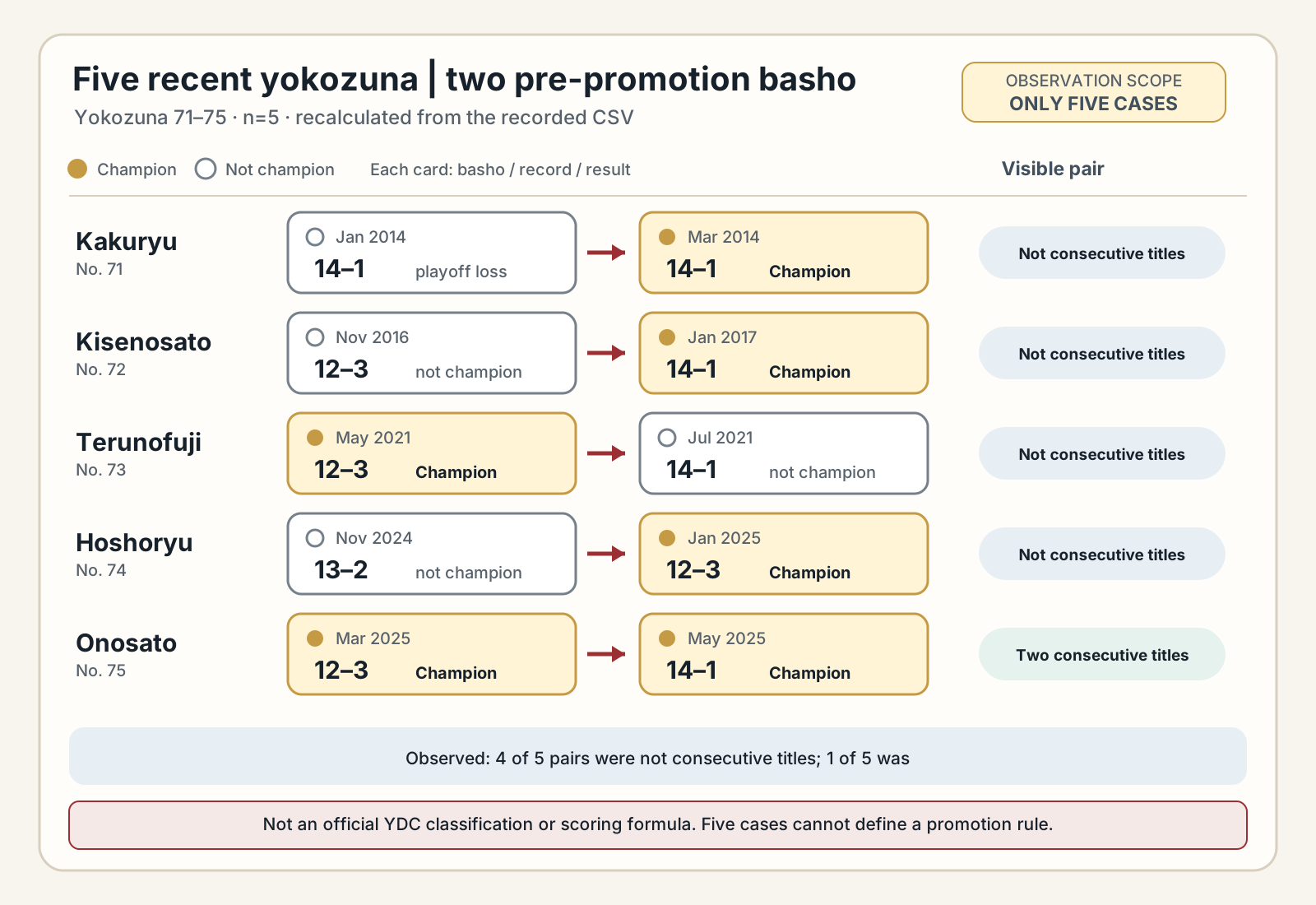
Kakuryu recorded 14-1 with a playoff loss in January 2014 and 14-1 with the championship in March. Kisenosato went 12-3 without the championship in November 2016 and 14-1 champion in January 2017. Terunofuji was 12-3 champion in May 2021 and 14-1 without the championship in July. Hoshoryu went 13-2 without the championship in November 2024 and 12-3 champion in January 2025. Onosato was 12-3 champion in March 2025 and 14-1 champion in May. The scope is only Yokozuna 71-75, so the graphic cannot establish a general promotion formula.
Graphic: SUMO ARCHAEOLOGY CLUB · Figure source 1 · Figure source 2 · Figure source 3 · Figure source 4 · Figure source 5 · Figure source 6 · Figure source 7 · Figure source 8 · Figure source 9
What the written standard actually says
The Japan Sumo Association’s own explanation quotes the Yokozuna Deliberation Council’s internal standard. The candidate is an ozeki of outstanding dignity and strength who either wins two consecutive tournaments or records performances equivalent to that achievement.
Three translations need care here.
- Ozeki is the rank immediately below yokozuna.
- A top-division championship is the tournament title, not simply a strong winning record.
- “Equivalent performance” describes room for judgement. The cited standard does not publish a numerical conversion table.
This article therefore does not grade the council’s decisions. It checks the visible records that immediately preceded five promotions and asks a narrower question: were both tournaments championships?
The two-tournament pairs
The sample runs from the 71st yokozuna, Kakuryu, through the 75th, Onosato. We checked the official promotion features and career records current on September 2, 2026.
| Yokozuna | Earlier tournament | Final tournament before promotion | Visible pattern | | — | — | — | — | | Kakuryu | January 2014: 14–1, lost playoff | March 2014: 14–1, champion | Not two championships | | Kisenosato | November 2016: 12–3, not champion | January 2017: 14–1, champion | Not two championships | | Terunofuji | May 2021: 12–3, champion | July 2021: 14–1, not champion | Not two championships | | Hoshoryu | November 2024: 13–2, not champion | January 2025: 12–3, champion | Not two championships | | Onosato | March 2025: 12–3, champion | May 2025: 14–1, champion | Consecutive championships |
Four of five promotions—80 percent of this small, recent sample—did not follow consecutive championships.
That does not turn 80 percent into a timeless promotion probability. Five cases cannot represent the entire history of yokozuna selection. Nor does the table capture bout quality, opponents, playoff context, conduct or the deliberations themselves. It shows only that the alternative route in the written standard has been highly relevant in the most recent sequence.
“Not consecutive” is not one single pattern
The four cases are interesting precisely because they are not copies of one another.
Kakuryu went 14–1, lost a championship playoff, then went 14–1 again and won the title. Terunofuji’s order was reversed: a 12–3 championship followed by a 14–1 finish behind Hakuho’s perfect 15–0. Kisenosato moved from 12–3 to a 14–1 first championship. Hoshoryu paired a 13–2 non-championship result with a 12–3 title.
It is tempting to look at those rows and announce a new rule: perhaps two twelve-win tournaments are enough, or perhaps one championship plus one excellent finish is the real formula. The evidence does not permit that leap. We can see the records; we cannot recover a secret score from five outcomes.
For the accompanying dataset, we label these four rows EQUIVALENT_OBSERVED. That is a research convenience, not an official council classification. The label means only “promotion occurred, and the visible pair was not two championships.”
Why keep a flexible phrase at all?
The five records do not reveal why no points table is published or how much weight each consideration received. This article does not infer the council’s reasoning from the permanence or prestige of the rank; that part remains unknown without an attributed primary statement.
But “overall judgement” can become opaque to readers. The honest response is neither to pretend there is a formula nor to stop asking questions. We can preserve the official wording, publish the underlying records and separate what the source says from what we infer.
The next time promotion talk begins, try watching the two tournaments as a pair. Note whether there was a championship, a playoff, a late decisive loss, or a dominant run against the top ranks. Then compare that record with the council’s public recommendation rather than relying on a social-media threshold.
That tiny word—“equivalent”—starts to feel less like an escape clause and more like an invitation to look closely.
Method and update trigger
The accompanying raw CSV contains the two completed tournaments immediately before each promotion, including rank, wins, losses, absences, championship status, promotion date and official source URLs. A deterministic script checks that both ranks are ozeki, each result totals fifteen scheduled days, the five records match the declared values, and the observed count remains four non-consecutive pairs versus one consecutive-championship pair.
We will rerun the audit after the next yokozuna recommendation, any change to the cited standard, or an official correction to the records.
Sources
- Japan Sumo Association, quiz No. 1140 explaining the recommendation standard
- Japan Sumo Association official promotion features for Kakuryu, Kisenosato, Terunofuji, Hoshoryu and Onosato
- Official career profiles for Hoshoryu and Onosato
- Official Sumo Fan Club retrospective on Terunofuji’s July 2021 performance
Checked: September 2, 2026
Source links used for verification
Each link was used for the corresponding claim in this article; inclusion is not a blanket endorsement of the whole page.
Article verified:
- Japan Sumo Association quiz No. 1140 on the yokozuna recommendation standardPrimary source (as checked for this article)
- Official feature: 71st Yokozuna KakuryuHistorical primary source (record from that period)
- Official feature: 72nd Yokozuna KisenosatoHistorical primary source (record from that period)
- Official feature: 73rd Yokozuna TerunofujiHistorical primary source (record from that period)
- Official Sumo Fan Club retrospective on TerunofujiHistorical primary source (record from that period)
- Official feature: 74th Yokozuna HoshoryuHistorical primary source (record from that period)
- Hoshoryu official profilePrimary source (as checked for this article)
- Official feature: 75th Yokozuna OnosatoHistorical primary source (record from that period)
- Onosato official profilePrimary source (as checked for this article)