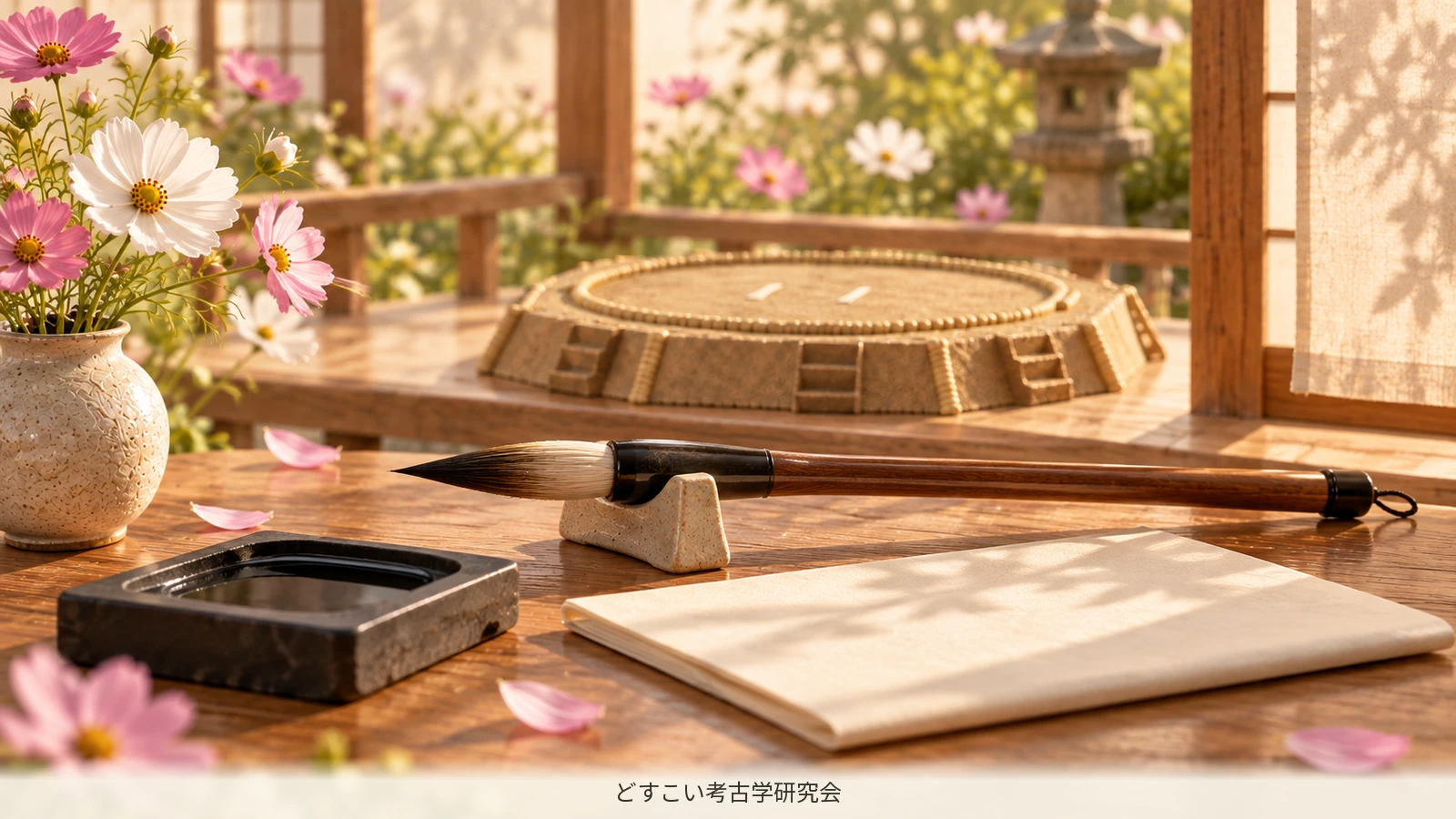
An Association explainer published on 18 March 2024 calls the heavy banzuke lettering Negishi-ryu and links it with the Negishi publishing family and transmission through gyoji. That is a dated historical account, not proof of every current production step or assigned writer. Use the current banzuke to observe lettering and placement; if the page looks impenetrable, find one wrestler’s ring name first.
An unfolded banzuke can look like a wall of ink. Names become smaller and denser down the sheet, with almost no obvious entry point for someone who reads little or no Japanese. Then you find one familiar set of characters. The names around it acquire directions and levels, and the wall turns into a map of where hundreds of people stand at one moment in the sumo calendar.
Detailed description of this diagram
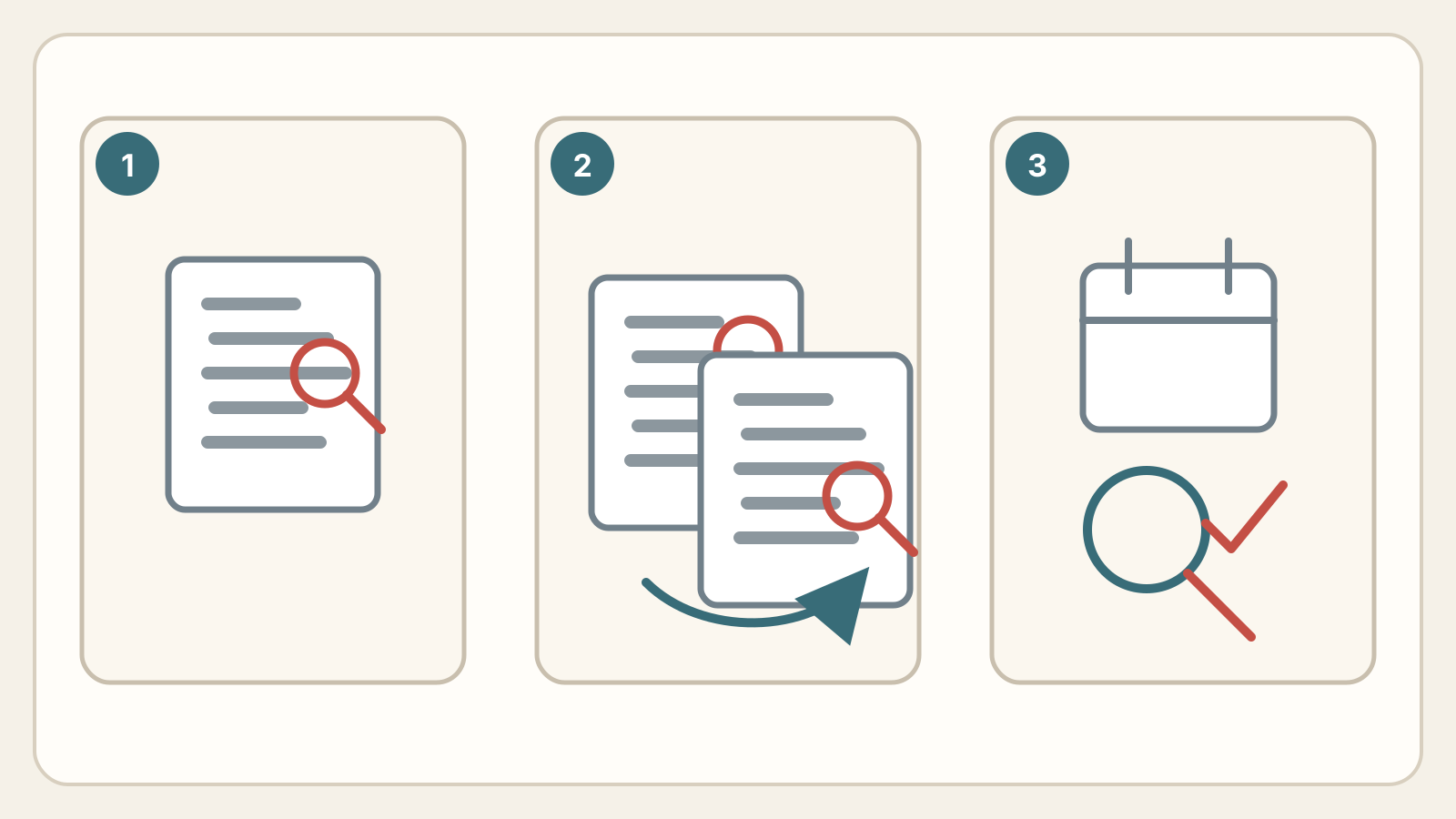
Three cards run left to right. Card one uses uneven grey bars on an abstract page and a red target to mean find one name. The bars are not characters, Negishi-ryu or a sampled banzuke layout. Card two uses two abstract pages and targets in different positions to mean compare separately dated sources; it asserts no actual wrestler's movement or cause. Card three combines a calendar, magnifier and check for returning to the source date and legend. No ring name, rank, East/West placement, population, stroke width, commercial sheet or edition-specific page is reproduced.
Graphic: SUMO ARCHAEOLOGY CLUB · Figure source 1 · Figure source 2 · Figure source 3 · Figure source 4
Sumo script is called Negishi-ryu
The Association’s 18 March 2024 explainer identifies the script as Negishi-ryu and connects it with Mikawaya Negishi Jiemon, a hereditary name in a family that specialised in publishing banzuke. The page is a historical account; it does not by itself establish every current production procedure or prove one uncontested origin from surviving workshop records.
The 2024 official explainer says the family was known through the shop name Mikawaya, later received the elder name Negishi, and used Negishi Jiemon as a hereditary head’s name. It says the present form of sumo lettering is believed to have been established around the middle of the Meiji period. Preserve that attribution and cautious wording; do not infer the individual’s motives or undocumented workshop process.
That history matters because the typeface is not a modern “traditional-looking” font applied after the rankings are decided. It belongs to the way sumo has made its hierarchy visible for generations.
Compare an 1860 sheet with the latest rankings
The Tokyo Metropolitan Library provides a high-resolution image of a banzuke printed for an Ekoin tournament in the spring of 1860. Its catalogue notes say that single-sheet woodblock banzuke are believed to have been distributed from the Kyoho era, 1716–1735, and that the vertical woodblock format for Edo sumo is said to date from the winter of 1757.
The careful phrases “believed to” and “is said to” should be preserved; they are not exact production records for every early sheet. The 1860 object itself, however, is there to inspect. Place it beside the Association’s current digital banzuke. Every athlete’s name has changed, yet the ambition to compress an entire sporting society into one vertical field of writing remains recognisable.
The referees also carry the brush
The Metropolitan Library’s catalogue explanation says gyoji inherit Negishi-ryu and write the thick sumo characters. That source does not establish the exact 2026 assignment, tools, number of writers or timetable for each banzuke. Identify a current individual writer only when a current primary credit is available.
A 2017 Sumo Museum exhibition described a large wooden *ita-banzuke*, distinct from the paper sheet, and said that makushita- and sandanme-ranked gyoji wrote it over three or four days. It also described the small roof as an *iriyama-gata*. This is a dated exhibition account; it does not prove identical staff, duration or form at every present venue.
One profession therefore contains two radically different speeds: a split-second decision at the straw boundary and several days spent placing characters on a board.
It is not simply “Japanese bold type”
The Association distinguishes Negishi-ryu from *Kantei-ryu*, familiar from kabuki signage, and *Tachibana-ryu*, used in the world of traditional comic storytelling. They belong to related urban performance cultures, but they are not interchangeable names for the same lettering.
For a first visit, use the dated official name Negishi-ryu as a reading aid for the banzuke. Do not confuse that shortcut with proof that every bold Japanese display script shares the same lineage or that every current production step is documented here. A kabuki poster or storyteller’s programme can become a later comparison, with each tradition checked on its own sources.
Begin with one ring name
The Association’s online banzuke lets you inspect wrestlers by division without decoding the full printed sheet. Choose one person you have watched, note the Japanese characters of the ring name, then find that shape on a paper banzuke. Look at its size, its side of the sheet and the names immediately above and below it.
Repeat the search on the next banzuke. The strokes may look equally heavy, but the name’s address may have moved after two months of results. The banzuke is not only a hierarchy; it is the previous tournament transformed into a new location for every name.
If you want to go further, begin with the free current banzuke and the Metropolitan Library’s free historical scan. Paper banzuke, official handwritten products and specialist books can be enjoyable, but any commercial link on this site will be marked as advertising and will never be placed ahead of those public resources.
Find one name, then look at the entire sheet again. What first seemed like an unreadable block becomes hundreds of current positions held together by a living hand. When a gyoji next raises his gunbai, you may also see the brushwork that waits beyond the dohyo.
Sources
- Japan Sumo Association, Sumo Quiz No. 800 on Negishi-ryu (published 18 March 2024; checked 2 September 2026)
- Tokyo Metropolitan Library, catalogue entry and digital image for the Spring 1860 Ekoin tournament banzuke (checked 2 September 2026)
- Sumo Museum, “What Is Grand Sumo? Things Seen on Television,” including the board banzuke (published 20 June 2017; checked 2 September 2026)
- Japan Sumo Association, September 2026 digital banzuke (checked 2 September 2026)
Source links used for verification
Each link was used for the corresponding claim in this article; inclusion is not a blanket endorsement of the whole page.
Article verified:
- Japan Sumo Association Sumo Quiz No. 800: Negishi-ryuHistorical primary source (record from that period)
- Tokyo Metropolitan Library: Spring 1860 Ekoin tournament banzukeHistorical primary source (record from that period)
- Sumo Museum: What is grand sumo? Board banzukeHistorical primary source (record from that period)
- Japan Sumo Association September 2026 banzukePrimary source (as checked for this article)