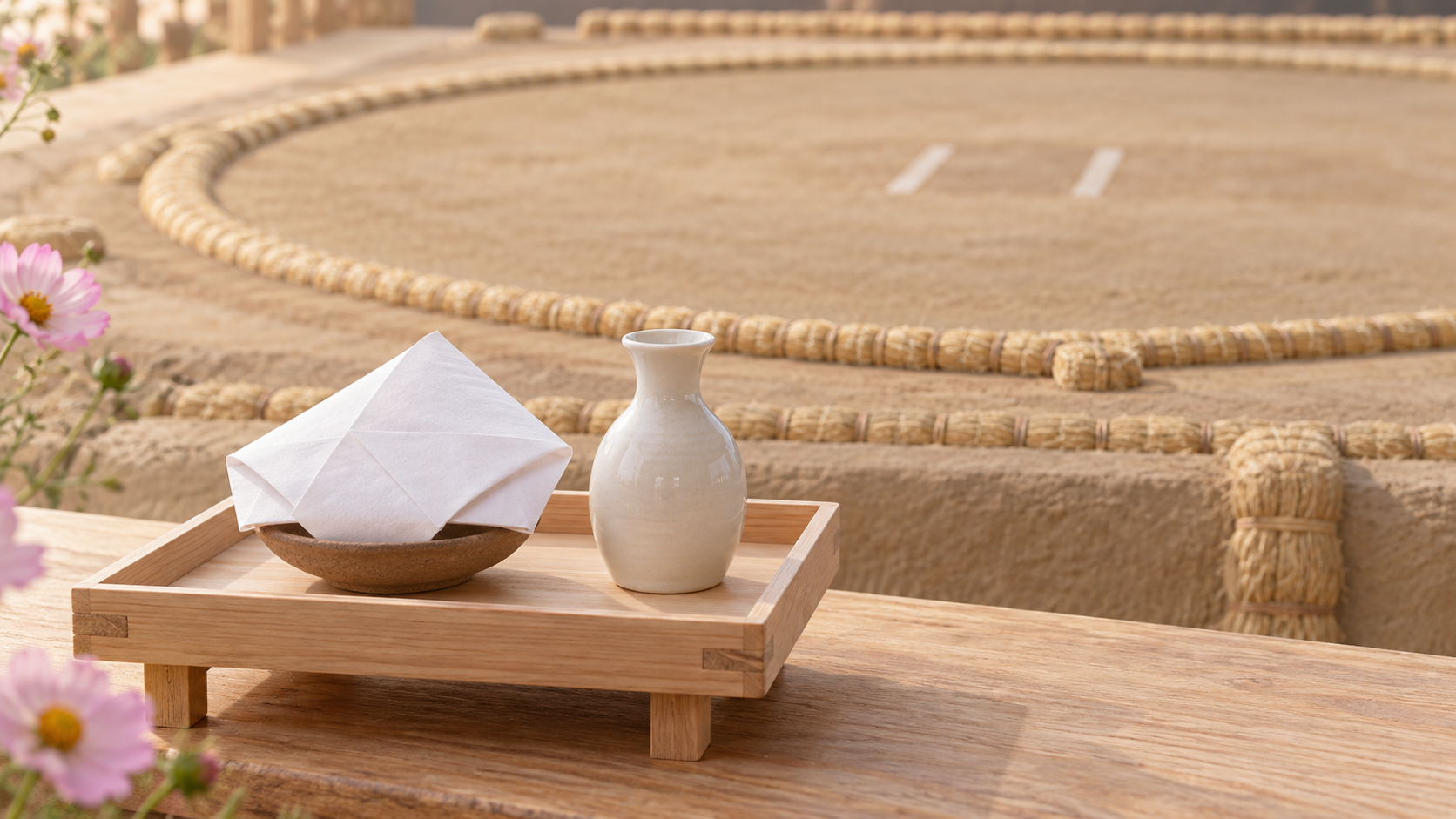
Dohyo-matsuri is a ceremony held on the day before a Grand Sumo tournament begins. The highest-ranked referee acts as chief celebrant, recites a ritual prayer and presents offerings. The prayers are for safety during the tournament, a successful event, peace in the country and a good harvest. Six auspicious items are then placed beneath the centre of the ring.
The name is sometimes rendered “ring festival”, but that English word can give the wrong impression. This is not a lively fan event headlined by famous wrestlers. It is a solemn preparation of the place where they will compete. Once you know that something was deliberately placed below the clay, the apparently empty centre of the dohyo acquires a hidden layer.
Detailed description of this diagram
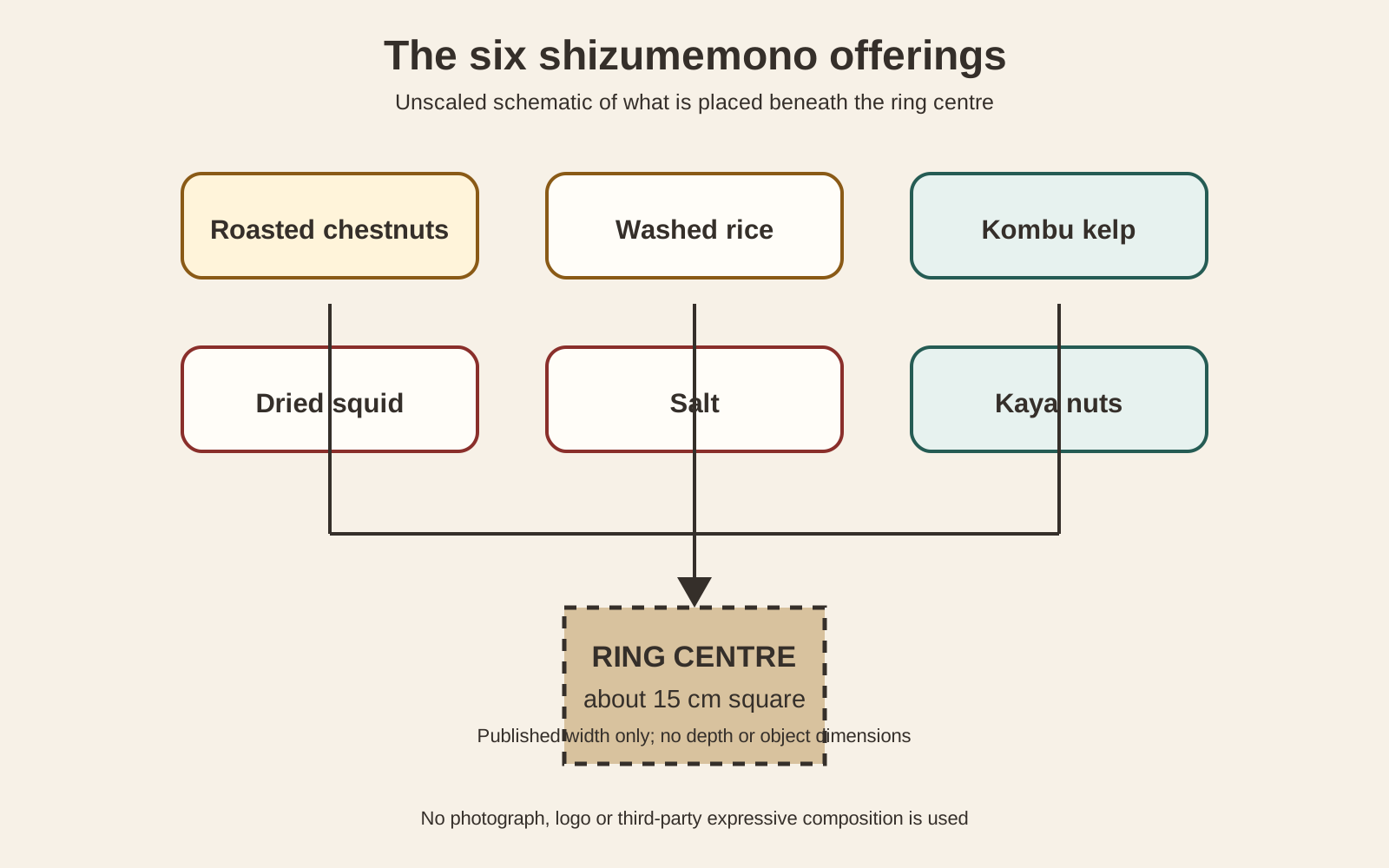
Six text cards name roasted chestnuts, washed rice, kombu kelp, dried squid, salt and kaya nuts. Lines converge on a dashed square labelled as the ring centre and about 15 centimetres square. The graphic is unscaled and does not depict depth, object dimensions, wrapping or actual arrangement.
Graphic: SUMO ARCHAEOLOGY CLUB · Figure source
The chief referee leads the ceremony
For the May 2026 tournament at Ryogoku Kokugikan, the Japan Sumo Association said that the *tate-gyoji*, its senior referee, would serve as chief celebrant. The Association chairman, elders from the judging department, all referees, representatives of the ringside supporters’ group and other Association personnel were listed as attendees. The notice explicitly said that wrestlers would not attend.
Those attendance details belong to that official May notice; they should not be copied blindly into every future event announcement. What the source makes beautifully clear is where the focus lies. The voice at the centre belongs to a referee, and the subject is the dohyo and the fifteen days ahead—not a wrestler publicity appearance.
Six small objects enter the centre of the ring
The Association’s explanation calls the buried items *shizumemono*, offerings intended to settle or safeguard the dohyo. A square opening measuring about fifteen centimetres on each side is made at the centre. The six items are:
- roasted chestnuts associated with victory;
- washed rice;
- kombu kelp;
- dried squid;
- salt; and
- kaya nuts, the seeds of the Japanese nutmeg-yew.
The official account says they are placed in a small earthenware dish, wrapped in formal *hosho* paper and set in the opening, where sacred sake is poured. The hole is then closed. A spectator watching the tournament cannot see any of this beneath the fighting surface—and that invisibility is part of the fascination.
Salt is the bridge between the hidden and visible rituals. Wrestlers will throw white salt before many top-division bouts, while another portion has already been enclosed under the clay. On your next broadcast, watch the grains land near the centre and remember the rice, kelp and nuts below. What looked like one brief purification now belongs to a ceremony that began before opening day.
The offerings frame the tournament in time
The objects are not intended to remain buried forever. Another Association feature says they are dug out after the final day, once the closing *kami-okuri* rite has finished. They therefore enter the ring before Day 1 and leave after Day 15.
This gives the clay a kind of internal calendar. A different article can tell you that the fighting circle measures 4.55 metres and uses twenty small straw bales. Dohyo-matsuri reveals another structure: an unseen centre that accompanies one tournament from preparation through closure.
Public access changes from tournament to tournament
Never assume that turning up on the preceding day guarantees admission. The May 2026 ceremony in Tokyo was open free of charge on a first-come basis. Its official notice asked visitors to remain quiet, stay in place after the ceremony began, take photographs only from their seats and avoid flash.
Two months later, the Association announced that the July 2026 ceremony would not admit the general public. It instead scheduled a livestream on its official YouTube channel. These two primary notices are a useful warning: date, venue, admission, photography and streaming arrangements are event-specific. Check the current Association announcement each time, and do not treat permission to watch a stream as permission to copy or rebroadcast it.
The September 2026 Ceremony Is Open on 12 September
The Japan Sumo Association notice published on 3 September says the ceremony will take place at the main dohyo inside Ryogoku Kokugikan on Saturday, 12 September 2026. The admission window is 9:20–9:50 a.m.; the notice says entry is not possible after 9:50. Admission is free and first come. Wrestlers will not attend.
For a visitor, the important distinction is that 9:50 is an entry cutoff, not a target time to reach the station or the outside of the building. The notice does not give a platform-to-gate time, queue duration, bag process or seat-finding time, so we cannot promise a latest safe train. Add your own margin. Once the ceremony has begun, visitors are asked not to enter, leave or move seats. Photography must be from your seat and without flash, and visitors are asked to leave promptly afterwards.
The published notice does not state an exact ceremony start or finish time, live queue length or assigned seat. If steps, wheelchair access, illness or remaining still and quiet may affect the visit, “free and first come” should not be read as guaranteed access; contact the Association in advance. If you miss the cutoff or cannot follow the event-day instruction, do not force entry. The fallback is to check later official coverage rather than invent permission from an earlier tournament.
One thing to see in the next bout
You do not need to memorise all six offerings. Just look at the centre of the dohyo for one second before the wrestlers put their fists down. Nothing visible marks the place, but the tournament’s first formal act was directed there.
The next collision may last only a few seconds. Its preparation began before the public contest, in a quiet ceremony without wrestlers. That contrast is wonderfully sumo-like: explosive action supported by careful work that asks for no attention. Once you have noticed the hidden centre, the salt, the referee’s fan and the straw boundary no longer feel like separate decorations. They belong to the same prepared ground.
Keep More Than One Interpretation Open
We separate what the official or collection source establishes from our observation. A ritual, object or posture may have another interpretation or theory across periods, regions and explainers. When primary evidence does not establish a single origin or meaning, we leave it unknown or contested rather than turn visual resemblance into historical fact.
Sources
- Japan Sumo Association, September 2026 dohyo-matsuri notice, published and checked 3 September 2026
- Japan Sumo Association, May 2026 dohyo-matsuri notice (checked 2 September 2026)
- Japan Sumo Association, July 2026 dohyo-matsuri notice dated 6 July 2026 (checked 2 September 2026)
- Japan Sumo Association, Sumo Quiz No. 1094, published 6 January 2025 (checked 2 September 2026)
- Japan Sumo Association, Sumo Quiz No. 919, published 15 July 2024 (checked 2 September 2026)
Source links used for verification
Each link was used for the corresponding claim in this article; inclusion is not a blanket endorsement of the whole page.
Article verified:
- Japan Sumo Association: September 2026 dohyo-matsuri noticePrimary source (as checked for this article)
- Japan Sumo Association: May 2026 dohyo-matsuri noticeHistorical primary source (record from that period)
- Japan Sumo Association: July 2026 dohyo-matsuri noticeHistorical primary source (record from that period)
- Japan Sumo Association Sumo Quiz No. 1094: shizumemono offeringsPrimary source (as checked for this article)
- Japan Sumo Association Sumo Quiz No. 919: removing the offeringsPrimary source (as checked for this article)