Shiori’s Research Notes
Start with Musoyama, then compare Akebono, Takanohana and Wakanohana. Three wins and one loss offer four different ways to look beyond a technique’s name.
One bout becomes a whole notebook spread
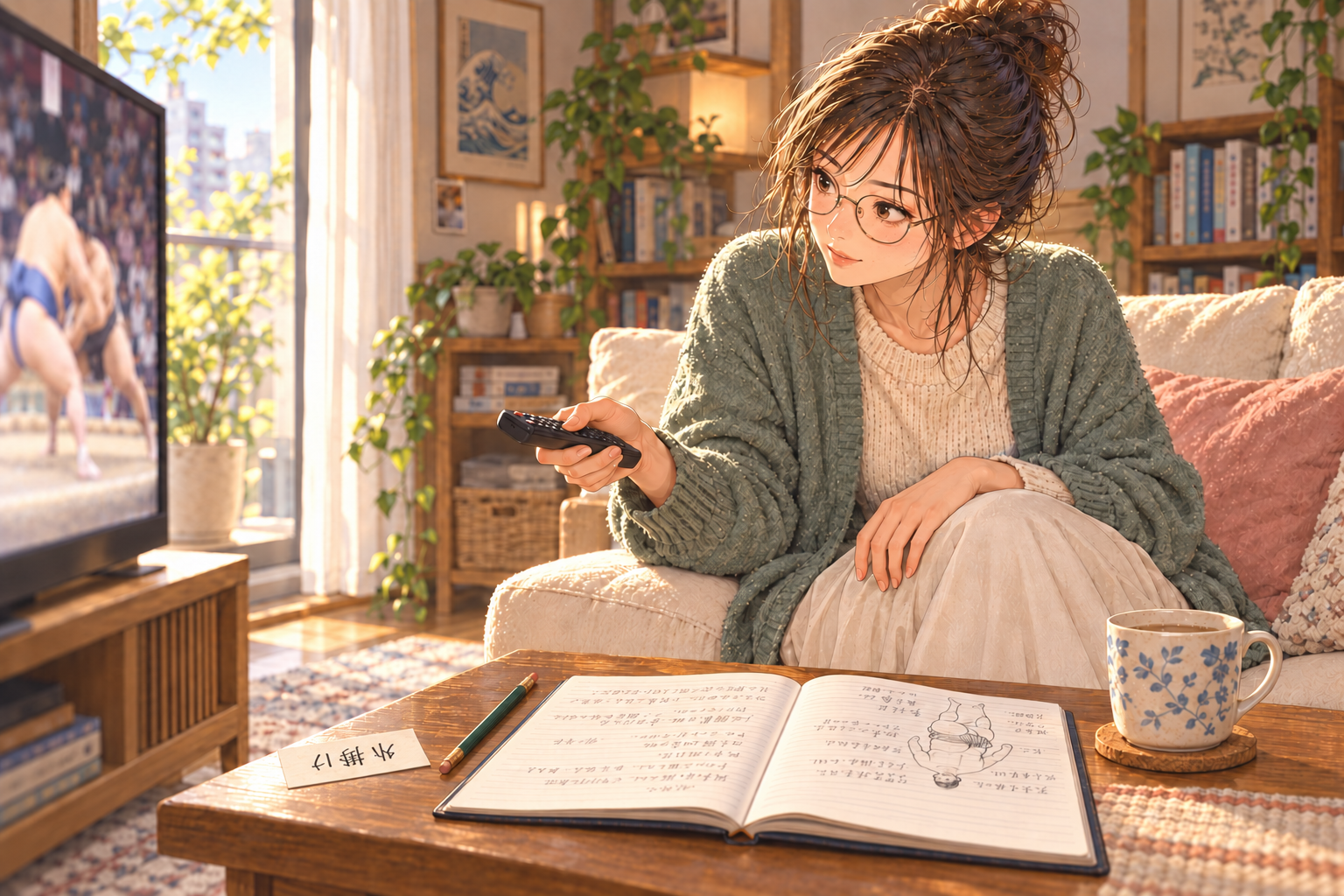
On Sunday afternoon, I put my tea at the edge of the coffee table and opened my notebook. Today I had time for Mainoumi. I kept thinking about the moment he faces Musoyama again after being held from behind. He can still come back from there? I wanted another look.
Stopping at “the smaller wrestler won” might miss the interesting part. I brought in records of other bouts, putting a defeat beside the victories. How can a similar-looking technique lead to a different ending? Once I divided the page into four spaces, I found more things I wanted to explore.
The four bouts to compare
Musoyama is our starting point. The Japan Sumo Association’s centenary feature includes this bout, chosen by an association member who had been Mainoumi’s attendant. This is an official selection with archive footage, not a fan-vote ranking.
| Tournament / day | Opponent | Mainoumi | Kimarite |
|---|---|---|---|
| July 1994 / 5 | Musoyama | Won | Sotogake |
| November 1991 / 11 | Akebono | Won | Uchigake |
| July 1994 / 2 | Takanohana | Won | Kirikaeshi |
| July 1994 / 4 | Wakanohana | Lost | Abisetaoshi |
Records: Fuji Television’s Mainoumi episode of Ōzumō Ibushigin Retsuden. In the last row, abisetaoshi is Wakanohana’s winning technique.
Musoyama: what happens after he gets behind?
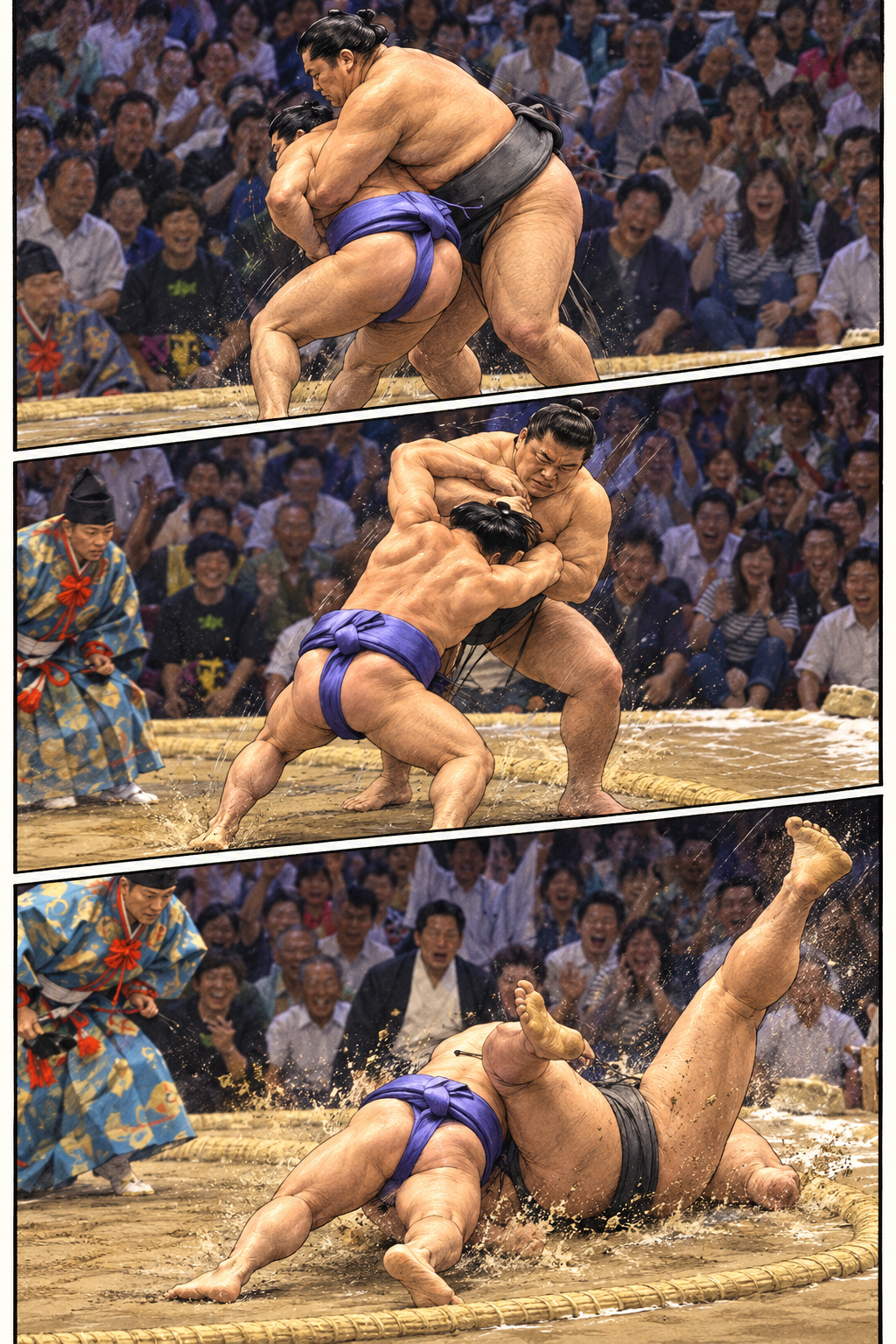
Musoyama is behind him, the larger wrestler holding him around the body. I could easily assume the contest is already decided here.
Then the orientation changes. The opponent who was behind is in front again. Even knowing the final reversal, I want to return to that transition. At what point does “this looks difficult” become “this could still change”?
In the official clip, around 0:48, Musoyama holds Mainoumi’s torso from behind. Around 0:51, they face one another again. Watching only for the final sotogake can conceal this change.
Our reading: separate regaining a facing position from executing the finish. This distinguishes a fixed condition—body size—from conditions that can change, such as orientation and position. The overlapping legs do not justify a precise claim about every foot movement. These approximate times refer to the Musoyama clip on the linked page.
The JSA guides offer a useful distinction: sotogake hooks the opponent’s leg from outside; kirikaeshi uses knee contact against the outside of the opponent’s knee, with the attacking foot remaining on the clay. That gives you a specific detail to investigate at the finish.
- First, watch the whole exchange.Choose one moment when you think the position becomes difficult.
- Next, watch the feet.Compare where both wrestlers stand and which way their bodies face before and after that moment. Leave hidden feet marked as hidden.
- Then, follow the opponent.Return to the same passage and look for a response you missed while following Mainoumi.
Open the JSA’s official footage page and find “平成6年七月場所五日目” — July 1994, Day 5. Afterwards, compare your notes with the recorded finish: sotogake.
Use just three headings: body direction, foot placement and the opponent’s response. Add one observation at a time. Each new line gives you something more precise to look for on the next viewing.
Read the three panels from top to bottom, then return to the official clip. The movements between them are the next things to look for.
Akebono: an attempted technique and a recorded finish
Mainoumi attempted mitokorozeme, but the recorded finish was uchigake. Keep those two facts separate. Consult the interview alongside the JSA’s explanation of mitokorozeme.
Make two columns: “what was attempted” and “how the bout ended.” This keeps the entire exchange from being squeezed into a single label. It also helps you check which moment your own explanation actually describes.
A question to investigate:what stays the same, and what changes, between the attempted combination and the finish? Check the contact made by the legs, hands and head separately.
Takanohana and Wakanohana: put a defeat beside a success
In the interview, Mainoumi explains embracing the opponent, falling and twisting as part of his kirikaeshi approach. The accompanying discussion describes the Wakanohana bout as a reversal of his attempt. Read the testimony and discussion.
Move from the Day 2 victory to the Day 4 defeat. Change one question in your notebook: from “How did he finish it?” to “What could his opponent still do?”
- Which way do both bodies face just before the finish?
- Does adding the opponent’s response change your first explanation?
- Can you establish the order of contact with the clay from what is visible?
Mainoumi won against Takanohana and lost against Wakanohana. Comparing them must not turn them into the same outcome. Leave a question mark where you cannot distinguish a movement, and return to the official kirikaeshi explanation.
Finish with one discovery of your own
Open a hint to compare with your notes
“Won by sotogake” records the outcome. “Faced his opponent again after being held from behind” records an intermediate observation. Keeping these on separate lines preserves more than the technique’s name.
After comparing the four records, leave three short lines in your notebook.
- Your first expectation:where you thought the bout would be decided.
- What you could establish:a visible movement or a fact stated in a source.
- Your next question:something still hidden, or worth comparing with another bout.
As the afternoon light faded, I nearly closed my notebook, then opened it again. Next time, I want to follow only the opponent. Perhaps I have been watching only the parts that first caught my eye. That thought makes the same bout feel as though it still has more to offer. I wrote it in the margin before making another cup of tea. After writing it down, I closed the notebook on my lap and looked up toward the TV, eager to watch the bout again.