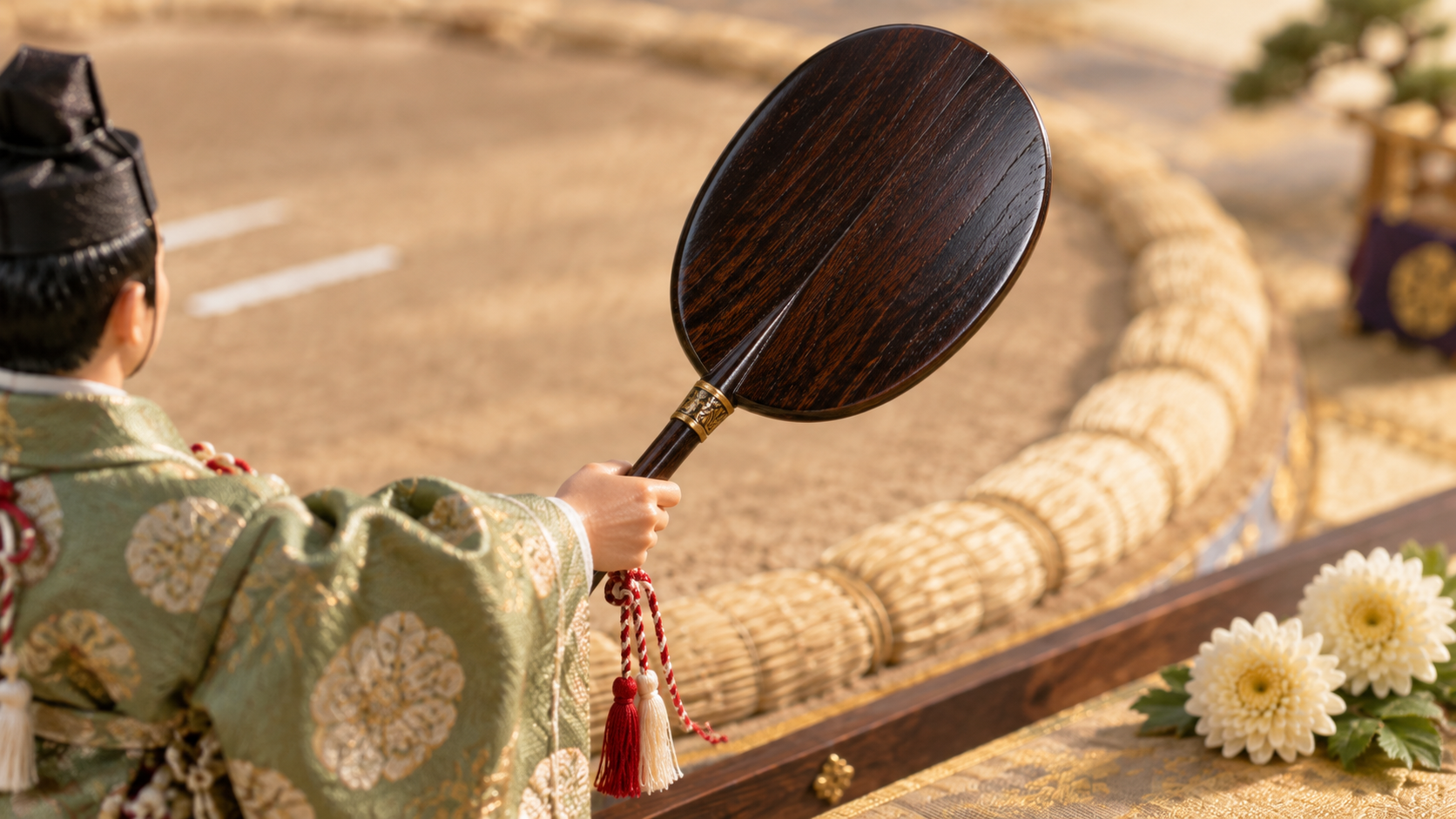
The *gunbai* is the rigid fan carried by a sumo referee, or *gyoji*. At the finish, the gyoji raises it towards the wrestler judged to have won. The Sumo Museum identifies two main silhouettes—an oval “egg” shape and a pinched “gourd” shape—and woods including rosewood, zelkova and oak. Yet the most revealing fact is not the fan’s decoration: at the edge, the gyoji is looking first for who loses.
Most of us follow the wrestler we want to win. The referee has a different task. He moves around two colliding bodies, avoids obstructing them and must still identify the first losing action. When the gunbai rises, it is the visible end of a much faster journey made by his eyes.
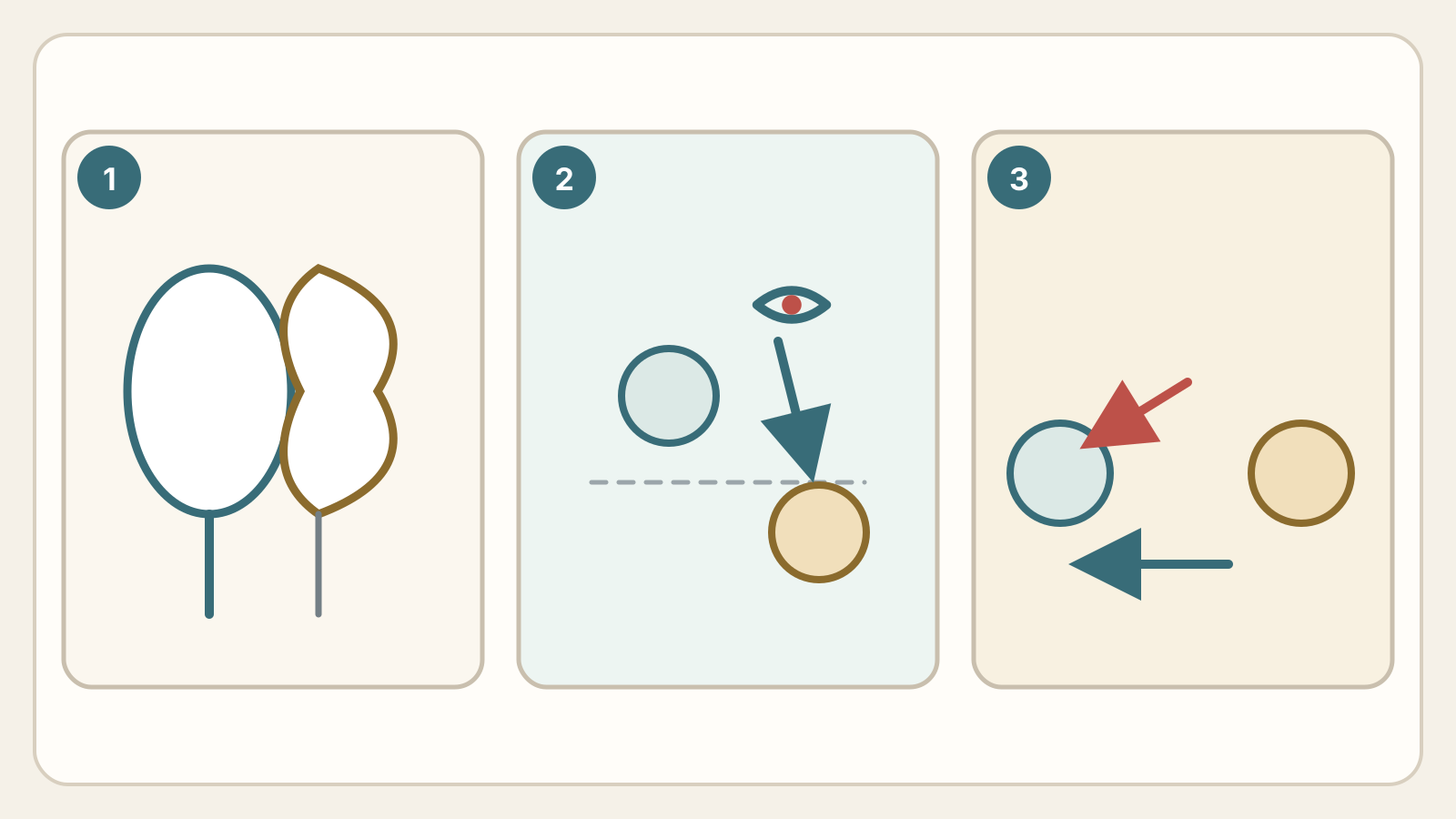
Detailed description of this diagram
Card 1 places a blank rounded paddle token beside a blank centre-pinched paddle token. They preserve only the Sumo Museum's two broad categories and copy no real proportion, handle, tassel, lettering, lacquer, wood grain or owner's design. Card 2 places two competitor circles around an abstract boundary and directs an eye cue toward one losing-state token, encoding attention rather than a bout. Card 3 gives a one-way direction cue toward the opposite circle for the winner indication. No gyoji, wrestler, body, contact order, ring geometry, camera angle, timing, sufficient judging condition or mawashi-uchiwa performance is depicted.
Graphic: SUMO ARCHAEOLOGY CLUB · Figure source 1 · Figure source 2 · Figure source 3
A fan that gives the first decision a direction
The Sumo Museum describes the gunbai as one of the gyoji’s tools and says it is raised towards the winning wrestler. After the contest, the referee also calls the winner’s ring name in the formal winner’s announcement.
For a first-time viewer, this is the easiest way to read the result before understanding the Japanese announcement. Do not try to decode every gesture. As the wrestlers separate, notice whether the fan points towards the east or west side. The decision becomes a physical direction a moment before the rest of the arena settles.
Egg-shaped or gourd-shaped—and made from different woods
An official museum object note divides gunbai outlines into two broad types. The *tamago-gata* is rounded like an egg. The *hyotan-gata* narrows in the middle like a gourd. The museum lists rosewood, zelkova and oak among the materials. Its featured fan used by the 27th Kimura Shonosuke was finished in Tsugaru lacquer.
You do not need to identify an individual referee’s fan at full speed. A replay or still photograph is enough to compare the outline. What looked like a generic prop becomes a personal working object, with choices of wood, finish, shape and tassel. It has a practical job on the dohyo and can also be read as a piece of craft.
The gyoji watches for the first loser
The Association’s explanation of refereeing at the edge turns a familiar sporting instinct upside down. Spectators tend to watch who is winning. A gyoji concentrates on which wrestler loses first. He looks for the first foot to cross the boundary or the first part of a body other than the soles to touch down, then raises the gunbai towards the other wrestler.
That perspective offers a useful viewing experiment. During a close finish, stop following only the attacking wrestler. Glance at the referee’s face and see which feet or hands he is moving to inspect. You will not acquire a professional referee’s judgment in one bout, but you can borrow the question guiding his eyes: who has already lost?
The gunbai is not casually switched mid-gesture
The Association uses the term *mawashi-uchiwa* for an old action in which a gyoji began to raise the fan to one side, realised the mistake and redirected it to the other. According to its official explanation, the board prohibited this in September 1985. If ringside judges identify the original decision as wrong, it is recorded as a referee’s reversed decision, or *gyoji sashichigae*.
This does not mean the raised gunbai can never be reviewed. Ringside judges may call a *mono-ii* and discuss a close finish. It means the gyoji himself is expected to commit to one initial direction rather than visibly change sides halfway through raising the fan. The sources establish an initial direction and the later mono-ii process; they do not establish the referee’s private feeling or pressure.
Borrow the referee’s eyes for one second
There are many details to enjoy: the colourful court costume, the call during the action, the writing or lacquer on the fan. Begin with only one. When the wrestlers approach the straw boundary, watch where the gyoji moves his head. Then look at the direction of the raised gunbai.
He is not simply dodging the wrestlers. He is searching for a line of sight to the first losing contact. The sources selected for this article do not substantiate a ring-diameter figure in this paragraph. Keep to the observable point: the gyoji changes position on the same dohyo as two moving wrestlers. Once you notice the work required before the fan rises, the winner is no longer the only person whose movement completes the bout.
Sources
- Sumo Museum, “From Banzuke Announcement to the Final Day,” including the 27th Kimura Shonosuke’s gunbai (published 18 February 2020; checked 2 September 2026)
- Japan Sumo Association, Sumo Quiz No. 1304 on what a gyoji watches at the edge (published 4 August 2025; checked 2 September 2026)
- Japan Sumo Association, Sumo Quiz No. 1019 on *mawashi-uchiwa* (published 23 October 2024; checked 2 September 2026)
- Sumo Museum, “Gyoji Costumes and Gunbai” exhibition record (2006; checked 2 September 2026)
Source links used for verification
Each link was used for the corresponding claim in this article; inclusion is not a blanket endorsement of the whole page.
Article verified:
- Sumo Museum: From banzuke announcement to the final dayHistorical primary source (record from that period)
- Japan Sumo Association Sumo Quiz No. 1304: the gyoji's view at the edgePrimary source (as checked for this article)
- Japan Sumo Association Sumo Quiz No. 1019: mawashi-uchiwaPrimary source (as checked for this article)
- Sumo Museum: Exhibition of gyoji costumes and gunbaiHistorical primary source (record from that period)