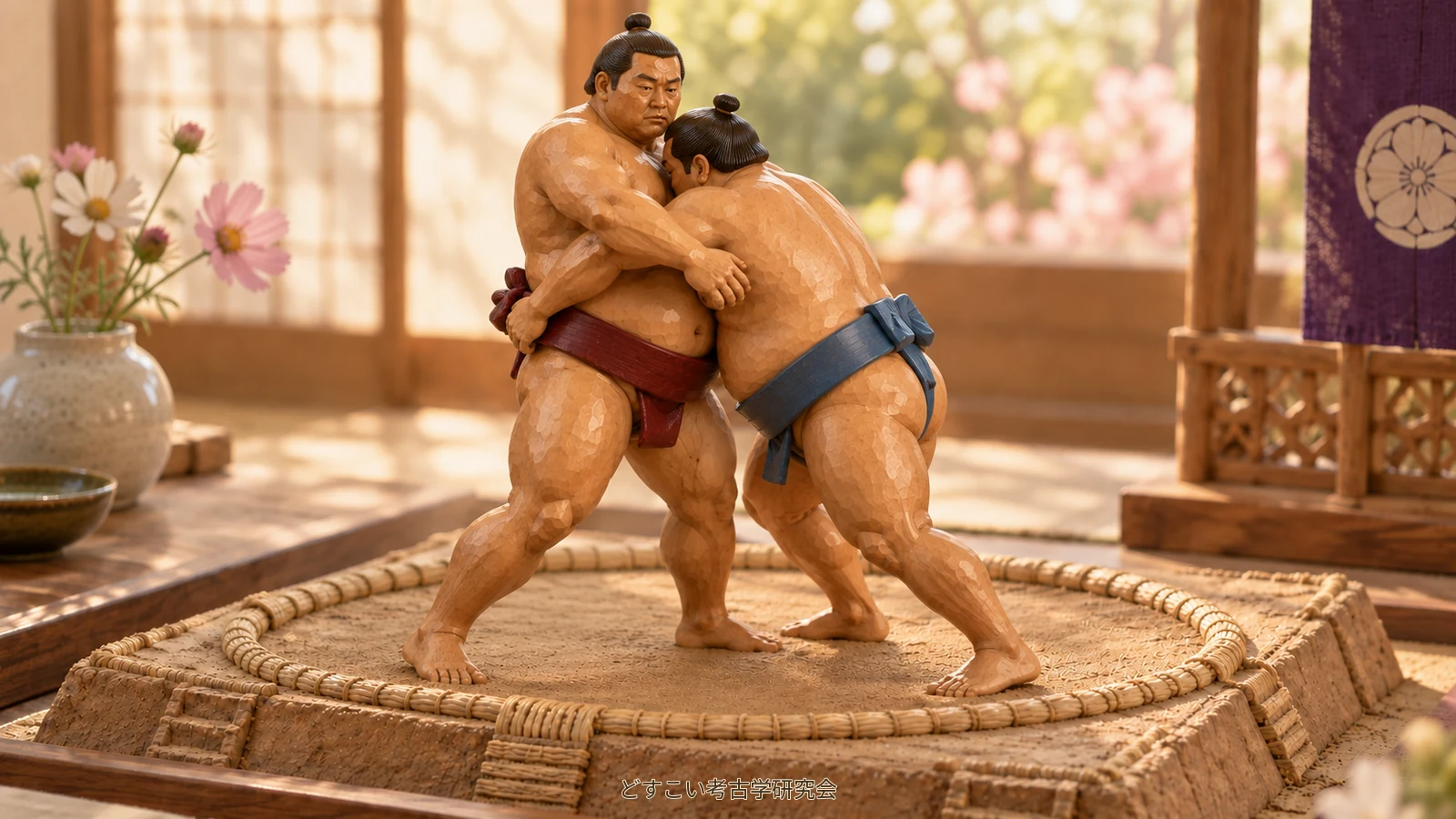
Watch the winner’s body and hands at the edge. In yorikiri, the wrestler keeps close body contact and advances forwards or sideways to carry the opponent out. In oshidashi, one or both hands press at the opponent’s chest or under the arms and drive him out. Do not decide only by whether somebody touched the belt; ask whether the finish came through close contact or hand pressure with space between the bodies.
The arena announces a kimarite after every bout. For a newcomer, “yorikiri” can arrive just after a finish that looked like pushing, producing the useful thought: what did I miss? A bout you did not classify is not a failed viewing. It is one you now have a reason to replay.
The official definitions in plain English
The Japan Sumo Association defines yorikiri as winning by keeping the body in close contact with the opponent and moving forwards or sideways until he leaves the ring. Its oshidashi definition describes placing one or both hands—often in a Y-shaped hazu hand position—against the chest or under the arms and pushing the opponent out.
Both are basic techniques in which the loser generally remains standing as he crosses the boundary. If pressure causes him to fall, the announced technique may instead be yoritaoshi or oshitaoshi. The final action matters.
A belt grip is a clue, not the complete test
Yorikiri often involves a mawashi grip, but a viewer should follow the relationship between the two bodies. Are chest and shoulder close? Is the winner bringing his hips in and walking the opponent’s centre of gravity towards the tawara? Does the pair remain connected through the step out?
In oshidashi, the winner’s hands tend to remain active at the upper body while some space stays between the torsos. Yet a bout can change shape. A wrestler may begin with thrusts, become locked chest to chest, and finish by yorikiri. The opening style does not dictate the official ending.
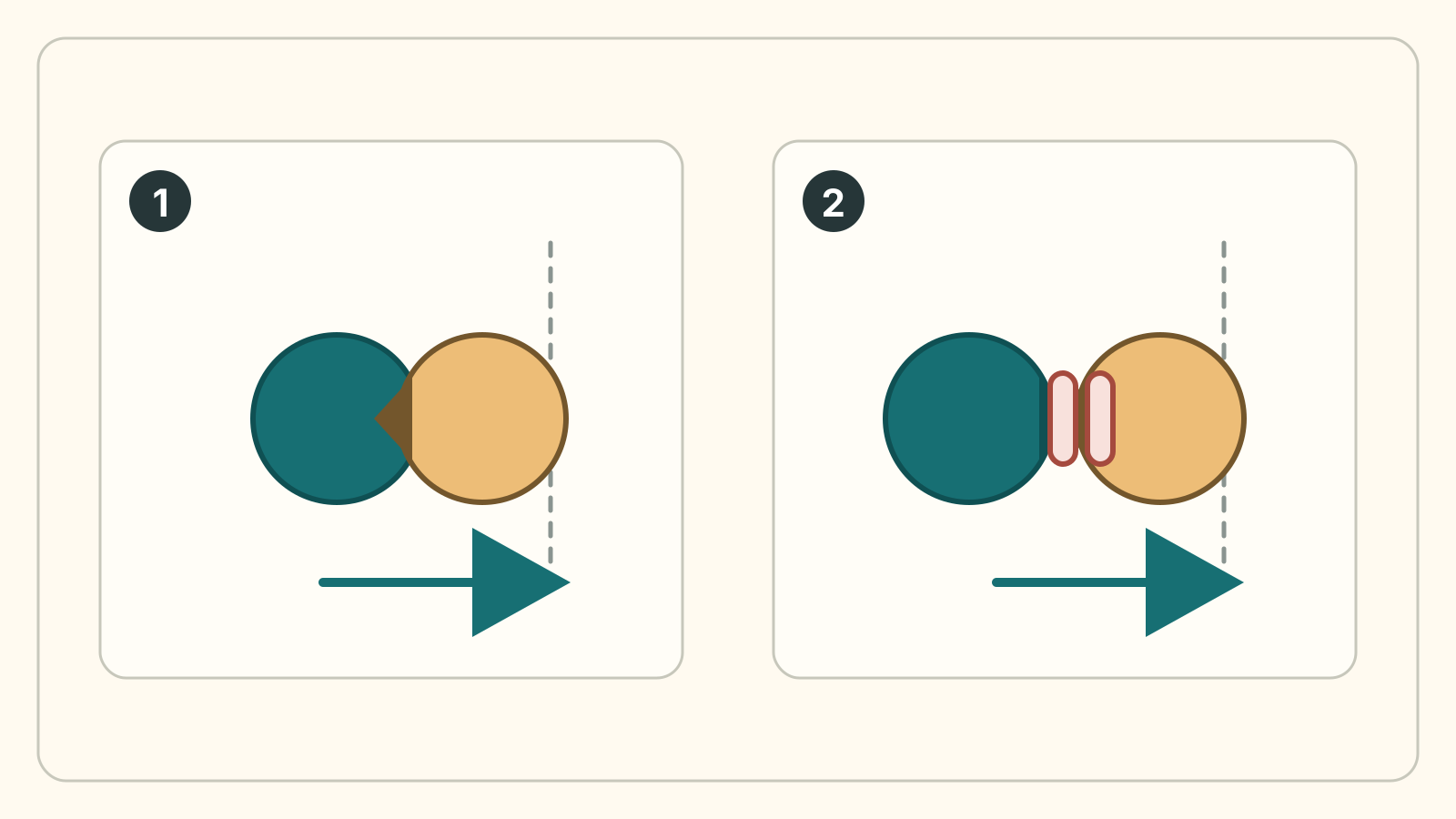
Detailed description of this diagram
Card 1 places blue and gold circular competitor tokens in contact and gives the pair one direction of advance, abstracting only the official yorikiri conditions of close body contact and forward or sideways movement. Card 2 separates the tokens and puts two red contact bars between them, with an advance arrow, abstracting the official oshidashi hazu push at the chest or underarm without drawing hands or bodies. A dashed line is an abstract boundary. Token size, gap, contact-bar position or number, and arrow length are neither measurements nor judging conditions. A real bout can change form before the finish, so the decisive sequence and official result remain necessary.
Graphic: SUMO ARCHAEOLOGY CLUB · Figure source 1 · Figure source 2
Together, they account for about half of the official sample
The Association’s pages currently analyse 190,450 bouts from January 2013 through the final day of July 2026. Oshidashi ranks first with 47,936 wins, or 25.2 percent. Yorikiri ranks second with 47,473, or 24.9 percent. The displayed percentages total 50.1 percent.
You therefore do not need all 82 recognised techniques before most bouts become more legible. Learning this pair creates an observation in roughly half of the current sample. The statistics and named wrestler rankings can change, so we review them with later data updates.
Follow distance from the tachiai
For the next bout, watch only three transitions:
- Do the hands keep the opponent away at chest level?
- Do the torsos close and stay connected?
- At the tawara, does the winner keep space or carry the opponent out chest to chest?
This reveals a contest before the named technique. One bout may keep hand pressure and separation to the edge; another may change into close contact before the exit. “Oshidashi or yorikiri?” becomes “Which relation was visible at the decisive instant?” without assigning an unspoken preference or plan.
The feet may tell you before the hands do
On an effective oshidashi, the winner’s legs continue to drive under the hand pressure; it is not simply an arm shove. In yorikiri, small advancing steps preserve balance while moving another person’s weight. Watch the feet for one bout and the familiar finish gains texture.
Kimarite are labels for the decisive action, not scores for how interesting a match was. Their value for a beginner is that a one-word announcement sends your eyes back into the previous seconds. When you recognise the finish just before the voice names it, the dohyo has started to speak a language you can hear.
Evidence limits and event-day fallback
Confirmed fact: The Association describes yorikiri as close body contact while advancing forwards or sideways to take the opponent out, and oshidashi as one or both hands at the chest or underarms pushing him out. Counts belong to their displayed period.
What remains unknown: Close contact, hands and touch order at the decisive instant may be hidden. A belt grip or torso gap alone cannot settle a knockdown, another technique, either wrestler’s intention or physical condition.
Reasoned inference: Comparing late-bout body contact with the visible hand action can support a prediction. Confidence is medium; ‘space equals oshidashi’ is not a necessary-and-sufficient rule.
Editorial suggestion: Follow changing distance from the tachiai, but check the decisive phase and official result for the answer. This is not a substitute for judging, coaching or physical assessment.
Fallback: If hands or body relation are hidden, do not force the binary choice; record the resemblance and check the official kimarite.
Sources
- Japan Sumo Association, kimarite explanation for yorikiri (checked 2 September 2026)
- Japan Sumo Association, kimarite explanation for oshidashi (checked 2 September 2026)
- Japan Sumo Association, list of 82 kimarite (checked 2 September 2026)
Source links used for verification
Each link was used for the corresponding claim in this article; inclusion is not a blanket endorsement of the whole page.
Article verified:
- Japan Sumo Association kimarite: yorikiriPrimary source (as checked for this article)
- Japan Sumo Association kimarite: oshidashiPrimary source (as checked for this article)
- Japan Sumo Association list of 82 kimaritePrimary source (as checked for this article)