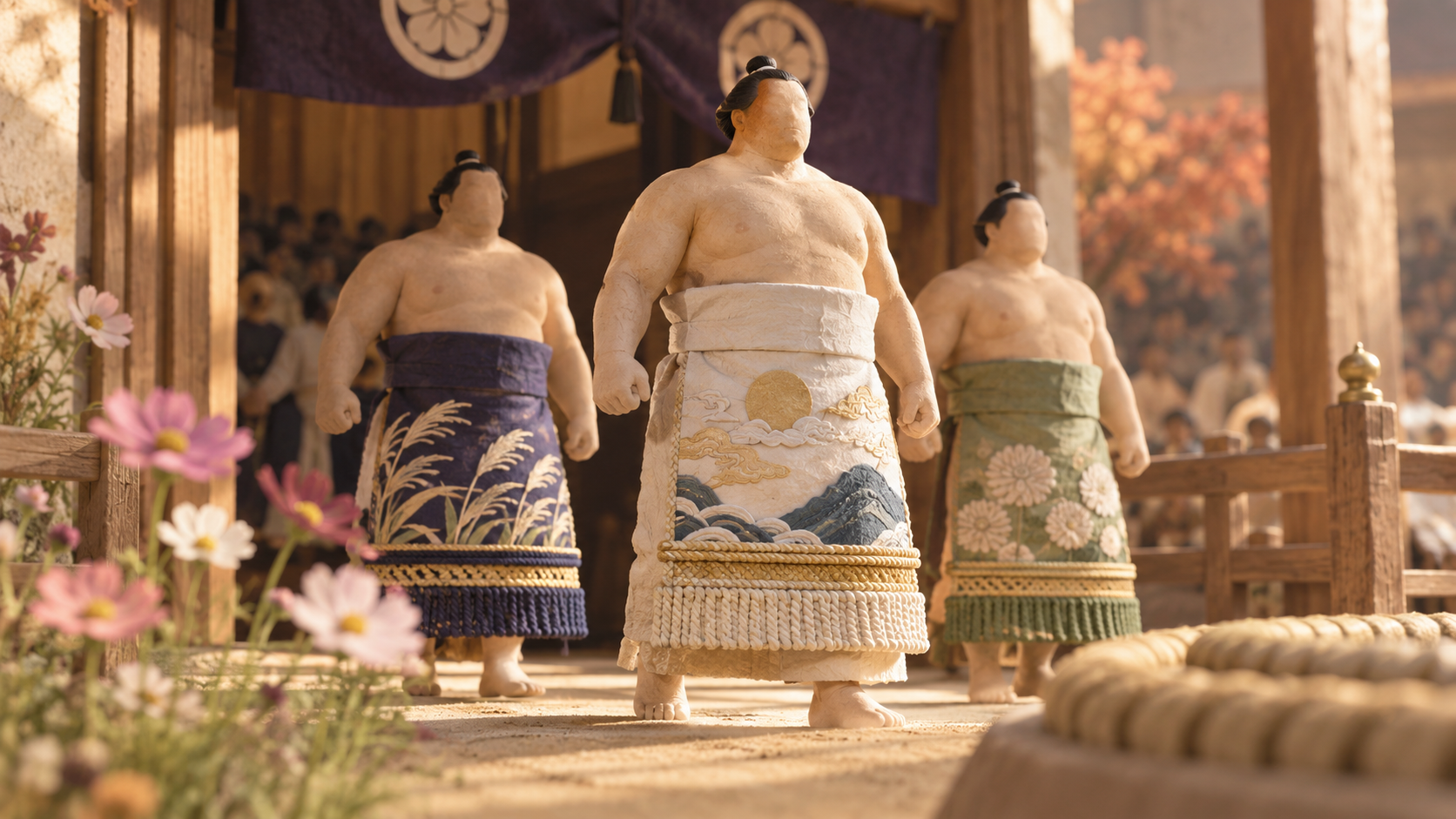
Makuuchi is professional sumo’s top division; juryo is the division immediately below it. Even if you mainly want to see famous top-division wrestlers, try to be in your seat before the juryo ring-entering ceremony. Juryo is not an opening act. It is the first rank at which a wrestler is recognised as a sekitori, and watching that threshold makes the later makuuchi session mean much more.
The printed banzuke runs downwards from makuuchi to juryo and then makushita. A tournament day travels in the opposite direction. Lower divisions compete first, and the programme climbs towards juryo and makuuchi. The arena effectively reads the ranking sheet from the bottom upwards for you.
Juryo is the doorway to sekitori status
Juryo’s formal name is *jumaime*. A checked historical Japan Sumo Association explainer describes 14 wrestlers on each side—28 in total—at its publication point and calls juryo and makuuchi wrestlers sekitori. From juryo, wrestlers use decorative kesho-mawashi in the division ring entrance. Do not write that every wrestler necessarily has an oicho topknot without checking individual hair conditions; recheck the current headcount in the latest banzuke.
That means the boundary between makushita and juryo is more than one line on a chart. The Association also explains that the juryo ring entrance takes place while five makushita bouts remain. During those bouts, the juryo wrestlers change from their ceremonial aprons into the belts used for competition. The action has not stopped; two levels of the sumo world are briefly moving at once.
Makuuchi is the top division, not a separate story
Makuuchi contains yokozuna, ozeki, sekiwake, komusubi and maegashira. It brings the leading names and the most visible championship race, so it is understandably the target for many visitors. Yet arriving only for makuuchi can make every wrestler look like a star who appeared fully formed.
Juryo contains newcomers experiencing sekitori status for the first time as well as established wrestlers trying to return to makuuchi. Choose one new juryo wrestler or one wrestler seeking a return to makuuchi from the current official banzuke, then follow only when the name appears on that day’s official schedule. Makuuchi is a possible future destination, not a forecast before the next banzuke is published.
Watch the transition, not a fixed clock time
Exact timings change by tournament day and with the running order, so check the Association’s official day schedule shortly before your visit. The useful sequence is simpler: juryo ring entrance, juryo bouts, nakairi with the makuuchi and yokozuna ring entrances, then makuuchi bouts.
Nakairi is not an interval halfway through makuuchi. The Association defines it as the break after the juryo bouts and before the makuuchi bouts. It normally includes the makuuchi and yokozuna ring entrances and a change of ringside judges. If you have already watched juryo, you see two ceremonial circles of kesho-mawashi and feel the colour and sound in the building rise by stages.
That sequence is a planning frame, not a guarantee that every element appears at the same clock time or looks the same each day. What is visible may vary with the running order, whether a yokozuna entrance applies, your seat angle, standing spectators and the television or stream camera. Missing it is not a failed visit: check the official day schedule and rejoin at either the juryo bouts or the makuuchi ring entrance. The useful story survives even when one visual moment does not.
Choose one wrestler at the boundary
You do not need to memorise 28 juryo names. Pick one newcomer, one wrestler seeking a return to makuuchi, or one highly ranked juryo wrestler whose next banzuke position is uncertain. Watch how he is introduced in the ring entrance, then watch his bout. That single thread is enough.
Staying from juryo into makuuchi gives you more than a longer day. The banzuke starts to look like human movement. If you find yourself searching for that unfamiliar name when the next ranking sheet is released, juryo has already done its quiet work.
Sources
- Japan Sumo Association, “A tournament day in Tokyo” and quizzes No.27, No.1010, No.1317 and No.1264 (verified 2 September 2026).
Source links used for verification
Each link was used for the corresponding claim in this article; inclusion is not a blanket endorsement of the whole page.
Article verified:
- Japan Sumo Association: A tournament day in TokyoPrimary source (as checked for this article)
- Japan Sumo Association quiz No.27: juryo and jumaimeHistorical primary source (record from that period)
- Japan Sumo Association quiz No.1010: the juryo ring entranceHistorical primary source (record from that period)
- Japan Sumo Association quiz No.1317: when the juryo ring entrance occursHistorical primary source (record from that period)
- Japan Sumo Association quiz No.1264: nakairiHistorical primary source (record from that period)