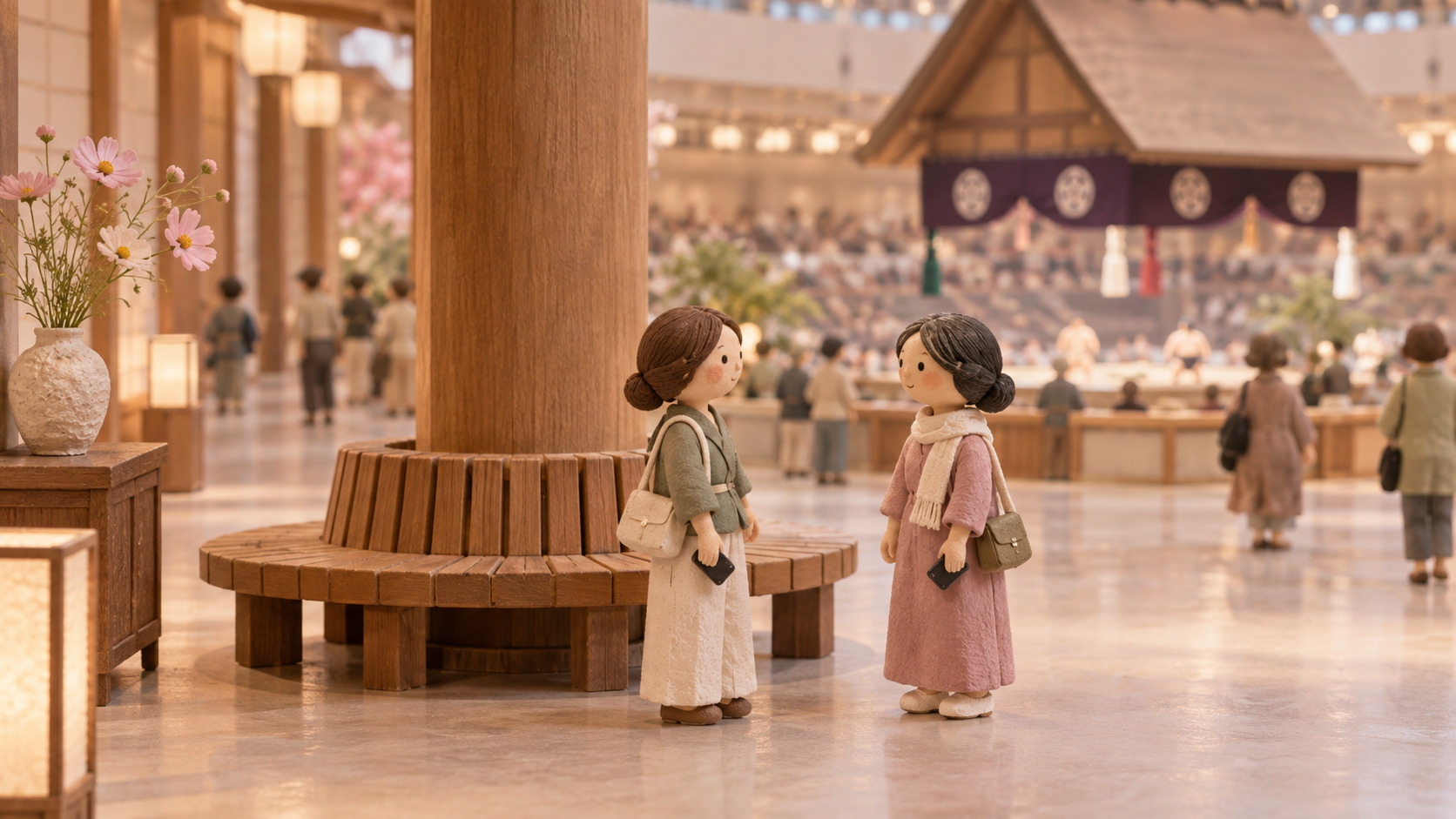
Before entering, give every visitor their own valid ticket, record each seat, and agree on one precise meeting place and one meeting time. Mobile reception can vary with location, crowding, network and device, so this guide does not promise signal, public Wi-Fi or a charging point inside Ryogoku Kokugikan. The useful plan is the one that still works when a message does not.
Sumo creates natural reasons to separate. One person follows the aroma of yakitori, another goes to the restroom, and somebody else notices a ceremonial apron across the concourse. “I will text you” sounds complete until a phone battery expires, roaming data fails or thousands of visitors try their networks at once. You do not need to predict which failure will occur. You need three shared decisions.
1. Do not leave every QR ticket on one phone
For the September 2026 tournament, the Japan Sumo Association says that a group using QR tickets must transfer the tickets to each member before arrival. An undistributed ticket, a screenshot or a printed QR code will not be accepted for entry. Complete the transfer in advance and ask every person to open the live ticket on the device they will actually carry.
Once inside, each person should also know the ticketed seat: seat type, side of the arena, row or box and number. A small paper note is useful if a phone dies. It is not a substitute admission ticket, but it can help an attendant guide a separated visitor back to the correct section. Our September QR ticket guide covers the entry rules, while the small-bag and phone-power checklist keeps preparation proportionate. No special gadget is required.
2. Point to a real meeting place after you arrive
“Near the main entrance” and “outside the shop” are not precise in an unfamiliar arena. After everyone has entered, walk past a possible landmark together and point to the same sign, named counter or numbered feature. Ask an attendant whether waiting there would obstruct movement. We have not found an official fixed lost-person meeting point for the September tournament, so this article does not invent one from an old map.
Never choose an aisle, staircase, doorway, exit or evacuation route. The Association’s spectator contract requires visitors to follow staff instructions and prohibits watching from passages and other non-seating areas. A meeting point must yield immediately if staff redirect the crowd.
For children or a companion who needs support, the safer plan may be no independent wandering at all. If separation nevertheless happens, teach the person to remain in a safe staffed area, show the seat note to an identifiable attendant and avoid leaving the building alone.
3. Agree on a time and what happens next
A place without a time creates a loop: one visitor reaches the landmark while the other has gone back to the seats. Use one complete sentence, such as: “If messages fail, we meet by the landmark at each hour, wait ten minutes, and then return to our ticketed seats.” Choose intervals that suit your group rather than copying that example blindly.
Tokyo’s September notice allows re-entry only once per day and requires the ticket stub to be carried. Do not spend that allowance by leaving the arena to search without first speaking to staff. Start with your seat, the agreed internal landmark and an attendant. The First Visit hub puts these decisions into the wider order of an unfamiliar sumo day.
An emergency cancels the ordinary rendezvous
This meeting plan is for an ordinary separation in a busy venue. During an earthquake, fire alarm or instructed evacuation, do not push against the flow to reach your chosen landmark. Follow announcements and staff directions; the live situation outranks your private arrangement and any online map. Read the Kokugikan emergency route guide before the visit for that different scenario.
The Tokyo Metropolitan Government describes carrier-operated disaster message boards as one option for checking safety during a disaster. Availability and use depend on the current carrier service. It is a backup, not a reason to ignore arena instructions.
When you reunite, trade one tiny discovery
There is no need to turn a ten-minute separation into the story of a ruined day. Ask what the other person saw. Perhaps a yobidashi’s voice travelled farther than expected, a wrestler repeated one careful pre-bout movement, or a kesho-mawashi carried an animal nobody else noticed. A no-signal plan does more than prevent panic: it gives everyone enough confidence to look around, then return with one new piece of sumo to share.
Use different rules for a child, a dead battery and an emergency
Confirmed fact: September guidance requires QR tickets for a group to be distributed before entry and allows re-entry once per day.
What remains unknown: Indoor signal, charging facilities and a fixed official lost-person meeting point are not guaranteed by the sources checked.
Reasoned inference: Combining ticket distribution and one re-entry suggests that concentrating tickets and communication on one phone makes one device failure affect the whole group. This concerns dependency, not signal strength. Updated official operation would overturn it.
Editorial suggestion: Do not ask a child or person needing support to navigate alone to the rendezvous; agree that they stay put and show the seat note to staff. This is practical advice, not an arena rule.
Fallback: Wait only for the agreed interval, then return to the seat or staff point. During an earthquake or fire, cancel the rendezvous and follow announcements and staff.
Sources
- Japan Sumo Association, September 2026 Tokyo spectator notice (checked 3 September 2026)
- Japan Sumo Association, spectator contract (checked 3 September 2026)
- Tokyo Metropolitan Government, disaster terminology and emergency message-board guidance (checked 3 September 2026)
Source links used for verification
Each link was used for the corresponding claim in this article; inclusion is not a blanket endorsement of the whole page.
Article verified:
- Japan Sumo Association September 2026 Tokyo spectator noticePrimary source (as checked for this article)
- Japan Sumo Association spectator contractPrimary source (as checked for this article)
- Tokyo Metropolitan Government disaster terminology and emergency message-board guidancePrimary source (as checked for this article)