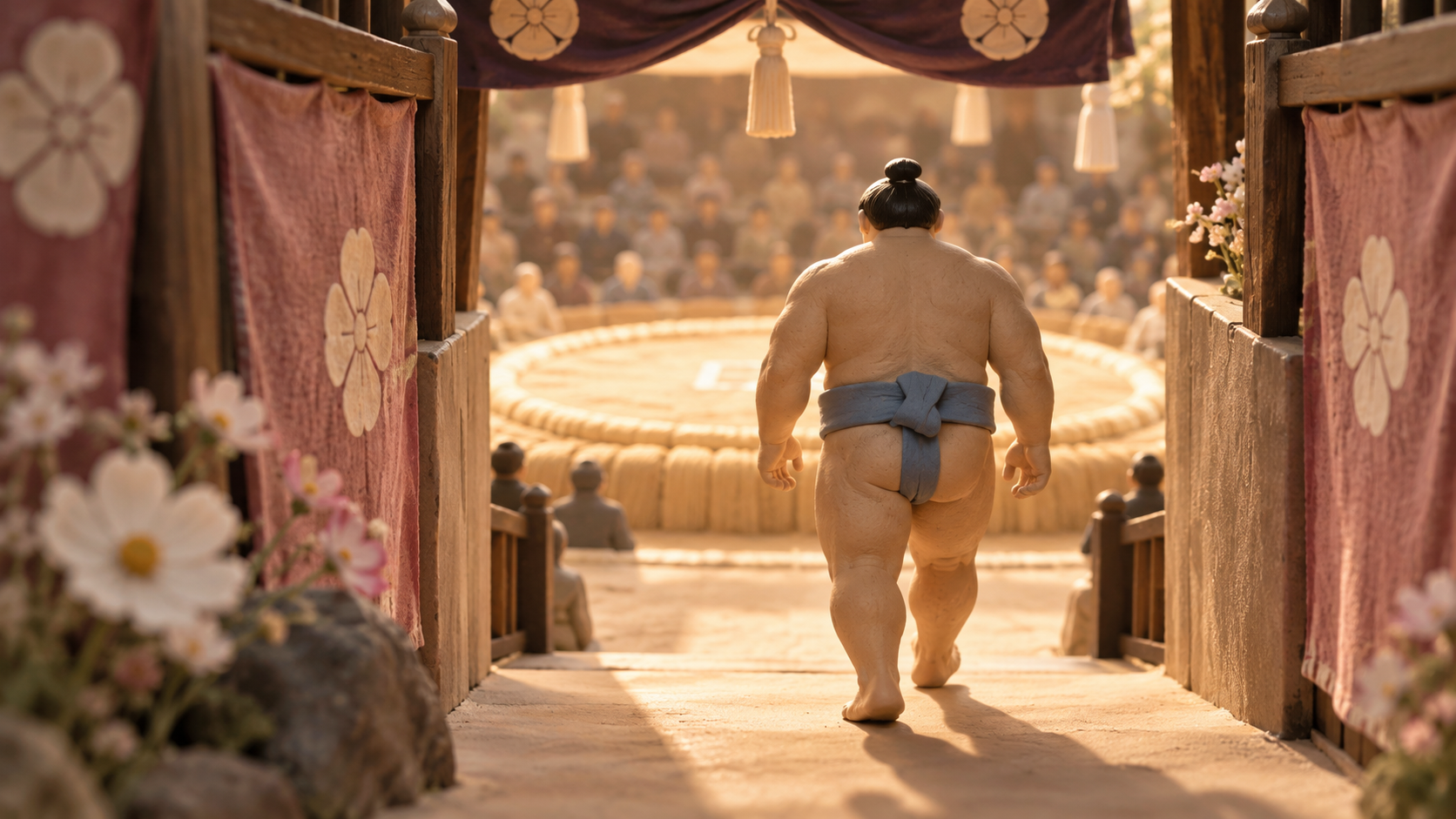
Komusubi sits below sekiwake and above the numbered maegashira positions in makuuchi. The Japan Sumo Association ordinarily groups ozeki, sekiwake and komusubi as *sanyaku*, so komusubi is a named championship-division rank rather than “Maegashira 0.” The official sources checked here do not say that every winning record produces automatic promotion to sekiwake or that a komusubi must use one prescribed style. Locate the rank first; in the next bout, watch only whether the wrestler reaches a preferred position immediately after the tachiai.
The word *komusubi* can look like one more unfamiliar label to memorise. On the actual banzuke, however, it is a hinge. Above it are sekiwake and the senior ranks; below it begins the long numbered run of maegashira. Once you spot that hinge, an upper-division bout carries a little more narrative without requiring a spreadsheet.
Komusubi is between sekiwake and maegashira
The makuuchi order is yokozuna, ozeki, sekiwake, komusubi and maegashira. Maegashira positions have numbers—first, second and so on—on the East and West sides. Komusubi is printed as a rank name without one of those maegashira numbers.
The Association’s September 2026 banzuke topics identify Hakunofuji as a new komusubi and Daieisho as returning to komusubi. These are current examples, not permanent occupants. The next banzuke can change the names and the East–West arrangement. A biography that says “highest rank: komusubi” also records a career high; it does not prove the wrestler holds komusubi today.
Komusubi belongs to sanyaku in the ordinary use of the word
Association quiz No.701 explains that ozeki, sekiwake and komusubi are ordinarily called sanyaku, while yokozuna is now treated separately. The same page warns us, indirectly, not to make the label too rigid: in some treatment and administrative contexts, sanyaku means sekiwake and komusubi without ozeki. The final-day *sanyaku soroibumi* is an event name with its own context and can feature yokozuna.
For a visitor hearing the word for the first time, the safest move is simple: use “sanyaku” as a group clue, then read the wrestler’s exact position on the official banzuke.
A winning record is not presented here as an automatic sekiwake ticket
It is easy to turn the banzuke into a board game: win at komusubi, move exactly one square to sekiwake. The official banzuke and explanatory sources used for this article do not publish such a one-result automatic formula. The rank becomes a current fact when the Association publishes the new banzuke and its topics.
Quiz No.718, for example, celebrated Ura’s promotion to new komusubi when that banzuke was announced. It is a useful historical case, not a rule promising the same outcome after every superficially similar record. Results matter, but readers should not fill in an unpublished future rank by themselves.
“Komusubi-like sumo” is an opinion, not a rule in these sources
Commentators and supporters may praise forceful forward movement as worthy of sanyaku, or judge how a komusubi performs against higher-ranked opponents. Those are legitimate evaluations. They should not be rewritten as a formal requirement that every komusubi use the same kimarite or tactical shape.
One komusubi may push, another may seek the belt, and another may create an angle. Keeping rank rules separate from aesthetic expectations leaves room to notice the wrestler rather than merely test a stereotype.
Watch the first position the wrestler tries to claim
In the next komusubi bout, pause the promotion calculations for one exchange. Immediately after the tachiai, does the wrestler place hands on the opponent’s chest, reach a belt, or shift the contest off the centre line? That first claimed position is often easier for a beginner to follow than every hand movement. It is our viewing prompt, not a promotion criterion.
After the bout, return to the official banzuke and look one line above and below komusubi. Moving between a few seconds of contact and the slower architecture of the rankings makes the title memorable. Komusubi stops being a vocabulary test and becomes a place where a particular wrestler is trying to make the next bout look like their own sumo.
Sources
- Japan Sumo Association, September 2026 banzuke and banzuke topics, and quizzes No.701 and No.718 (verified 3 September 2026).
Source links used for verification
Each link was used for the corresponding claim in this article; inclusion is not a blanket endorsement of the whole page.
Article verified:
- Japan Sumo Association September 2026 banzukePrimary source (as checked for this article)
- Japan Sumo Association September 2026 banzuke topicsPrimary source (as checked for this article)
- Japan Sumo Association quiz No.701: the scope of sanyakuHistorical primary source (record from that period)
- Japan Sumo Association quiz No.718: an official new-komusubi exampleHistorical primary source (record from that period)