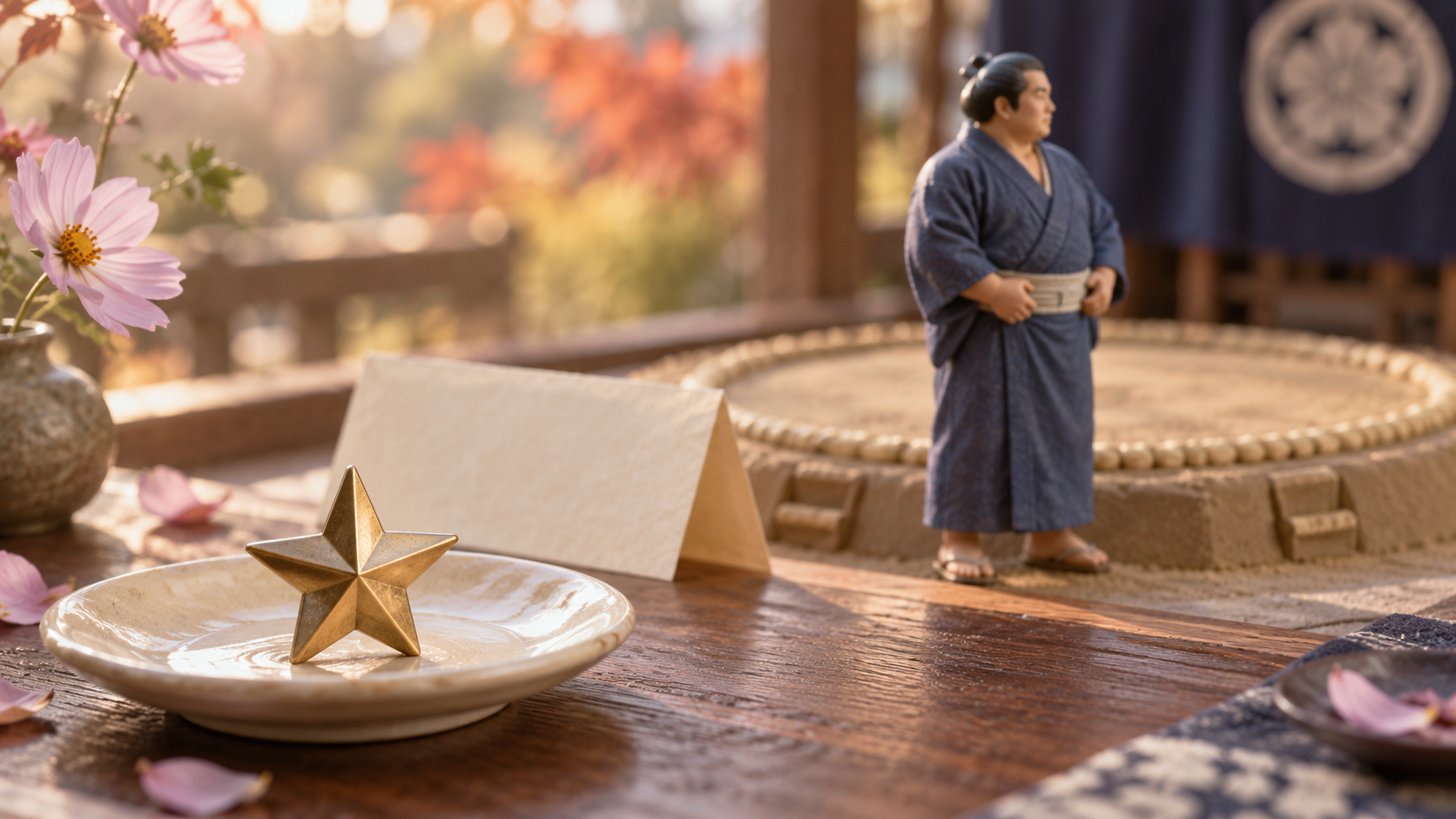
Maegashira is the makuuchi rank below komusubi, arranged by number on the East and West sides of the banzuke. *Hiramaku* is the group term for top-division wrestlers outside yokozuna and sanyaku. According to the Japan Sumo Association, only hiramaku wrestlers can earn a *kinboshi* for a win over a yokozuna—and even a hiramaku win over a yokozuna in a championship playoff is not a kinboshi. Before the next possible upset, check the rank line first.
The maegashira section is long enough to look like “everyone else” to a new viewer. Yet it is precisely here that the word *kinboshi*, literally “gold star,” becomes relevant. One numbered line on the banzuke can turn into the bout everybody remembers.
Maegashira begins below komusubi and uses numbers
Makuuchi runs from yokozuna through ozeki, sekiwake and komusubi to maegashira. Within maegashira, positions are numbered and divided between East and West. At the same number, East is listed ahead of West, so the reading order begins East Maegashira 1, West Maegashira 1, East Maegashira 2 and West Maegashira 2.
A smaller number marks a higher place on that tournament’s banzuke. It is not a permanent ability score. The Association’s September 2026 topics identify Asasuiryu and Toshinofuji as new makuuchi entrants. “New to makuuchi” records a career milestone; it does not guarantee that either wrestler will keep the same numbered position on the next banzuke.
Maegashira is the printed rank; hiramaku is a useful group term
The official banzuke prints maegashira as the individual rank. Hiramaku groups together makuuchi wrestlers outside yokozuna and the three sanyaku ranks. Association quiz No.1285 states the scope in its explanation of kinboshi: a hiramaku wrestler is a makuuchi wrestler other than yokozuna or sanyaku.
So an article can call a numbered maegashira a hiramaku wrestler without moving that person into a different division. Use maegashira when you need the exact number and side; use hiramaku when the distinction from the named senior ranks is the point.
Not every impressive yokozuna upset is called a kinboshi
Quiz No.1285 says that only hiramaku wrestlers can earn a kinboshi. A komusubi, sekiwake or ozeki can defeat a yokozuna in a major upset, but that win is not a kinboshi in this terminology. A supporter may use “gold-star performance” figuratively; the record term has a narrower scope.
There is also a context limit. Association quiz No.1441 explains that even if a hiramaku wrestler defeats a yokozuna in a championship playoff, it does not become a kinboshi. A sentence saying only “a maegashira beat a yokozuna” therefore lacks one necessary check: was this a regulation tournament bout rather than the playoff? This guide does not extend into pay increments or other details not established by the cited pages.
A number does not prescribe a wrestling style—or tomorrow’s opponent
It is tempting to treat upper maegashira as one tactical species and lower maegashira as another. The rank sources used here prescribe no single kimarite for maegashira. Nor should a reader infer an exact future opponent from the banzuke alone; the official daily torikumi is the place to confirm the pairing.
Think of the number as an address for following a wrestler, not an answer sheet describing how the bout must unfold. A pusher, belt fighter and angle-maker can all appear in the maegashira lines.
Before a yokozuna bout, look at the rank caption for one second
If the official torikumi pairs a maegashira with a yokozuna, look at the rank display before the tachiai. Note the number and East or West side. Should the upset happen in the regulation bout, the word kinboshi will now have an exact reason to appear; if the context is a playoff, you will know why the label changes.
On a day without a yokozuna pairing, that small rank check still gives you a thread through the tournament. Follow one maegashira from the opening day and let the wins, losses and styles collect around a single banzuke address. The long block of numbers stops being visual clutter. It becomes a map containing far more possible favourite wrestlers than you expected.
Sources
- Japan Sumo Association, September 2026 banzuke and banzuke topics, and quizzes No.27, No.1285 and No.1441 (verified 3 September 2026).
Source links used for verification
Each link was used for the corresponding claim in this article; inclusion is not a blanket endorsement of the whole page.
Article verified:
- Japan Sumo Association September 2026 banzukePrimary source (as checked for this article)
- Japan Sumo Association September 2026 banzuke topicsPrimary source (as checked for this article)
- Japan Sumo Association quiz No.1285: which rank can earn a kinboshiHistorical primary source (record from that period)
- Japan Sumo Association quiz No.1441: playoffs do not award a kinboshiHistorical primary source (record from that period)
- Japan Sumo Association quiz No.27: history of the maegashira labelHistorical primary source (record from that period)