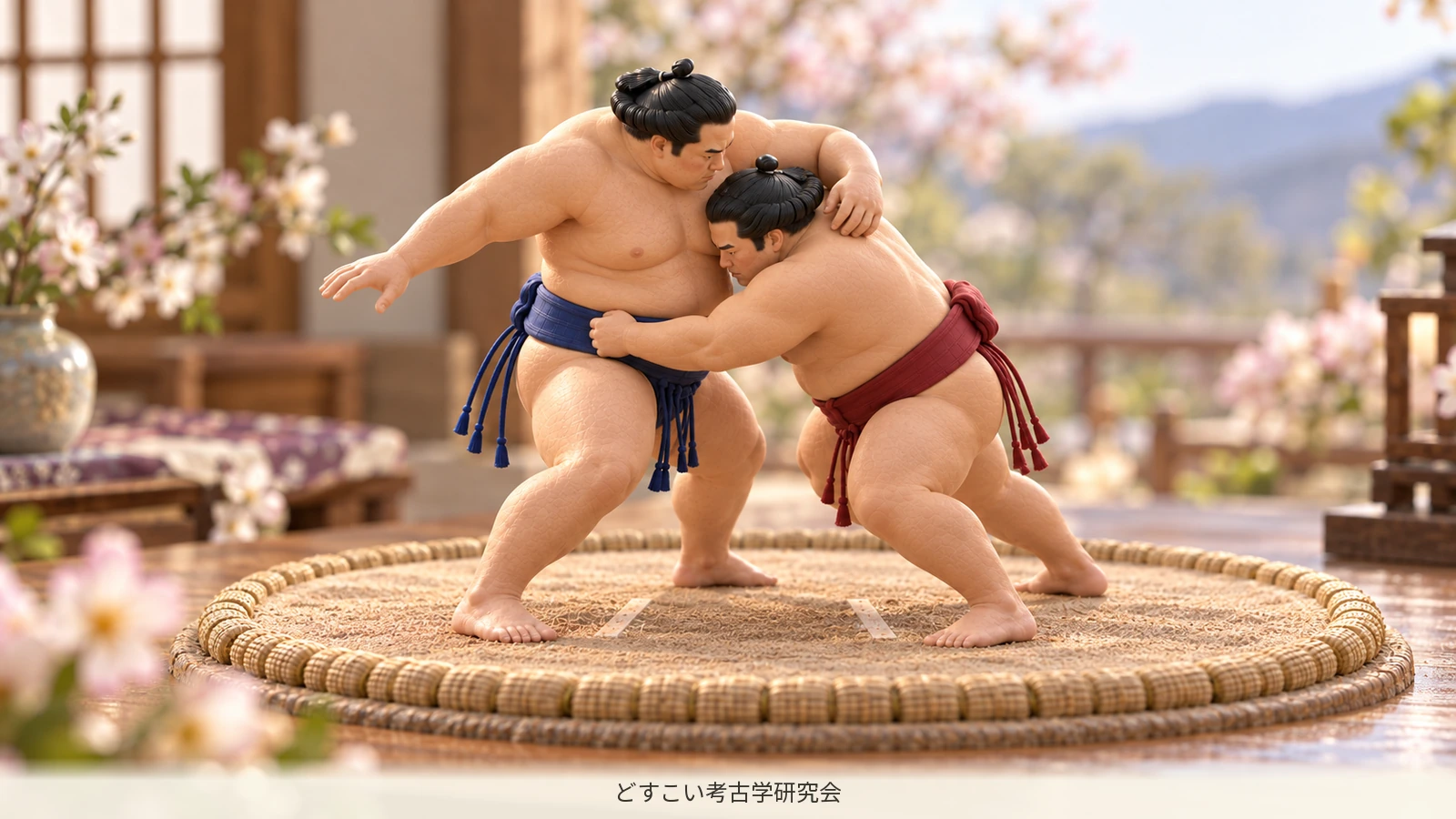
Kubinage is made by wrapping either arm around the opponent’s neck, bringing the hips into the action and twisting the body so the opponent is wound into the throw. A single frame showing an arm around the neck does not separate it from kubihineri. In the next bout, once you find the neck-wrapping arm, move your eyes down: did the winner bring in his hips and turn his whole torso through the throw?
Near the edge, two bodies overlap, an arm appears across a neck, and the picture turns upside down. Kubinage can look like an arm-powered rescue. The Japan Sumo Association’s definition sends us to a less obvious place. The hips and the body turn belong to the technique too. Follow the name downwards and the throw becomes a full arc rather than one frightening grip.
The official definition has three connected parts
The Association describes kubinage as wrapping the opponent’s neck with either hand, putting the hips into position and twisting the body while winding the opponent into a throw.
Its official page also gives a characteristic situation. A wrestler may use it as a last-resort reversal after allowing the opponent *morozashi*—both of the opponent’s arms inserted inside—being unable to reach the mawashi and getting driven towards the boundary. This is helpful context, not a rule that every kubinage must begin in that exact situation.
For identification, stay with the actual finish: an arm around the neck, hip involvement and a body twist that wraps the opponent into the throw.
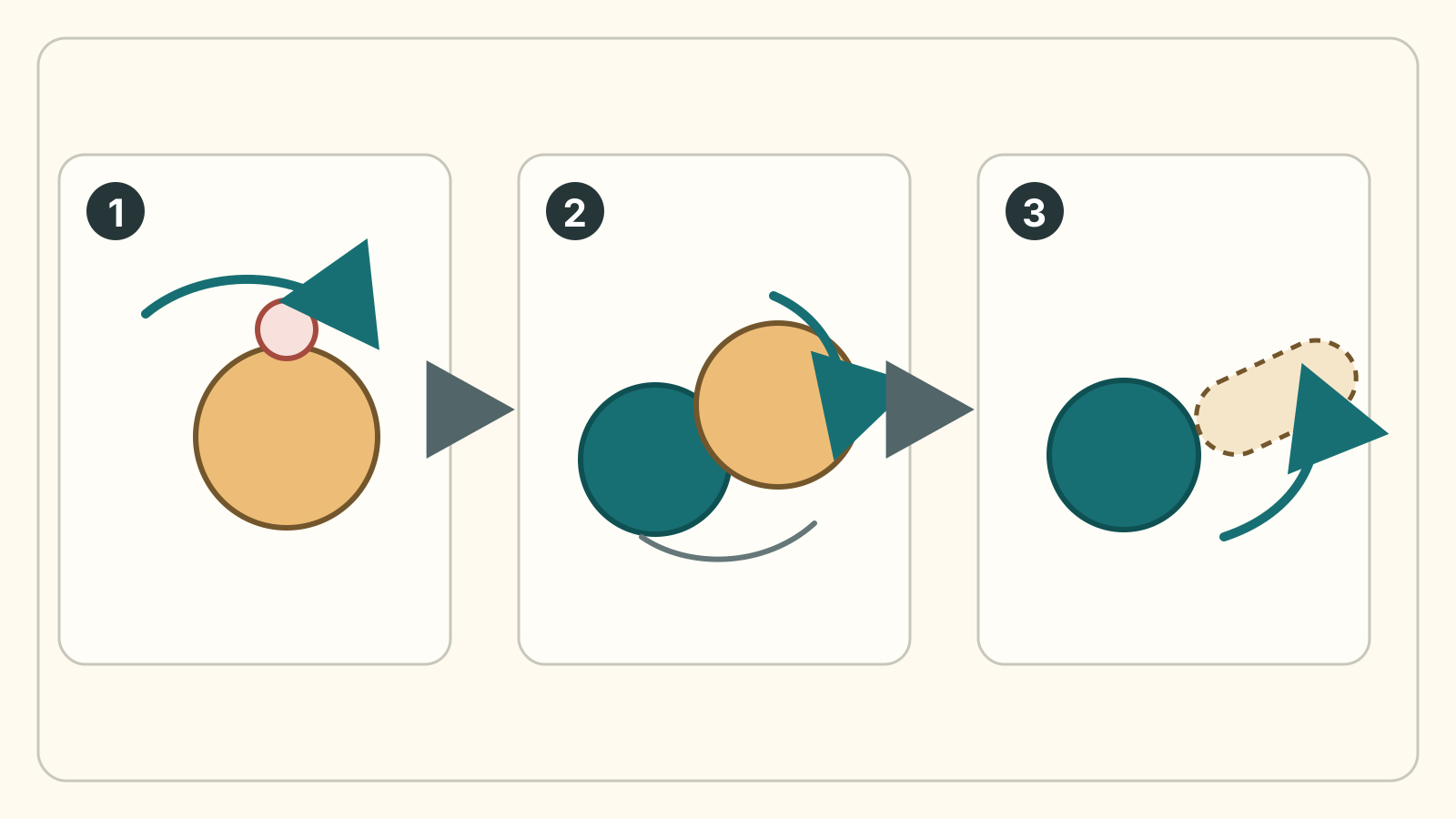
Detailed description of this diagram
Card 1 places a small contact marker above the gold opponent token and a blue curve around it, encoding only the arm-around-neck relation. Card 2 brings the blue winner token under and beside the gold token and uses a lower curve for the hip-setting support relation. Card 3 uses a horizontal gold token and a curved arrow for the turn-and-throw state. The upper marker, curves, overlap and token orientation encode no neck, hip or arm anatomy, choke, torque, exact position, angle, injury, sacrifice motion or execution method.
Graphic: SUMO ARCHAEOLOGY CLUB · Figure source 1 · Figure source 2 · Figure source 3
Kubinage vs kubihineri: find the other hand
Kubihineri also begins with one hand around the opponent’s neck. In the Association’s definition, however, the other hand takes hold of the opponent’s inserted arm and the winner twists him down to one side.
That makes the second hand a valuable question. In kubinage, does the winner bring in his hips and turn his own body to wind the opponent through a throw? In kubihineri, does the free hand visibly control the opponent’s inserted arm as the pair are twisted down?
The far arm is often hidden by both torsos. Do not use the neck contact alone as a confident verdict. Store what you could see, listen for the official announcement and use another angle if one becomes available.
Kubinage vs kotenage: neck or inserted arm?
Kotenage controls a different target. The Association defines it as enclosing the opponent’s inserted arm from outside and pressing down over that arm into a throw, without a mawashi grip.
The official kubinage page also describes a situation in which the winner cannot obtain the belt, but “no belt” does not distinguish the techniques. Follow the wrapping arm. Does it circle the opponent’s neck while the hips enter and the body turns? Or does it close around the upper arm that the opponent inserted beneath the armpit?
This neck-or-arm test is more reliable than guessing from how hard the landing looked.
A kimarite name is not a medical diagnosis
Because the name contains “neck,” a dramatic angle can prompt claims that a wrestler was choked, deliberately hurt or injured. The technique announcement establishes none of those things. The official page defines a movement: wrap the neck, engage the hips, twist and throw.
Any consequential statement about pain or injury should wait for a verifiable report from the wrestler, his stable, the Association or another responsible source. Keeping that boundary does not make the bout less physical. It respects the athlete by separating an observable grip from a diagnosis we are not in a position to make.
One thing to watch in the next bout
If an arm circles the neck, stop following the hand and look at the winner’s hips. Do they move into the opponent’s line as the torso rotates and draws him around? That connected hip-and-turn action is your kubinage clue. If the other hand instead controls an inserted arm, compare the picture with kubihineri.
The defender may square his body and prevent the hips from entering. No neck throw will be announced, but the defence has become visible. A name that sounded as though it belonged entirely to the upper body has taught you to watch the lower half. The next time an arm reaches the neck, the most exciting question may be whether the hips ever get permission to follow.
Similar Motion Does Not Set the Official Technique
A hand action or fall may look similar while the recorded kimarite differs according to the decisive action, sequence of balance loss and whether a body part touched down or crossed the ring first. Do not settle the difference between a similar technique, non-technique or foul from one camera angle; use the official result for that bout. A schematic marks viewing cues, not a substitute judges’ decision.
Sources
- Japan Sumo Association, kimarite explanation for kubinage (checked 2 September 2026)
- Japan Sumo Association, kimarite explanation for kubihineri (checked 2 September 2026)
- Japan Sumo Association, kimarite explanation for kotenage (checked 2 September 2026)
Source links used for verification
Each link was used for the corresponding claim in this article; inclusion is not a blanket endorsement of the whole page.
Article verified:
- Japan Sumo Association kimarite: kubinagePrimary source (as checked for this article)
- Japan Sumo Association kimarite: kubihineriPrimary source (as checked for this article)
- Japan Sumo Association kimarite: kotenagePrimary source (as checked for this article)