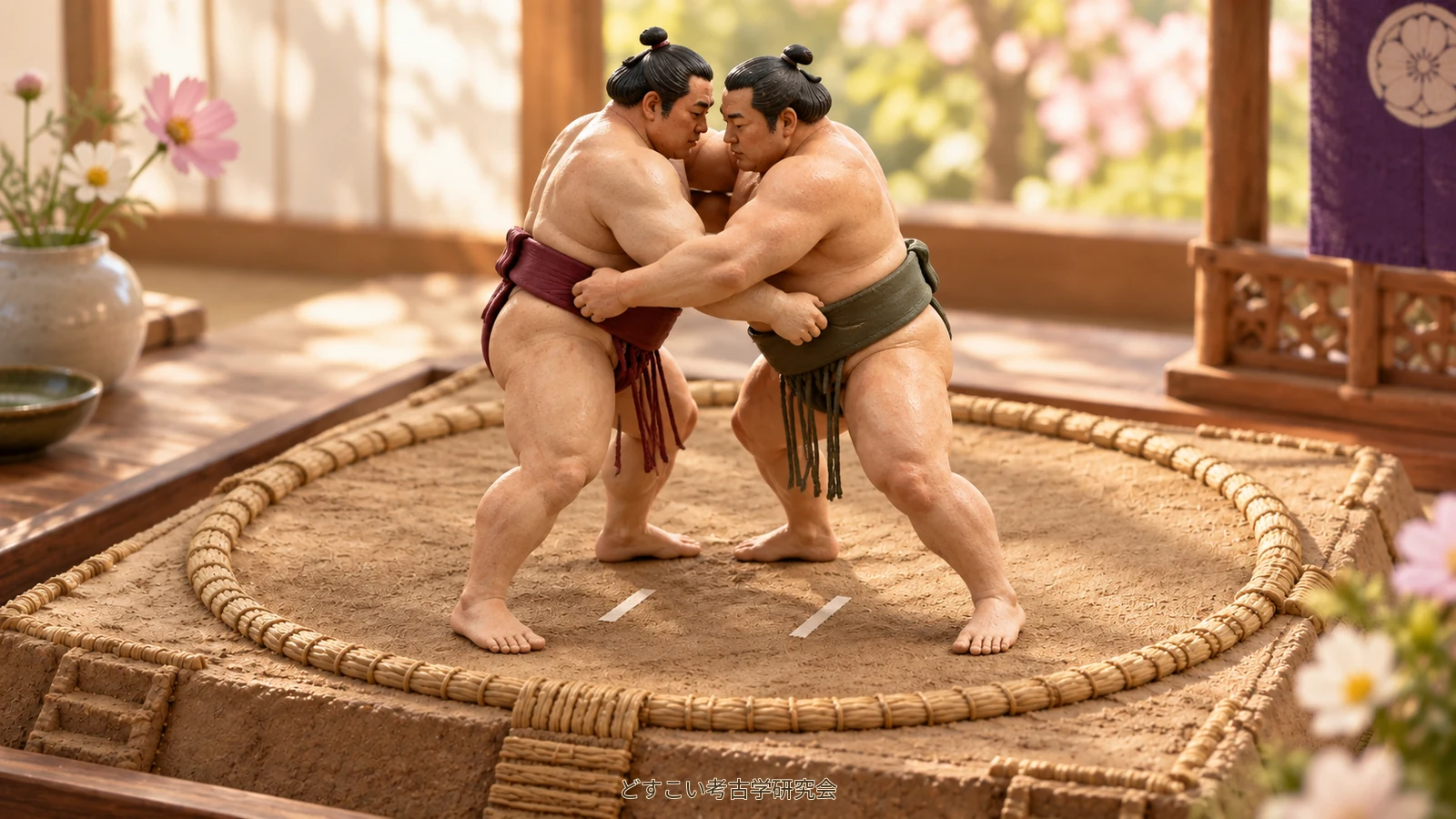
Do not start with “right hand or left hand?” Start with the position of the gripping arm. Uwatenage, usually translated as an overarm throw, uses a mawashi grip over the opponent’s inserted inside arm. Shitatenage, the underarm throw, uses a grip underneath that arm, from inside the opponent’s armpit. “Over” and “under” describe the two wrestlers’ arm positions; they do not grade the skill and they do not mean right versus left.
A throw is quick, and the bodies often hide the hand that created it. The useful moment comes earlier. When the wrestlers settle into a belt contest, choose one elbow and ask whether it travelled inside or outside the opponent’s arm. The winning announcement may then feel like the answer to something you had already begun to see.
First find the inserted arm
In a standard yotsu, or belt-grappling, position, a wrestler may insert an arm beneath the opponent’s armpit. That inside arm is the key reference point. A belt grip reached from outside and over it is an *uwate* grip. A belt grip reached with the inserted arm, underneath the opponent’s arm, is a *shitate* grip.
Right and left supply extra detail. A wrestler can have a right uwate or a right shitate, for example. The side tells you which hand he used; uwate or shitate tells you which route that arm took through the clinch.
Uwatenage comes from the outside grip
The Japan Sumo Association defines uwatenage as a throw made from a belt hold taken over the opponent’s inserted arm. The throwing elbow and shoulder may therefore appear outside and above the opponent’s arm.
The opponent does not have to roll dramatically in the centre of the ring. If the force of that throw carries him across the boundary while he remains on his feet, the winning technique can still be uwatenage. The name identifies the decisive action and grip, not a required landing pose.
Shitatenage comes from the inside grip
For shitatenage, the wrestler throws from the belt grip made beneath the opponent’s inserted arm. His elbow often looks tucked closer to his own body because the arm has travelled inside the opponent’s armpit.
The official pages currently cover 190,450 bouts from January 2013 through the final day of the July 2026 tournament. In that sample, uwatenage appears 8,802 times, or 4.6 percent, and ranks sixth. Shitatenage appears 4,323 times, or 2.3 percent, and ranks tenth. Those totals are useful context, not permanent constants, so this page is reviewed when the displayed sample changes.
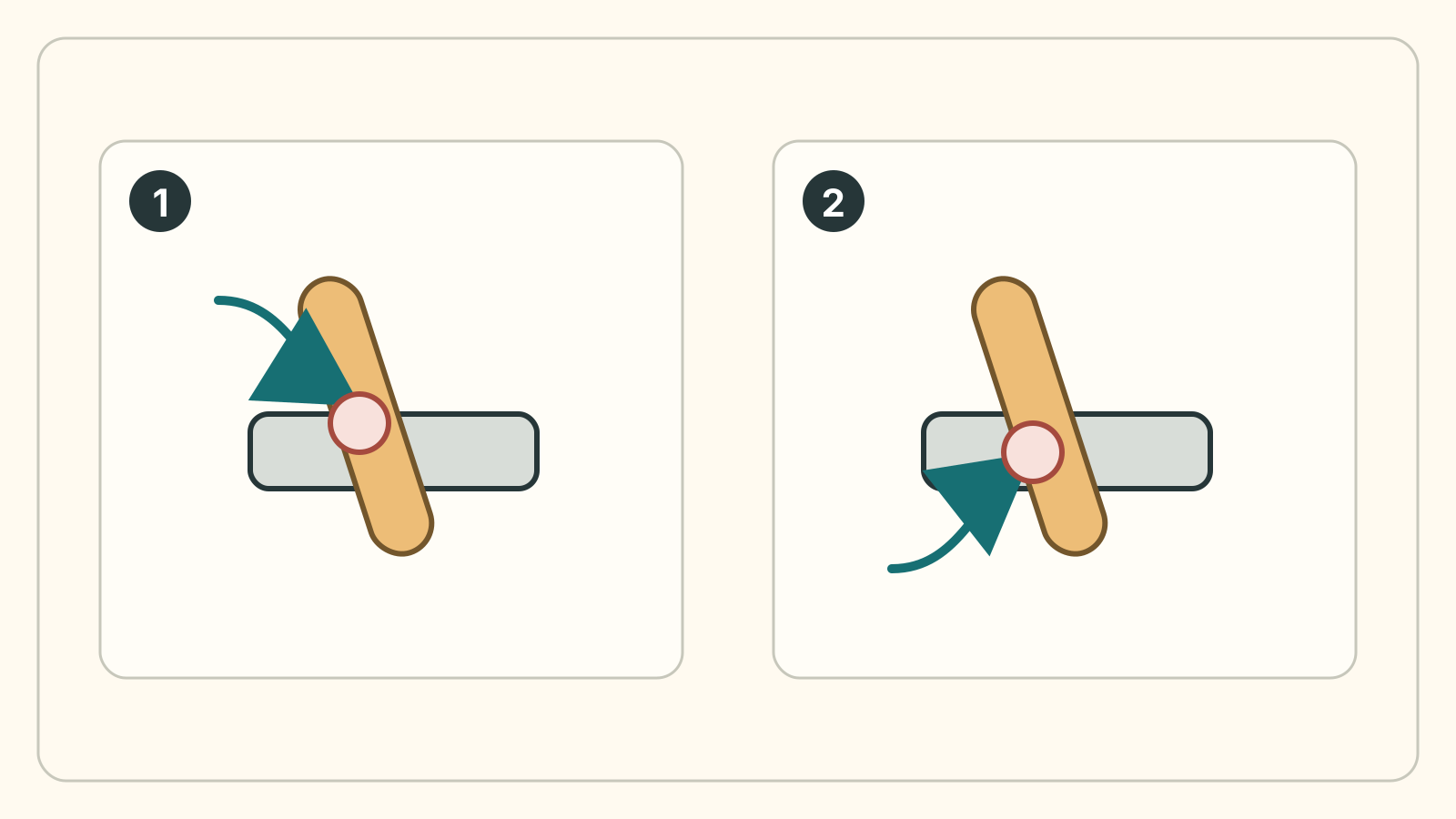
Detailed description of this diagram
Both cards contain a grey horizontal band abstracting the belt as the decision reference. A diagonal gold bar is only a layer marker for the opponent's inserted arm, not an arm shape or angle. In card 1, a blue line and red contact marker reach the band from above the gold bar, encoding the official over-arm uwate relation. In card 2, the line and marker reach from below the bar, encoding the official under-arm shitate relation. Band width, bar angle, marker position and line curvature reproduce no torso, mawashi, hand, left or right side, grip depth or throwing direction and cannot guarantee the recorded technique.
Graphic: SUMO ARCHAEOLOGY CLUB · Figure source 1 · Figure source 2
Look before the throwing motion begins
Waiting for the turn of the hips is often too late. Prepare during the brief stillness of the clinch:
- Which arm is inserted beneath an armpit?
- Has that inside hand reached the belt?
- Has the outside hand found a grip over the opponent’s arm?
- Which elbow begins to pull as the hips rotate?
You do not need to track all four arms. If the eventual winner’s right elbow was inside, remember that one observation and listen. When the arena calls shitatenage, the Japanese word has attached itself to a picture rather than a flashcard.
One belt becomes two different maps
Both wrestlers may hold the same broad strip of mawashi, but the paths their arms took are different. One wants an inside grip; the other may fight to secure the outside grip or deny the preferred side. The throw begins in that quiet argument over centimetres, before either body leaves the ground.
For the next bout, do not wait for somebody to fly. Pick one elbow as soon as the wrestlers lock together. A later “uwatenage” or “shitatenage” will no longer sound like a label pasted onto the result. It will name the grip you watched becoming dangerous.
Similar Motion Does Not Set the Official Technique
A hand action or fall may look similar while the recorded kimarite differs according to the decisive action, sequence of balance loss and whether a body part touched down or crossed the ring first. Do not settle the difference between a similar technique, non-technique or foul from one camera angle; use the official result for that bout. A schematic marks viewing cues, not a substitute judges’ decision.
Sources
- Japan Sumo Association, kimarite explanation for uwatenage (checked 2 September 2026)
- Japan Sumo Association, kimarite explanation for shitatenage (checked 2 September 2026)
Source links used for verification
Each link was used for the corresponding claim in this article; inclusion is not a blanket endorsement of the whole page.
Article verified:
- Japan Sumo Association kimarite: uwatenagePrimary source (as checked for this article)
- Japan Sumo Association kimarite: shitatenagePrimary source (as checked for this article)