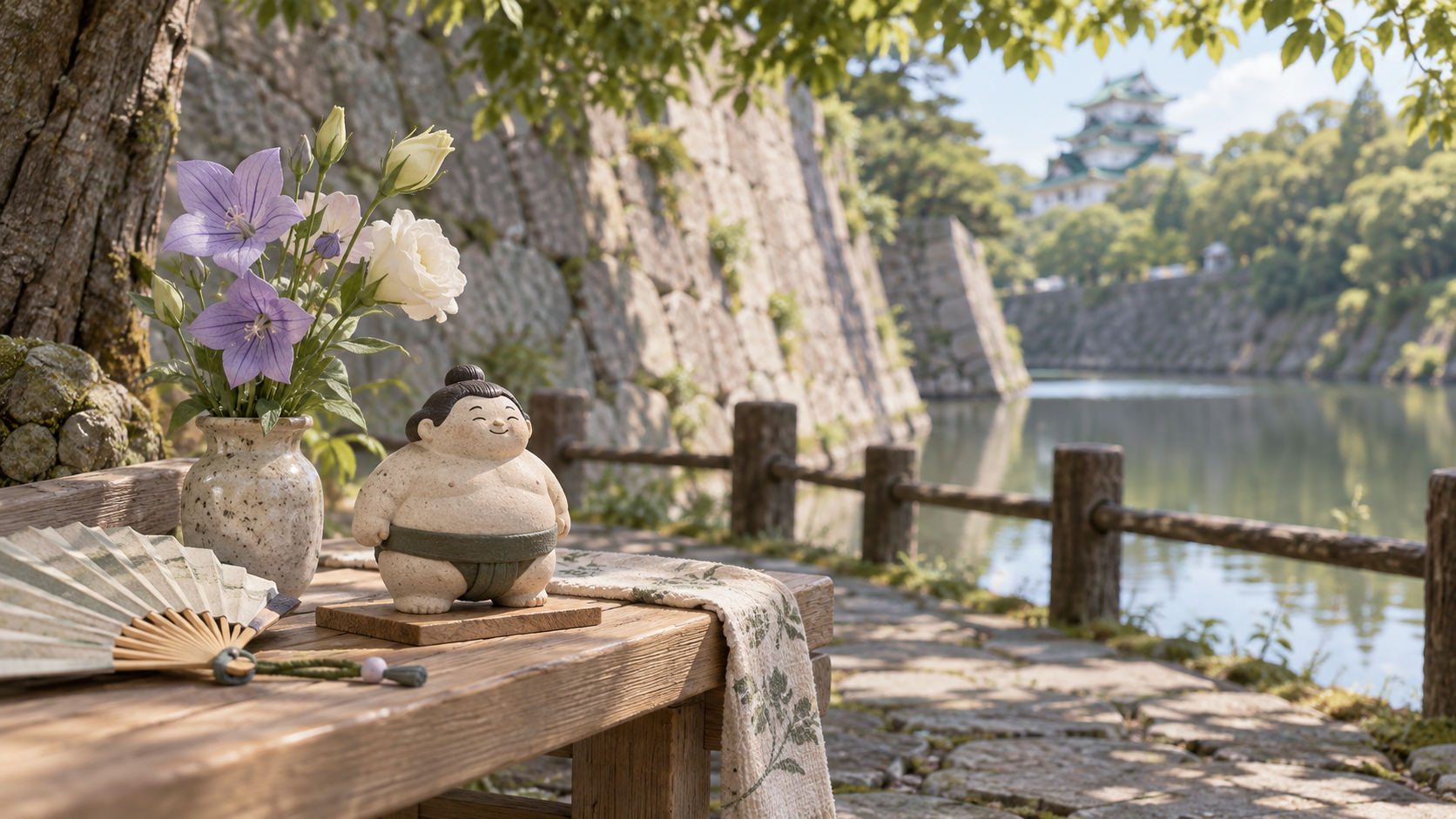
If you want one nearby addition to a Nagoya tournament day, consider Nagoya Castle or the surrounding Meijo Park area. First check the castle’s official opening, admission and closure information, the day’s heat or rain, your group’s walking capacity and the time printed on the sumo plan. Prepare three valid versions: enter one castle area, take a short park-side walk, or skip the detour entirely. “Nearby” never means that every attraction fits before makuuchi.
This is not an assignment to consume more history. A castle wall and moat operate at a scale that your body can feel while walking. Returning from that landscape to a compact clay circle can make the dohyo look unexpectedly small and intense.
Let the castle’s own website define access
Opening days, admission times, available areas, construction and special events can change. Use Nagoya Castle’s official information for the date of your visit rather than an old search snippet or travel blog. Access to the grounds and access to every individual building are not identical promises.
For a pre-sumo visit, work backwards from the moment you want to be seated at IG Arena. Include the journey, entrance procedure, finding the seat and a restroom stop. The castle receives only the time left after those essentials, not the other way round.
Three versions of the detour
A: choose one area inside
Select one officially open element rather than building a checklist. A wall, gate, garden or palace area can be enough. If the site requires a reservation, a separate ticket or timed admission for something specific, follow the current official notice.
B: make a short park-side walk
If admission no longer fits, look for one visible relationship: the line of the moat, shade beside the park, or the outer profile of the castle. Follow signed, open routes. A straight line on a map does not prove a walkable, illuminated or step-free path, particularly when construction or an event changes circulation.
C: remove the detour
Extreme heat, heavy rain, a warning, illness, large luggage, a tired child or a hard onward deadline is enough reason to connect the hotel and arena directly. Deleting an attraction is good editing. It protects the experience that brought you to Nagoya.
From the castle boundary to the dohyo boundary
After seeing stonework, watch the tawara rice-straw bales around the dohyo once. Both create a boundary, but a castle boundary holds people apart while the small sumo boundary forces two bodies to solve distance immediately. The comparison does not prove a historical relationship. It is simply an observation that can make a familiar sporting surface feel architectural.
Do not assume that the final bout and the castle’s closing time will align for a post-sumo visit. If the official admission window has ended, do not search for an unofficial dark route around closed areas. Return by a signed, lit route to the station or your accommodation.
One well-chosen detour should leave energy for the opening clap and first charge. If the castle makes the dohyo look smaller—or the dohyo makes the surrounding city look larger—the day has already linked its two places without a crowded checklist.
Fallback when the live conditions differ
If an area shown in an older photograph is closed, follow the current sign rather than trying to reproduce the photograph. If castle admission no longer fits but a signed public park route remains open and suits the weather and bodies in your group, that short walk can be the second plan. If either condition is unclear, the final fallback is the verified route between accommodation and arena. Curiosity should leave a trail of checked choices, not an unofficial shortcut.
Evidence limits and event-day fallback
Confirmed fact: Official castle, arena and Association pages are starting points for facilities and ordinary access. An old photograph or straight map line does not guarantee live opening or passage.
What remains unknown: Opening, final admission, price/booking, accessible areas, works/events, park lighting/steps/opening, heat/rain, luggage and actual arena time are live conditions.
Reasoned inference: Three plans—one castle area, a confirmed short park route, or no detour—are likely to preserve curiosity without consuming sumo. Confidence is medium, not a feasibility promise.
Editorial suggestion: Work backward from the sumo moment and give the castle only the remaining time. This is neither an official sightseeing order nor an accessible-route designation.
Fallback: If closure, works, warning, fatigue, luggage or darkness breaks the plan, reduce the detour; if still unclear, return to the verified accommodation-to-arena route.
Sources
- Nagoya Castle official website (checked 3 September 2026; recheck opening areas, construction and admission on the visit date).
- IG Arena, official access information (checked 3 September 2026).
- Japan Sumo Association, Nagoya tournament visitor information (checked 3 September 2026).
Source links used for verification
Each link was used for the corresponding claim in this article; inclusion is not a blanket endorsement of the whole page.
Article verified:
- Nagoya Castle official websitePrimary source (as checked for this article)
- IG Arena accessPrimary source (as checked for this article)
- Japan Sumo Association Nagoya tournament visitor informationPrimary source (as checked for this article)