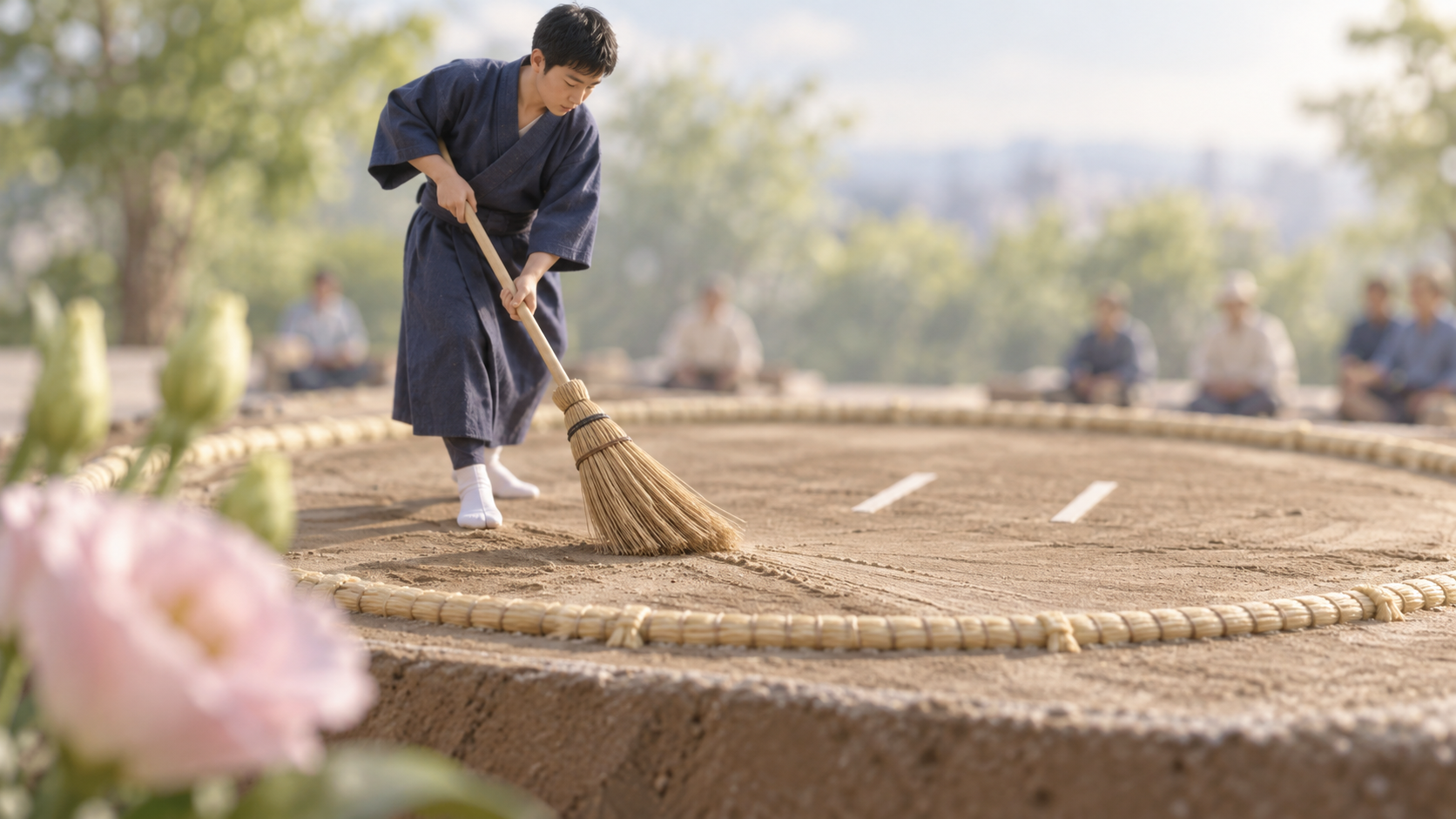
Start with the official opening time for your specific day, then divide the visit into three blocks: one focused hour of lower-division bouts, a planned recovery break, and a return for the afternoon divisions. Do not copy an opening time from another day or year. Arriving early is not a test of whether you can remain seated until the final bout. Hearing one quiet lower-division match clearly can be a complete reason to go in the morning.
An overseas visitor may know the televised makuuchi stars but have no map for the many bouts that happen earlier. That is an advantage rather than a deficiency. A quieter arena makes the yobidashi’s call, the gyoji’s costume, the sweep of the clay and the sound of a wrestler’s feet easier to isolate. The building seems to acquire its tournament atmosphere layer by layer.
Keep the opening time separate from the general timetable
Use the Japan Sumo Association’s event page for the opening time on the date printed on your ticket. Its general dohyo timetable helps explain the order of divisions, but it is not a guaranteed minute-by-minute programme. The number of bouts, the stage of the tournament and the final day can alter the flow. The day’s official bout list and arena announcements take priority.
Choose one station and one entrance route before leaving your accommodation. IG Arena publishes its transport access, but construction, crowd controls and event operations can change. Add a personal margin for summer heat, rain, luggage, accessibility and unfamiliar Japanese signs rather than relying on a best-case walking time.
One wrestler, one sound and one movement
For the first hour, select one lower-division wrestler from the official bout list. You do not need a biography. Watch only the direction of his first step after the tachiai. Then choose one sound—the caller’s voice or feet on clay—and one piece of work between bouts, such as the ring being swept.
This tiny assignment prevents a long morning from becoming a memory test. When the arena fills later, you may notice that the same call feels farther away or that the edge of the ring has become harder to see. You are then watching the audience and the architecture change as well as the competition.
Schedule recovery before you become tired
On entry, locate the restroom route, a place where you can organise water or food under current event rules, and a meeting point for your group. Decide roughly when to leave your seat before fatigue makes the decision for you. If a break requires going outside, ask staff about that day’s re-entry procedure before crossing the exit.
A masu box and a chair seat create different postures, but neither makes continuous sitting effortless. Medication, food needs, sensory overload, wheelchair use and a child’s rhythm all outrank a generic itinerary. Use IG Arena’s current facility information and contact the organiser where individual arrangements need confirmation.
Reuse the morning clue in the afternoon
When juryo or makuuchi begins, watch the first step in one bout again. Bright kesho-mawashi and larger cheers will compete for attention, yet your morning clue can join the day together. Avoid treating the divisions as a simple ladder of quality. Record what changed when the same clay was surrounded by more noise and expectation.
Leaving before the bow-twirling ceremony does not erase a valuable morning. Once you have heard sumo before the television window begins, the tournament stops being only an evening spectacle. The next time you open a live results page early in the day, you will know that a whole arena is already awake.
Evidence limits and event-day fallback
Confirmed fact: The event page gives the date’s opening information, the general timetable gives division order, and IG Arena publishes ordinary access/FAQ. They are not a minute-by-minute promise across years or venues.
What remains unknown: Live bout count/progress, entrance, control, re-entry, rest place, food/water, restroom, crowd, indoor feel and personal fatigue, medicine or sensory load remain unconfirmed.
Reasoned inference: Dividing the day into one morning hour, recovery and afternoon is likely to create a change point missing from a sit-until-final plan. Confidence is medium; this is not a bodily-suitability guarantee.
Editorial suggestion: On entry, confirm the restroom, a place to organise permitted food/water and a meeting point; prioritise the person’s own rest cycle. This is not medical or venue instruction.
Fallback: If heat, pain, fatigue, sensory load, facilities or re-entry fail the plan, drop the endurance goal: rest, arrive later, shorten or leave. Confirm re-entry before crossing the exit.
Sources
- Japan Sumo Association, Nagoya tournament visitor information and general dohyo timetable (checked 3 September 2026; the timetable is a general guide).
- IG Arena, access information and FAQ (checked 3 September 2026; recheck event-day transport and operations).
Source links used for verification
Each link was used for the corresponding claim in this article; inclusion is not a blanket endorsement of the whole page.
Article verified:
- Japan Sumo Association Nagoya tournament visitor informationPrimary source (as checked for this article)
- Japan Sumo Association general dohyo timetablePrimary source (as checked for this article)
- IG Arena accessPrimary source (as checked for this article)
- IG Arena FAQPrimary source (as checked for this article)