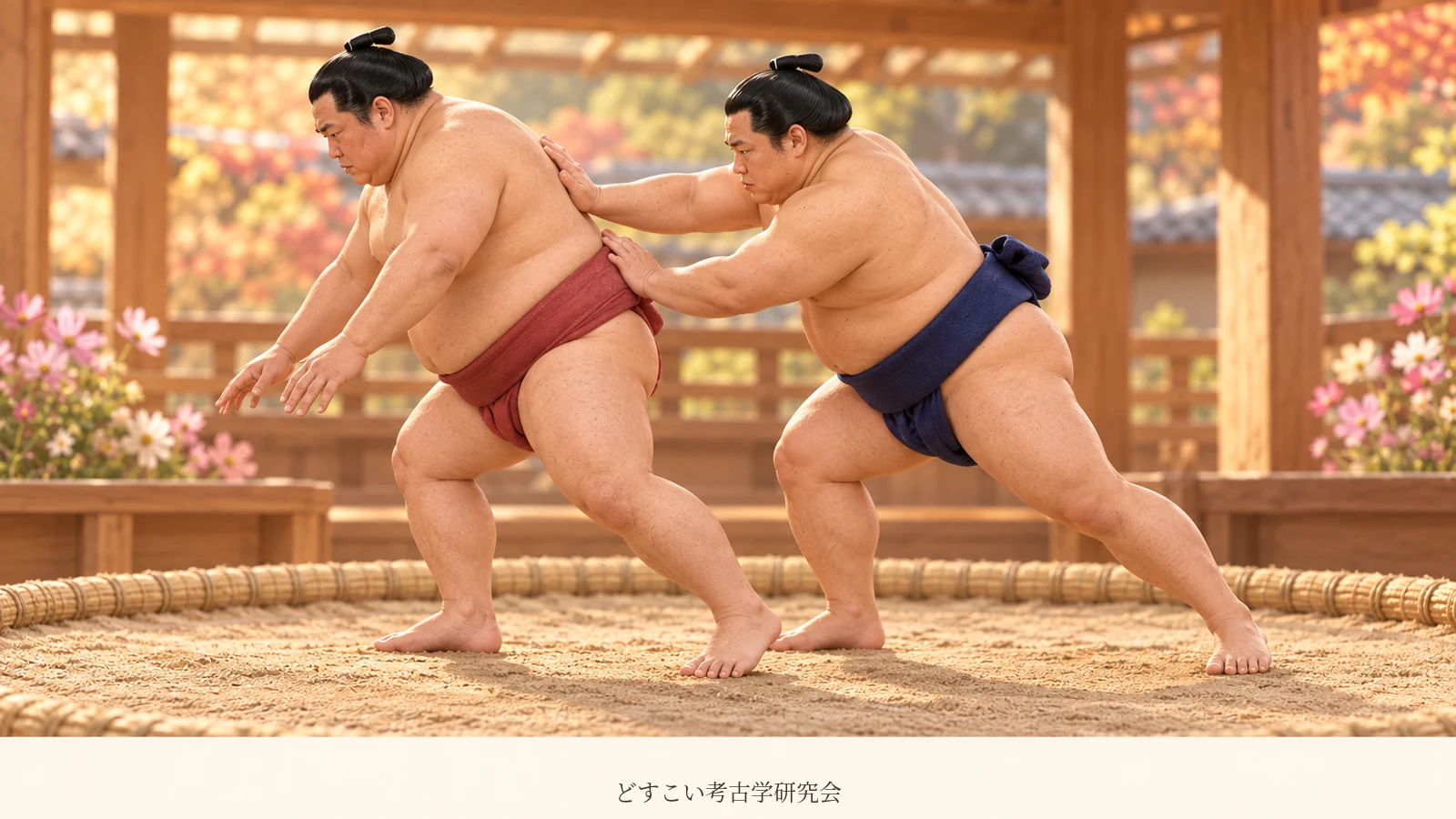
Okuridashi is a rear push-out: the winner moves behind the opponent and pushes or thrusts him outside the ring. Position is the clearest difference from oshidashi, which uses a hazu push at the chest or under the arms. If the rear attack knocks the opponent down inside the ring rather than sending him out upright, the official comparison points to okuritaoshi. In the next bout, watch for the moment one wrestler’s chest begins to face the other’s back.
The wrestlers collide face to face. A turn happens, one full back suddenly becomes visible, and the bout ends with both moving in the same direction. Okuridashi can feel as if the coordinates of the match changed while you blinked. The final push is only half the story. The more interesting question is how two opponents who were square became a person in front and a person behind.
The official definition starts with rear position
The Japan Sumo Association defines okuridashi as moving around behind the opponent, then pushing or thrusting him outside the ring. Notice the definition permits either a push or a thrust. Its first identifying condition is where the winner acts from.
An opponent merely showing his back for a frame is not enough for a viewer to declare okuridashi. Follow the sequence: when the decisive push or thrust occurred, had the winner reached the rear? Did the bodies begin to point in the same direction, with the winner’s chest oriented towards the opponent’s back?
This is also a good place for humility. Shoulders, hands and the boundary can be hidden by the camera angle. Treat your observation as a prediction and the arena announcement as the answer.
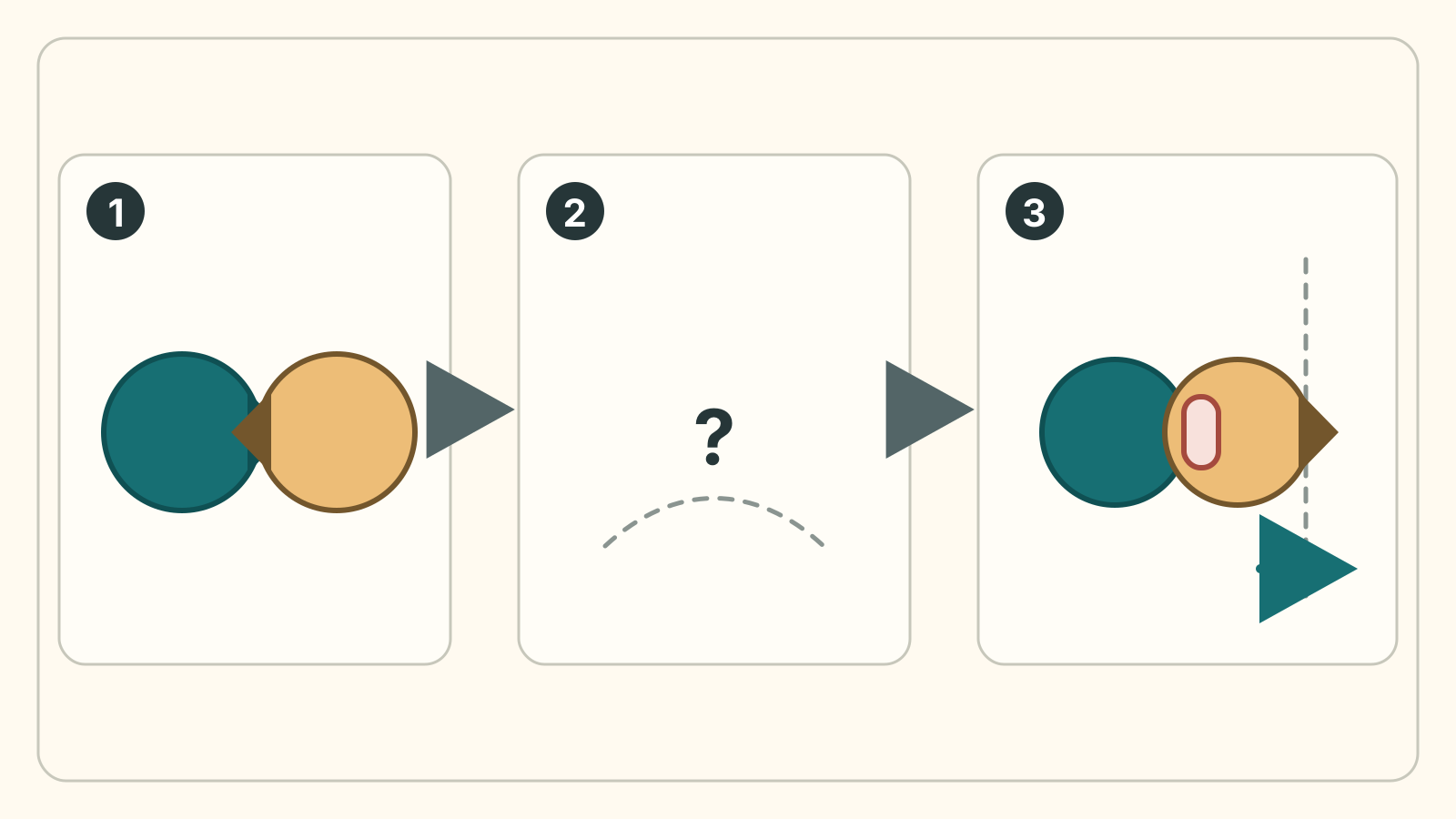
Detailed description of this diagram
Card 1 gives blue and gold circular competitor tokens inward-facing triangular orientation marks for a front relation. Card 2 contains only a question mark and dashed curve, refusing to infer one route, turn or cause from the definition. Card 3 points both tokens the same way, puts the blue winner token behind the gold opponent, and adds a contact cue and arrow beyond an abstract boundary. This shows only the official rear position plus push-or-thrust and upright exit relation. Token gap, path, hands, body orientation, boundary distance and time are not measurements or a real bout reconstruction.
Graphic: SUMO ARCHAEOLOGY CLUB · Figure source 1 · Figure source 2 · Figure source 3
How it differs from oshidashi
For oshidashi, the Association describes one or both hands in a Y-like *hazu* shape, placed at the opponent’s chest or under the arms and used to push him outside. It belongs to a front-facing pushing relationship.
A wrestler being pushed may twist near the edge, but a turned torso at the very end does not automatically convert every oshidashi into okuridashi. Ask where the winning pressure came from. If the decisive action remained a chest or underarm hazu push, oshidashi is the relevant model. If the winner had moved behind and finished with a push or thrust from there, think okuridashi.
How it differs from okuritaoshi
The Association’s okuritaoshi page gives a direct companion definition: the winner moves behind the opponent and pushes or thrusts him down inside the ring. It adds that if the opponent is not knocked down and is instead sent outside, the finish is okuridashi.
Use two questions. First, was the decisive attacker behind? Second, did the opponent remain upright through the exit or get knocked down in the ring? Rear position alone does not settle every “okuri” technique either. Lifting, throwing or hooking from behind can receive other official names. Here the decisive action must be a push or thrust.
The positional change begins before the back is obvious
At the end, the rear position may look comfortable. Before it, the two wrestlers were contesting their alignment. Imagine a short line connecting one wrestler’s shoulders. While his opponent remains squarely in front of that line, the rear is not yet won. When one body moves past the outside of a shoulder and the other cannot restore a face-to-face position, the geometry changes.
Why it changed will differ from bout to bout. A side movement, a turn under pressure or another exchange may create the opening. The official definition does not assign one universal cause, so neither should we. Rewind only until the shoulder lines first stop facing each other; that is enough to begin the investigation.
One thing to watch in the next bout
Choose one wrestler’s shoulders and mentally draw a bar between them. Keep watching until the opponent either remains in front of that bar or passes outside it. If the winner’s chest comes to face the opponent’s back before the decisive push, you have found the observation that makes okuridashi legible.
You may watch an entire bout without seeing a back. That is not a failed exercise. It means both wrestlers kept recovering a square position. Okuridashi teaches you to value the instant before the finish: a shoulder line slips away, the rear becomes exposed, and a contest of force turns into a contest of orientation.
Evidence limits and event-day fallback
Confirmed fact: The Association defines okuridashi as moving behind the opponent and pushing or thrusting him out. Its official inside-the-ring knockdown comparison is okuritaoshi.
What remains unknown: The move to the rear, decisive hand action, place of fall and touch order can be hidden. The cause of the turn, either wrestler’s intent, fatigue, pain and injury are not established by the definition.
Reasoned inference: Following the shoulder relation from square to rear at the decisive action can focus a replay. Confidence is medium; chest direction alone does not determine the technique.
Editorial suggestion: Separate ‘a back became visible’ from the conclusion that a rear push/thrust decided the bout. This is not judging procedure or physical assessment.
Fallback: If rear position, decisive action or boundary/touch order is hidden, leave the classification open and use the official result.
Sources
- Japan Sumo Association, kimarite explanation for okuridashi (checked 2 September 2026)
- Japan Sumo Association, kimarite explanation for okuritaoshi (checked 2 September 2026)
- Japan Sumo Association, kimarite explanation for oshidashi (checked 2 September 2026)
Source links used for verification
Each link was used for the corresponding claim in this article; inclusion is not a blanket endorsement of the whole page.
Article verified:
- Japan Sumo Association kimarite: okuridashiPrimary source (as checked for this article)
- Japan Sumo Association kimarite: okuritaoshiPrimary source (as checked for this article)
- Japan Sumo Association kimarite: oshidashiPrimary source (as checked for this article)