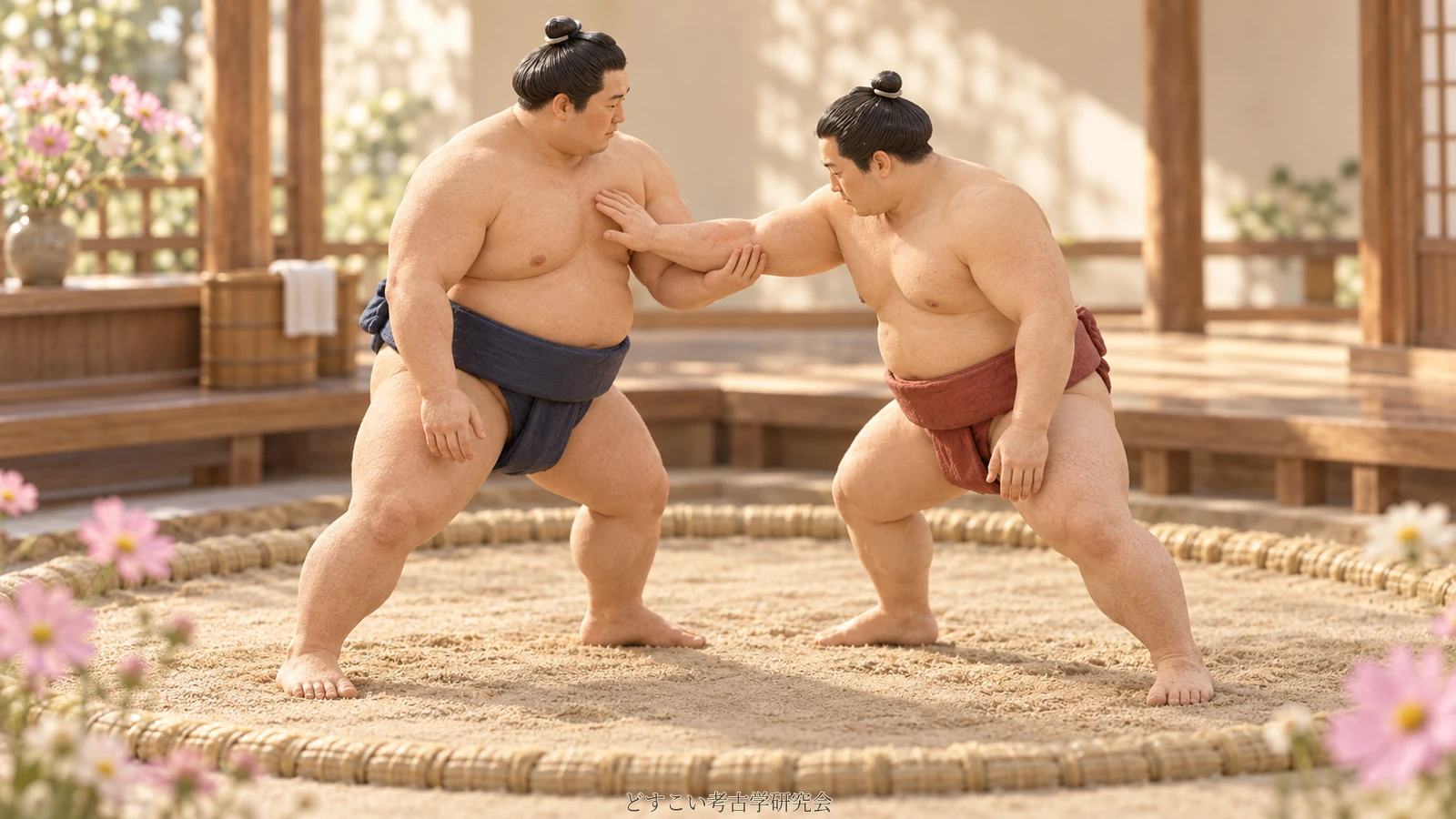
Ottsuke is a sumo technique in which a wrestler keeps the armpit tight, places a hand against the outside of the opponent’s arm and applies pressure upward, as if squeezing the arm from below. The Association presents it as a way to suppress an attack and turn defence into attack. It is not simply a forceful shove to the chest.
In the next bout, choose one outside hand and watch the opponent’s elbow. Do not confuse ottsuke with any push to the torso. If bodies hide the contact point, leave the strength and success of the action undecided.
Commentary may praise a “strong ottsuke,” and it is easy to assume this is simply a more expert word for pushing. The Japan Sumo Association’s explanation redirects the eye away from the centre of the torso. The important contact is arm against arm, and its direction is not merely backwards. A small upward movement at the edge of two bodies can change who gets the inside position.
The hand works from outside the opponent’s arm
The Association explains that *ottsuke* comes from a form of the word for pressing. When an opponent tries to insert an arm or attack with thrusts, the defending wrestler tightens the armpit, places a hand against the outside of that arm and applies pressure as if squeezing upward.
A second official explanation gives an especially useful visual cue: the wrestler keeps his own elbow against his own side while the hand meets the opponent’s elbow from outside. The basic pressure runs from low to high. You do not need to judge its force. Look for that compact shape—closed armpit, outside contact, upward line.
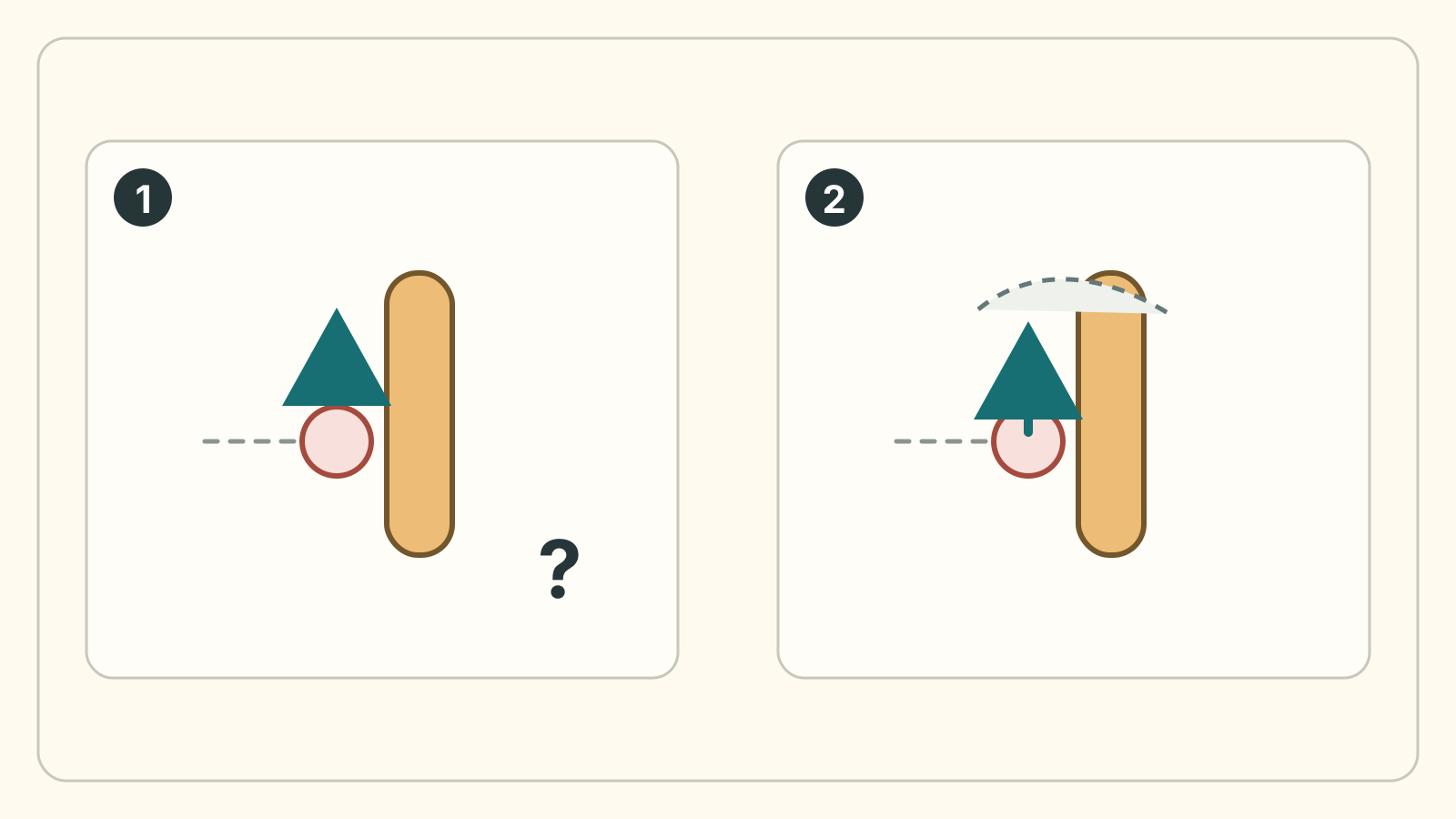
Detailed description of this diagram
Card 1 uses a gold vertical bar as an opponent-arm role and a red dot as outside-contact role; a dashed approach line leaves exact body location unresolved. Card 2 preserves the relation and adds a categorical lower-to-upper arrow. Arrow length and direction are not measured geometry or force, and bar/dot encode no armpit, elbow, hand, joint, pressure, pain, speed, success, forward attack, injury or training instruction.
Graphic: SUMO ARCHAEOLOGY CLUB · Figure source 1 · Figure source 2
Ottsuke is a technique within the bout, not a kimarite label
Oshidashi and tsukidashi are official winning techniques announced after a contest. Ottsuke describes work that can happen on the way to a result. A wrestler may use ottsuke, move forward and eventually win by yorikiri or oshidashi. There is no contradiction between the commentator’s description and the final announcement.
This distinction prevents a common beginner’s frustration. You did not mishear the broadcast because the result board shows another word. One term described a piece of the contest; the other recorded how the opponent finally lost.
It also tells you where to look. For a push-out, the opponent’s whole body and the boundary matter. For ottsuke, narrow the frame to an arm. Is the hand meeting the torso, or working against the opponent’s elbow and upper arm from outside?
Defence can become forward pressure
The Association calls ottsuke important for suppressing the opponent’s attack and changing from defence to offence.
If an opponent is trying to insert an arm, an outside arm moving upward may be an attempt to deny that position. The view does not tell us how many degrees a torso rises, how much force is applied or whether this action alone creates room to advance; those details remain unmeasured.
Do not infer success merely because the hands seem to be in the right area. A single camera view may hide the point of contact, and the opponent may continue to work inside. Keep observation separate from evaluation: “the outside hand moved beneath the elbow” is something you may see; “that action decided the bout” requires the rest of the sequence.
A one-arm exercise that survives a fast tachiai
Choose one wrestler before the start and ignore the other three arms for the first exchange. Watch the arm that remains outside. Does its elbow stay close to the wrestler’s side? Does the hand meet the opponent’s incoming arm and travel upward? Then let your eyes widen again. Did the bodies separate, lock together or begin moving toward the tawara boundary?
For a simple viewing aid, imagine two directions: one arm seeks the inside while the outside arm works upward. This is an editorial cue, not a measured force diagram. If contact is hidden, do not fill it in from the eventual result.
Sources
- Japan Sumo Association, Sumo Quiz Nos. 1320 and 440 (accessed September 3, 2026)
Source links used for verification
Each link was used for the corresponding claim in this article; inclusion is not a blanket endorsement of the whole page.
Article verified:
- Japan Sumo Association Sumo Quiz No.1320: shape and purpose of ottsukePrimary source (as checked for this article)
- Japan Sumo Association Sumo Quiz No.440: hand and elbow position in ottsukePrimary source (as checked for this article)