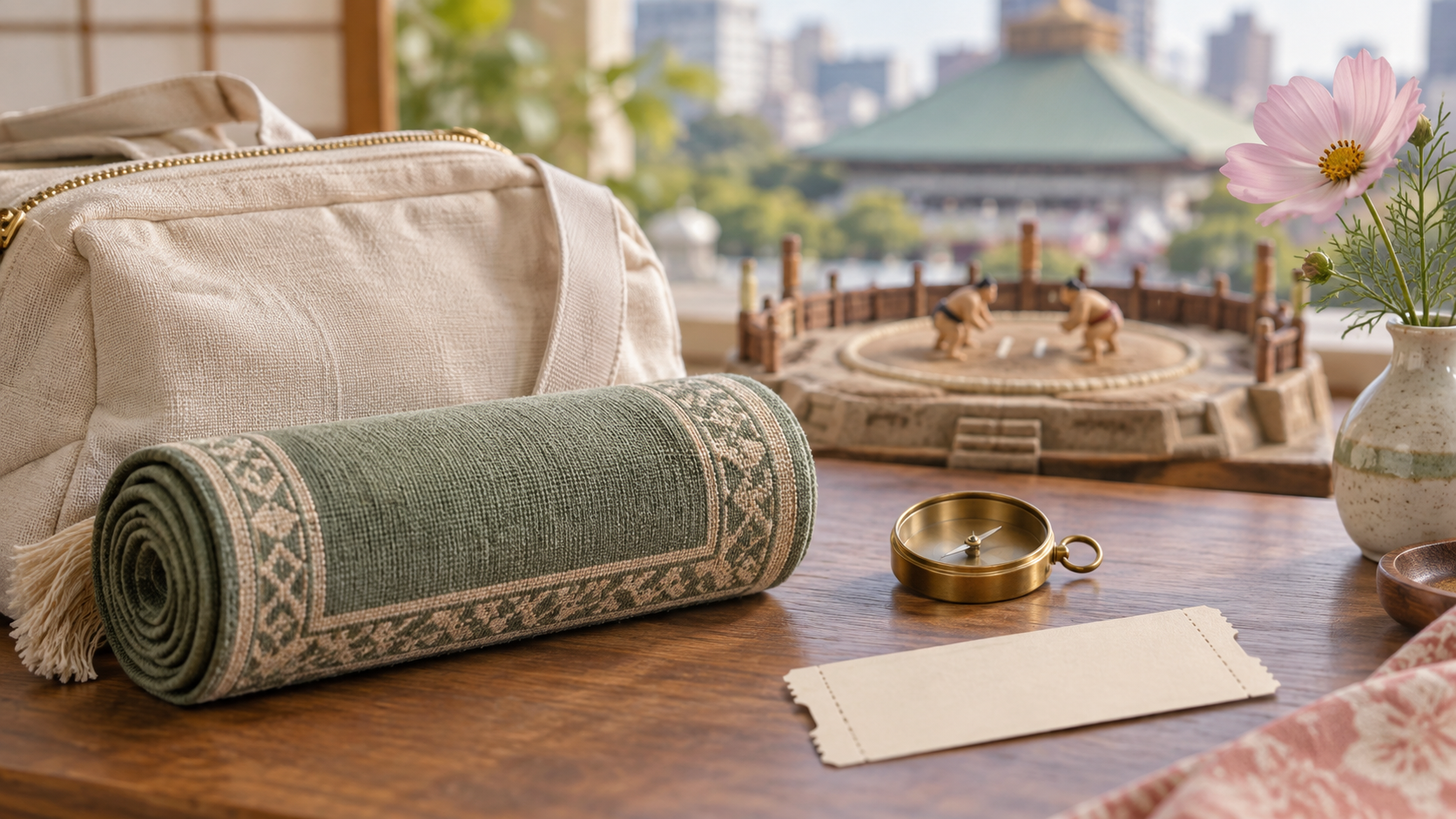
If you need to pray at set times, do not arrive assuming that Ryogoku Kokugikan has a permanent public prayer room. In the September tournament pages reviewed on September 3, 2026, we could not confirm an available prayer room, wudu facility, reservation process or gender arrangement. Ask the organiser specific questions before the visit, then prepare a religiously appropriate alternative for time, place and travel if an onsite arrangement is not available.
A national trend is not proof about one arena
The Japan National Tourism Organization says prayer rooms and mosques are found mainly in larger cities, and that major airports, tourist locations and Muslim-friendly hotels increasingly offer places to pray. This is helpful context, not a facility guarantee. An airport experience or an old report about another event cannot establish what operates inside Kokugikan for this tournament.
When contacting the organiser, give the date, ticket type, approximate time, number of visitors, space needed, washing requirements, direction requirements and whether a companion is involved. “Can I pray?” may produce an answer that is too broad. You need to distinguish a dedicated room, a temporary space offered with permission, and no available arrangement.
Ask six separate questions
- Is a dedicated or temporary space available on the actual tournament day?
- Is booking, check-in, a time limit or capacity limit required?
- Is there an appropriate washing facility and a procedure that keeps floors dry?
- Is qibla direction marked, or must the visitor determine it?
- Do a prayer mat, garments or another item require an entry check?
- If the arena cannot accommodate the need, would the alternative require leaving and using re-entry?
Record who answered, the date and where to reconfirm after arrival. Event operations can change. A current organiser answer outranks an undated review or a photograph without context.
Do not force prayer and one desired bout into the same unknown minute
Professional sumo follows a daily order, but an individual bout does not have a theatre-style start time. If a wrestler you want to see may appear near a prayer window, do not leave both decisions until the last seconds. Follow the religious timing judgment that applies to you and choose when to begin moving and when you might return.
The spectator notice asks visitors not to move during a bout. Begin necessary movement between matches. Never use an aisle, staircase, doorway or evacuation route as a prayer location simply because it looks quiet. An apparently empty space is not automatically authorised for private use.
An outside alternative must include re-entry
September 2026 permits re-entry once per day. If the plan uses a location outside the arena, combine it with any other outside errand and ask the gate about the return procedure before leaving. A nearby hotel or facility also requires direct confirmation of public access, hours, booking and the exact prayer provision; a lobby is not automatically available to non-guests.
If this site later links to prayer-aware accommodation or a reservable room, advertising will be disclosed and current operating conditions will outrank commission. “Muslim-friendly” must not be treated as proof that every visitor’s requirements are met.
Protect one quiet observation
Once time and place are settled, the clock does not need to dominate the whole tournament. Watch one wrestler bow before turning toward the salt. Preparing respectfully for your own essential practice can leave more attention for another person’s carefully repeated ritual.
Ask about hands, feet and time around prayer
Confirmed fact: The checked September spectator notice confirms one re-entry, but it does not confirm a public spectator prayer room inside Kokugikan.
What remains unknown: A dedicated room, washing facility, footwear handling, direction marker, gender arrangement and reservations remain unconfirmed.
Reasoned inference: Because the checked spectator and access pages do not identify a dedicated room, confidence in inferring permanent provision is low. This is not proof that none exists. A current floor plan or organiser reply would overturn it.
Editorial suggestion: Place prayer time, the desired bout, travel, washing needs, shoes and small belongings on one note, and tell companions when you may leave. This is practical planning, not religious advice or a venue rule.
If you do not speak Japanese, keep six paired terms on one screen: prayer room / 礼拝できる場所, washing / 手足を洗える場所, shoes / 靴, direction / 方角, time / 時間, and re-entry / 再入場. Show that screen to staff before trying to explain a long story. Keep the venue name and question on paper too in case the phone fails.
Fallback: Do not occupy an unsuitable passage. Use a nearby place you have verified before entry or after leaving, or adjust attendance according to your own religious guidance.
Sources
- Japan Sumo Association, September 2026 Tokyo spectator notice and access guide, checked September 3, 2026, for re-entry, movement and venue information.
- Japan National Tourism Organization, Muslim Travelers in Japan, checked the same day for general prayer-facility context. It is not used as proof of a Kokugikan prayer room.
Source links used for verification
Each link was used for the corresponding claim in this article; inclusion is not a blanket endorsement of the whole page.
Article verified:
- Japan Sumo Association September 2026 Tokyo spectator noticePrimary source (as checked for this article)
- Japan Sumo Association September 2026 Tokyo access guidePrimary source (as checked for this article)
- Japan National Tourism Organization guide for Muslim travelersPrimary source (as checked for this article)