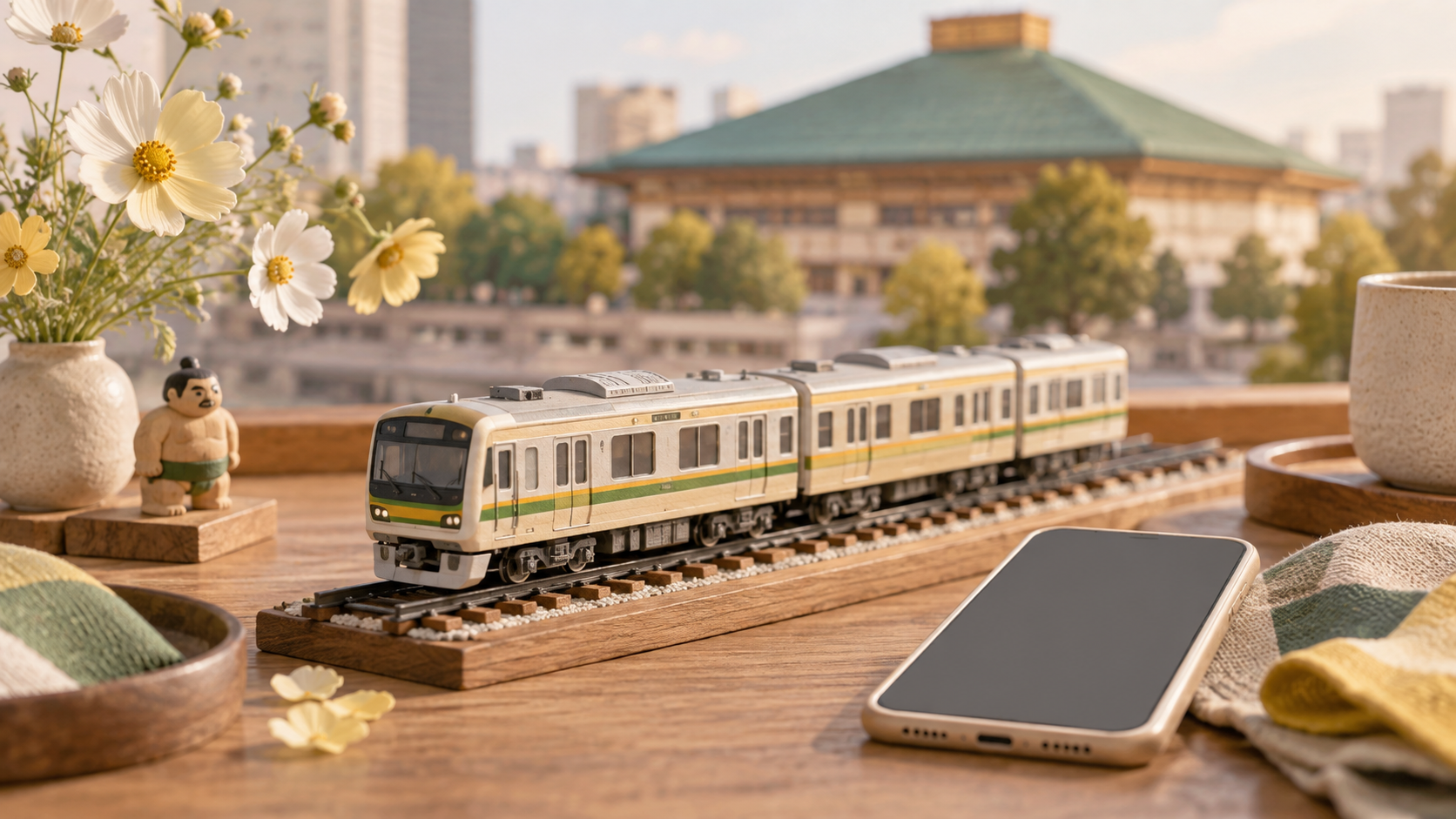
The Japan Sumo Association places Ryogoku Kokugikan two minutes on foot from the west exit of JR Ryogoku Station and five minutes from the Toei Oedo Line’s Ryogoku Station. “Ryogoku” is not one shared ticket gate. Save the railway, exit and station you will use on the journey home. Kokugikan has no visitor parking, and the official guide asks spectators to use public transport.
Separate JR and the Oedo Line before travelling
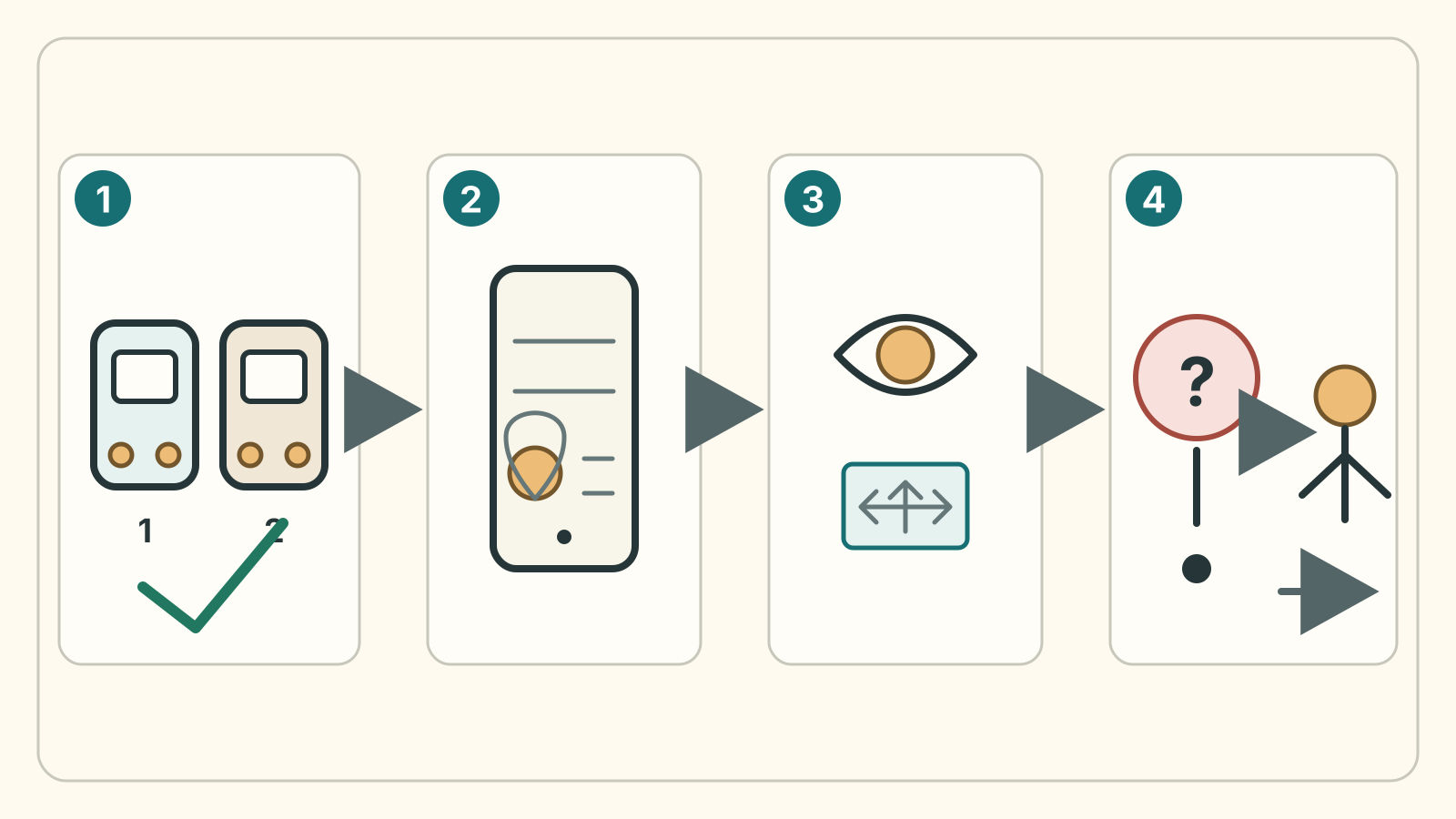
The JR option is Ryogoku on the Chuo-Sobu local service, with the west exit named in the Association’s guide. The subway option is Ryogoku on the Toei Oedo Line. A message saying only “meet at Ryogoku Station” can leave two people at different rail facilities or street exits.
Name the operator and landmark: “JR Ryogoku west exit” is far more useful than “the station.” For the subway, save the current official exit map and agree on a numbered exit or another verified feature. The tournament notice asks people not to wait for wrestlers around the venue because it disturbs the neighbourhood, so do not turn a congested athlete route into a private meeting point.
Detailed description of this diagram
Four cards run from left to right. Card 1 uses two differently outlined generic trains numbered 1 and 2 to separate JR Sobu Line Ryogoku Station from Toei Oedo Line Ryogoku Station despite the shared place name. They reproduce no real vehicle, logo or line colour. Card 2 places two information fields and a generic location-pin shape in an abstract phone, representing the editorial step of saving the operator or line together with the intended exit. It is not an actual app or ticket interface. Card 3 combines an eye with a generic four-arrow sign, meaning to compare the current operator's signs after arrival; its arrows do not point to real stations or Kokugikan. Card 4 moves from a question mark and stop point to an abstract station attendant, meaning to show the current location rather than walk by inference when saved details and live signs do not match. The graphic contains no station relationship, exit shape, route for the published two- or five-minute walking estimate, platform, stair, lift, level change, distance, crowd condition, duration or guarantee of arrival or accessibility.
Graphic: SUMO ARCHAEOLOGY CLUB · Figure source 1 · Figure source 2 · Figure source 3
Two or five minutes is not your complete arrival time
The published walking figures are useful orientation, not a promise covering the platform, lift, ticket gate, traffic signal, operating entrance, any inspection and the assigned seat. Add margin for a first visit, children, mobility needs, large luggage, rain or heat.
The Tokyo transport authority lists three lifts, a wheelchair-accessible toilet, lockers and other facilities at its Oedo Line Ryogoku station. The exact lift route, maintenance state and crowd level can change. A visitor who depends on a step-free route should read the current station map and ask staff rather than converting an equipment list into a guaranteed journey time.
Choose the departure station before the arrival station
Large numbers of spectators may leave after the final programme. The station that is shortest on arrival may not provide the simplest connection to your hotel, Shinkansen or airport. Save both a JR and Oedo Line route to the next important destination, then decide which one has fewer difficult transfers.
The Association’s daily timetable gives around 6 p.m. as the usual finish, but live competition can move. Do not book a final train or flight on the assumption that you will already be standing on the platform a few minutes after six. If a transport deadline is immovable, set an early-departure decision and an alternative route.
Keep cars and large luggage out of the fragile part of the plan
There is no arena parking. A taxi or private drop-off also does not create a guaranteed place to wait at the entrance; follow current traffic control and staff directions. Keep a suitcase at accommodation, in a verified station facility or with a current forwarding service where practical. Do not block a seat, aisle or evacuation route with it.
One direction clue for the arena
After arrival, notice how people divide toward the building’s east and west sides. Wrestlers also enter from east and west. A small piece of street orientation can make the directional language on the banzuke and in the arena feel less abstract.
“Two Minutes from the Station” Is Not a Platform-to-Seat Time
The official walking figure describes the stated station/exit and the Kokugikan; we found no confirmation that it includes the platform, congestion, admission, toilet and seat-finding. Our method compares the official venue access page with the railway operator’s station map and separates the journey into legs. We do not estimate a single platform-to-seat total. Add personal buffer for lifts or transfers, save a second railway route or taxi point for disruption, and show your current location to station or venue staff if lost.
Sources
- Japan Sumo Association, September 2026 Tokyo access guide, checked September 3, 2026, for JR and Oedo Line walking estimates and the no-parking statement.
- Tokyo Metropolitan Bureau of Transportation, Ryogoku Station guide, checked the same day for the Oedo Line station and listed accessibility facilities.
- Japan Sumo Association, September 2026 spectator notice, checked for the request not to wait for wrestlers around the venue.
Source links used for verification
Each link was used for the corresponding claim in this article; inclusion is not a blanket endorsement of the whole page.
Article verified:
- Japan Sumo Association September 2026 Tokyo access guidePrimary source (as checked for this article)
- Tokyo Metropolitan Bureau of Transportation Ryogoku Station guidePrimary source (as checked for this article)
- Japan Sumo Association September 2026 Tokyo spectator noticePrimary source (as checked for this article)