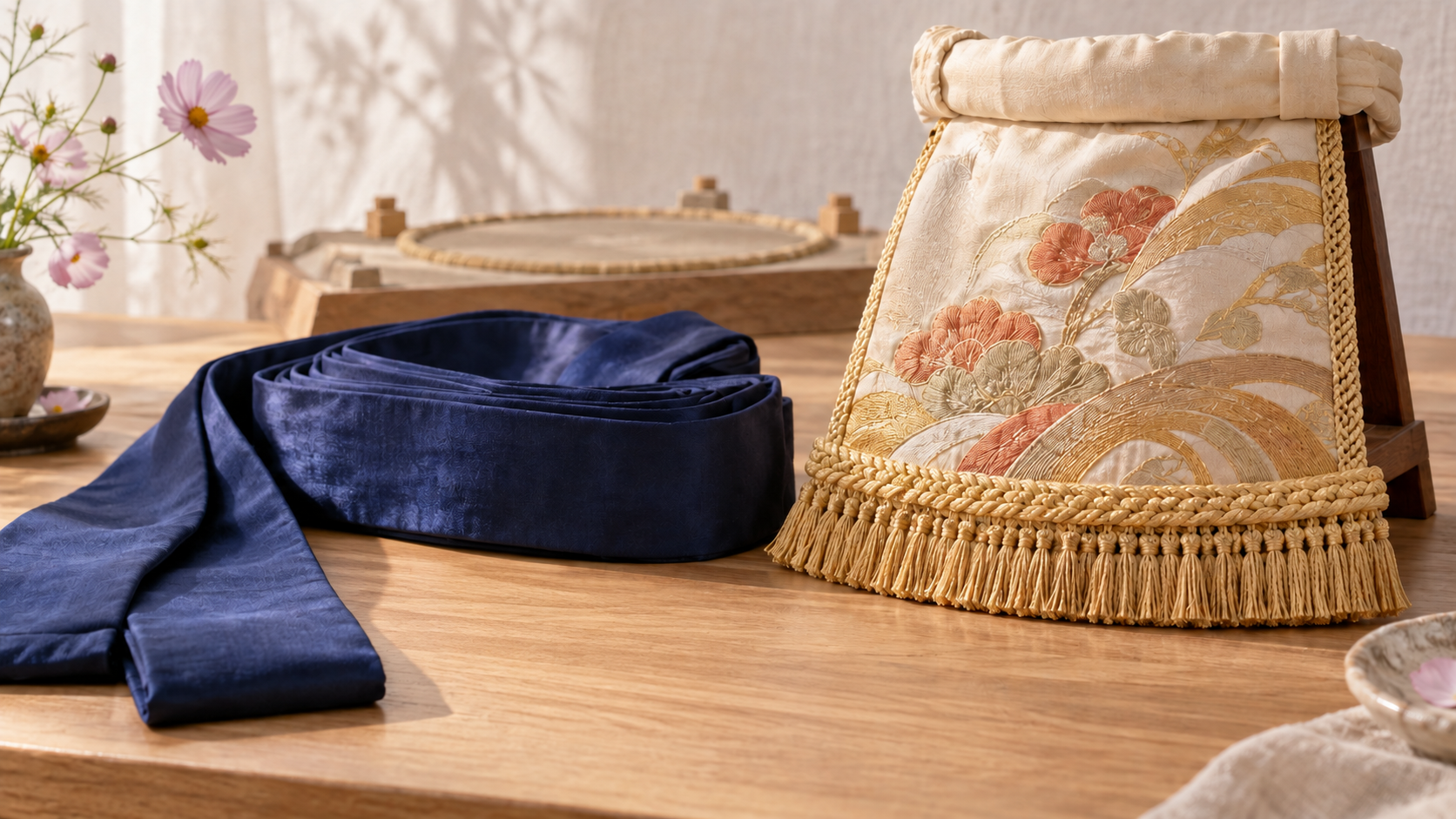
A *shimekomi* is the silk mawashi worn by a salaried wrestler in an official bout. A *kesho-mawashi* is the embroidered ceremonial apron worn by wrestlers in the juryo and makuuchi ring-entry processions. One is grabbed, pulled and tested in competition; the other presents a name and design before competition begins. The easiest way to learn the difference is not to memorise two definitions. Choose one wrestler during ring entry and find him again after he has changed.
English coverage often calls both objects a “belt,” which is understandable but visually unhelpful. They belong to different parts of the day and have different structures. Following one person across the change turns ring entry and the bouts from separate programme items into the first and second acts of the same appearance.
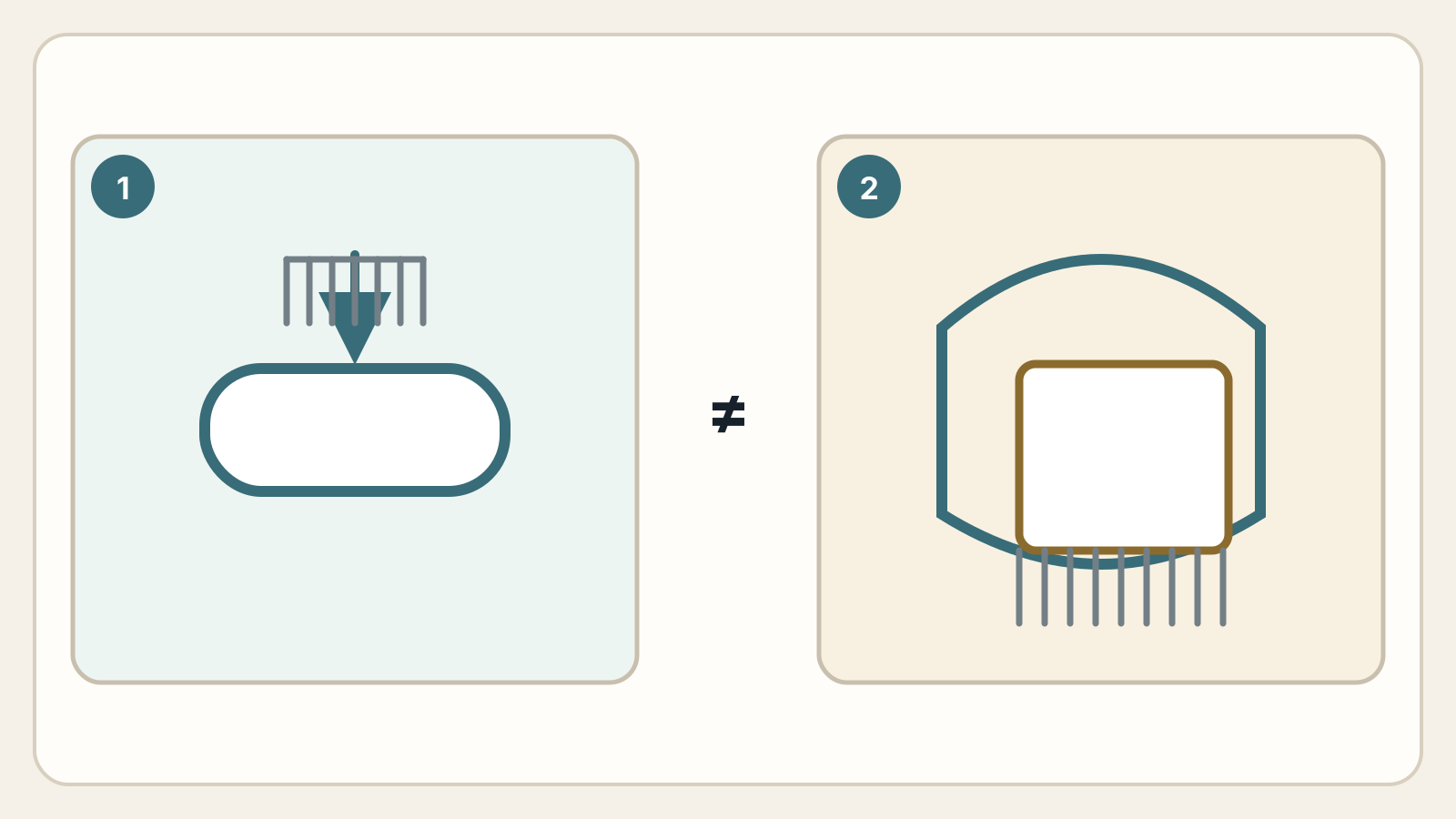
Detailed description of this diagram
The left card places an inserted component with several short lines above a blank closed belt token, using an arrow to express the competition shimekomi and sagari relation. Across a not-equal sign, the right card runs one blank band continuously into a front-panel rectangle, with short fringe lines below for baren. Neither token is a garment fitted on a body. It omits people, wrapping, real silhouette, dimensions, weight, silk or textile appearance, colour, embroidery, motif, donor, sponsor, logo, body fit, drape and motion during the ceremony.
Graphic: SUMO ARCHAEOLOGY CLUB · Figure source 1 · Figure source 2
The comparison at a glance
| What to compare | Shimekomi | Kesho-mawashi | |—|—|—| | Main use | Juryo and makuuchi tournament bouts | Juryo and makuuchi ring entry | | Appearance | Usually a solid-colour belt | Embroidered front apron with fringe | | Official guide figure | Silk, approximately 10 metres long | Continuous belt and apron, approximately 7 metres and 6–8 kilograms | | What hangs at the front | Sagari strings inserted into the belt | Baren fringe attached below the apron |
The figures are useful guides, not dimensions guaranteed for every individual piece. The Sumo Association itself qualifies the apron weight as varying by wrestler.
The shimekomi enters the contest
The Japan Sumo Association uses *shimekomi* for the competition mawashi worn by wrestlers with salaried rank. It is made of silk and is roughly ten metres long. Association rules describe navy or purple families of colour, while the Association’s own explainer notes that a much wider range is seen in practice.
The narrow cords hanging at the front are the *sagari*, inserted into the shimekomi. The selected sources attached to this comparison do not by themselves codify where an opponent may grip or every result of a loose sagari. Treat belt colour and sagari only as viewing clues; use the dedicated sagari article and current rules for what happens when one comes loose.
The kesho-mawashi introduces the wrestler
A kesho-mawashi is a continuous piece whose long belt wraps around the body and whose decorated apron hangs in front. The Association describes examples made with Hakata or Nishijin weaving. It gives an approximate length of seven metres and a weight of six to eight kilograms, depending on the wrestler. The fringe below the front panel is called *baren*.
Purple baren carry a rank restriction: the official explanation reserves them for yokozuna and ozeki. A motif, however, should not be treated as an automatic biography. Some aprons have documented donors and meanings; many designs do not have a public explanation attached. “I wonder why that bird is there” is better than inventing a confident story.
The same colour does not have to return
The selected sources do not state a general rule requiring the kesho-mawashi colour to match the competition shimekomi. Do not predict a red belt from a red apron. Use the announced name or broadcast identification to confirm the wrestler rather than deciding from build, hair or gait alone.
The Sumo Museum reinforces the distinction in the way it catalogues objects. Its Kisenosato exhibition separately described a used shimekomi and sagari, ceremonial aprons and the *akeni* carrying chest that held equipment. Museum labels do not collapse all of these into one generic “mawashi,” and neither should a beginner’s guide.
Arrive before ring entry if you want to see both
To follow the transformation, you need to be in your seat before the procession. The cited official page displays September 2026 Tokyo guide times—about 2:15 p.m. for juryo ring entry, 2:35 p.m. for juryo bouts, 3:40 p.m. for makuuchi ring entry and 4:05 p.m. for bouts—while retaining a May-tournament caveat. Treat them as conflicted provisional guides, not universal times; recheck the official page on your date and do not plan an arrival at the last minute.
One thing to watch next time
During ring entry, choose one apron instead of trying to absorb the whole circle. Catch one name. When the bouts begin, look for the same shoulders and walk inside a plain-coloured shimekomi.
The moment you think, “That is the wrestler with the embroidered crane,” you have learned more than two clothing terms. Someone who was one bright rectangle in a crowd has become the person whose return you anticipated. The difference between shimekomi and kesho-mawashi is worth knowing because it creates that tiny reunion—and tiny reunions are how a fifteen-day tournament begins to feel personal.
Keep More Than One Interpretation Open
We separate what the official or collection source establishes from our observation. A ritual, object or posture may have another interpretation or theory across periods, regions and explainers. When primary evidence does not establish a single origin or meaning, we leave it unknown or contested rather than turn visual resemblance into historical fact.
Where the Evidence Stops
A name, form or procedure confirmed by an official source is a fact; it does not automatically establish a person’s intention or a religious meaning. What the source does not state remains unknown. If an observation suggests a hypothesis, we label the inference, show what could contradict it and name the source that would resolve it.
Sources
- Japan Sumo Association, Sumo Quiz No. 318 on shimekomi and sagari, published 22 November 2022 (checked 2 September 2026)
- Japan Sumo Association, Sumo Quiz No. 352 on kesho-mawashi construction and baren, published 26 December 2022 (checked 2 September 2026)
- Japan Sumo Association, Sumo Quiz No. 680 on purple baren, published 19 November 2023 (checked 2 September 2026)
- Sumo Museum, special exhibition on the 72nd yokozuna Kisenosato and his equipment (checked 2 September 2026)
- Japan Sumo Association, September 2026 Tokyo dohyo schedule (checked 2 September 2026)
Source links used for verification
Each link was used for the corresponding claim in this article; inclusion is not a blanket endorsement of the whole page.
Article verified:
- Japan Sumo Association Sumo Quiz No. 318: shimekomi and sagariPrimary source (as checked for this article)
- Japan Sumo Association Sumo Quiz No. 352: kesho-mawashi and barenPrimary source (as checked for this article)
- Japan Sumo Association Sumo Quiz No. 680: purple barenPrimary source (as checked for this article)
- Sumo Museum special exhibition on 72nd yokozuna KisenosatoHistorical primary source (record from that period)
- Japan Sumo Association: September 2026 Tokyo dohyo schedulePrimary source (conflicting details noted)