The narrow strands hanging from the front of a wrestler’s mawashi during a bout are called sagari. For a salaried juryo or makuuchi wrestler, they are made from silk matching his competition belt and stiffened one strand at a time with paste. Their number is odd for good-luck reasons. If the sagari falls out during a bout, the wrestler must not pick it up with his hand.
At the initial charge, the strands flare like a small fan and then vanish between two bodies. They are easy to dismiss as a modesty fringe. Learning that each strand is prepared, combed and stiffened—and that even a loose one has to be handled in a particular way—turns this tiny object into one of the liveliest details in the ring.
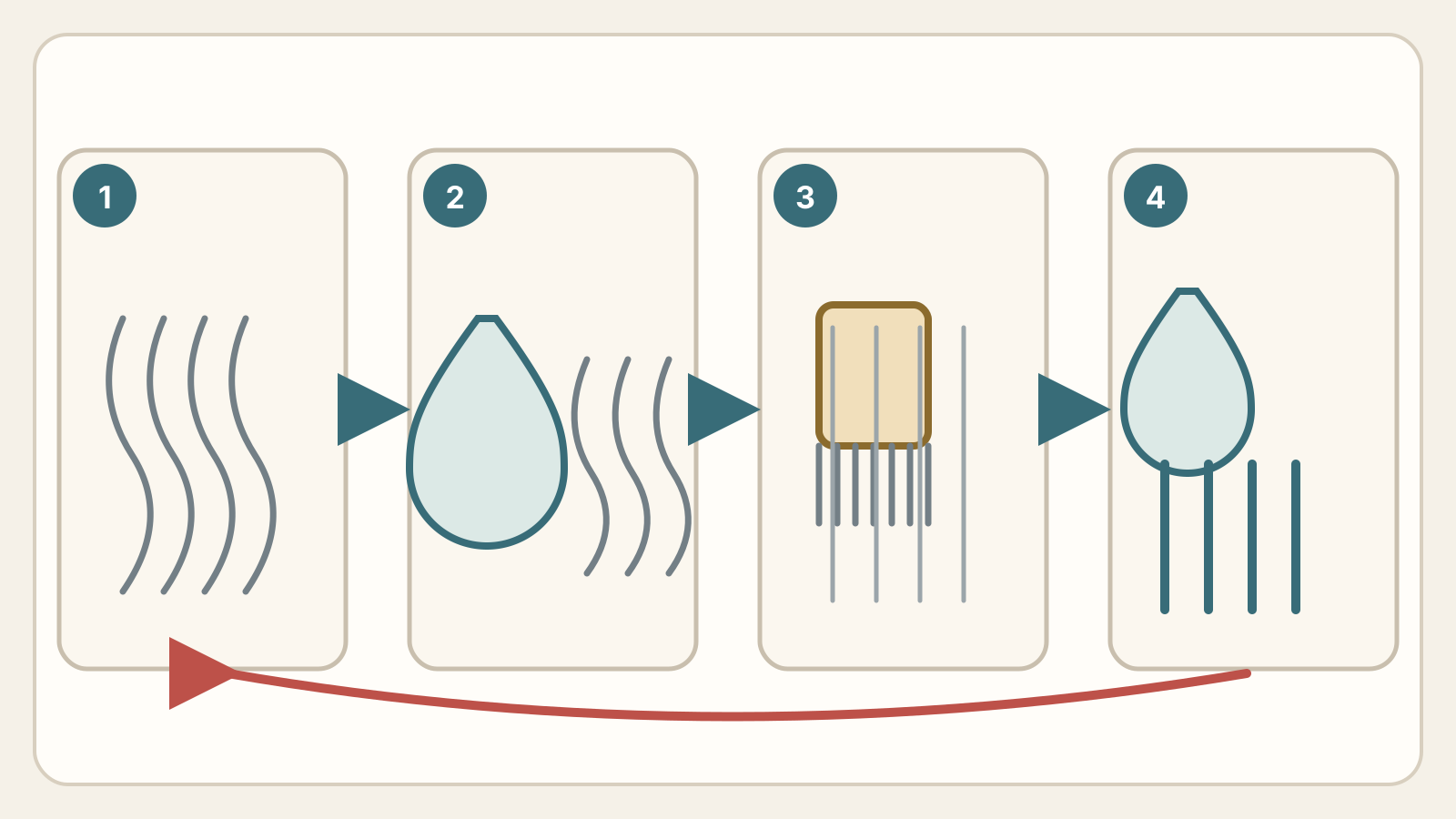
Detailed description of this diagram
Four cards are joined in a loop. The first uses several bent lines for the post-tournament state. The second adds a droplet and soft wavy lines for removing paste and returning to silk threads. The third uses a blank generic comb token and parallel lines for arranging the fibres. The fourth combines a drop and straight lines for working paste in and stiffening strands. The number and colours of lines are not factual counts or material colours. Fibre gauge, paste recipe, comb type and size, force, drying time, stiffness, body placement and an authentic craft procedure are not established and are omitted.
Graphic: SUMO ARCHAEOLOGY CLUB · Figure source
Salaried wrestlers use stiff, matching silk strands
The Japan Sumo Association distinguishes the silk *shimekomi* worn in official bouts by wrestlers in the top two divisions from the cotton practice mawashi used by wrestlers below juryo. The sagari is tucked into the front. For a salaried wrestler, the strands are made from the same cloth and match the shimekomi’s colour.
Their rigid appearance does not come from plastic or hidden wire. An Association feature says each silk strand is set with paste. Traditional funori seaweed paste is generally used, with other types sometimes mixed in to improve its strength.
That construction gives you an easy visual way to distinguish levels when watching a full day of sumo. Lower-division wrestlers use soft, unstiffened sagari with their cotton mawashi; the Association notes that those strands are not required to match the belt’s colour. By the time juryo arrives, the firm matching lines make the competition dress look noticeably different.
They are remade after each tournament
Fifteen days of collisions bend the stiff strands and wear away the paste. The Association’s 2025 explanation says that after a tournament the coating is removed, leaving individual silk threads. They are carefully combed, soaked with paste again and formed back into straight rods.
This is not a claim that every slightly crooked strand has been neglected. Quite the opposite: it reminds us that a slim line on screen has been through real bouts and will need real maintenance. Sumo’s material culture is full of such backstage cycles—build, use, repair and prepare again.
Odd does not mean “always nineteen”
The Association explains the odd count as wordplay and good-luck practice. An even number can be divided cleanly; in Japanese, “breaking the dohyo” also describes being forced out. Wrestlers therefore avoid an even number of sagari.
The reliable rule in this source is “an odd number”, not “exactly nineteen in every case”. Popular explainers often turn a common count into an absolute. You do not need to freeze the broadcast and count anyway. Find the middle strand before the charge and notice how the lines spread on impact—that is enough to make them visible.
A fallen sagari does not stop the contest
Sometimes the whole piece works loose and drops onto the clay. The Association’s official explainer says that if a wrestler picks up his own fallen sagari with his hand, he loses. It must instead be brushed away with a foot or removed by the referee.
This detail corrects an intuitive misunderstanding. A wrestler who ignores the fallen object is not being careless or disrespectful; the contest takes priority, and the rules shape who may move it. Next time one falls, watch the wrestler’s feet and the referee’s route rather than waiting for someone to bend down. A small costume mishap reveals the referee’s awareness of much more than the two bodies.
Its history comes with an honest gap
An Association article relates today’s sagari to the *baren* fringe of an older, apron-like form of competition dress. It describes the large front panel being removed and the fringe changing over time into separate strands. Importantly, that same article says the dates of the individual changes are unknown. Another Association explainer places the separation of belt and sagari by the end of the Edo period and links it to the danger of fingers catching.
Those official accounts are useful, but they do not justify inventing a single year when the modern sagari was “created”. The firmest distinction is in front of us now: baren hangs below a decorated kesho-mawashi in ring entry; sagari is tucked into the competition belt for a bout.
One thing to watch at the next charge
For one match, ignore the count. Watch a single central strand as the wrestlers launch. It jumps, bends into the contest and reappears when their bodies separate.
That strand began as silk thread, was combed and pasted by hand, and will be prepared again after the tournament. It does not decide the result, yet the force of the result passes through it. Following something so small makes the collision look larger—not because anyone told you to admire tradition, but because you have just seen where tradition physically flexes.
Sources
- Japan Sumo Association, Sumo Quiz No. 318 on shimekomi and sagari, published 22 November 2022 (checked 2 September 2026)
- Japan Sumo Association, Sumo Quiz No. 1231 on preparing stiff sagari, published 23 May 2025 (checked 2 September 2026)
- Japan Sumo Association, Sumo Quiz No. 773 on a fallen sagari, published 20 February 2024 (checked 2 September 2026)
- Japan Sumo Association, Sumo Quiz No. 888 on lower-division sagari, published 14 June 2024 (checked 2 September 2026)
- Japan Sumo Association, Sumo Quiz No. 1318 on the reported development of sagari, published 18 August 2025 (checked 2 September 2026)
Source links used for verification
Each link was used for the corresponding claim in this article; inclusion is not a blanket endorsement of the whole page.
Article verified:
- Japan Sumo Association Sumo Quiz No. 318: shimekomi and sagariPrimary source (as checked for this article)
- Japan Sumo Association Sumo Quiz No. 1231: starching salaried wrestlers' sagariPrimary source (as checked for this article)
- Japan Sumo Association Sumo Quiz No. 773: a fallen sagariPrimary source (as checked for this article)
- Japan Sumo Association Sumo Quiz No. 888: lower-division sagariPrimary source (as checked for this article)
- Japan Sumo Association Sumo Quiz No. 1318: the reported development of sagariPrimary source (as checked for this article)