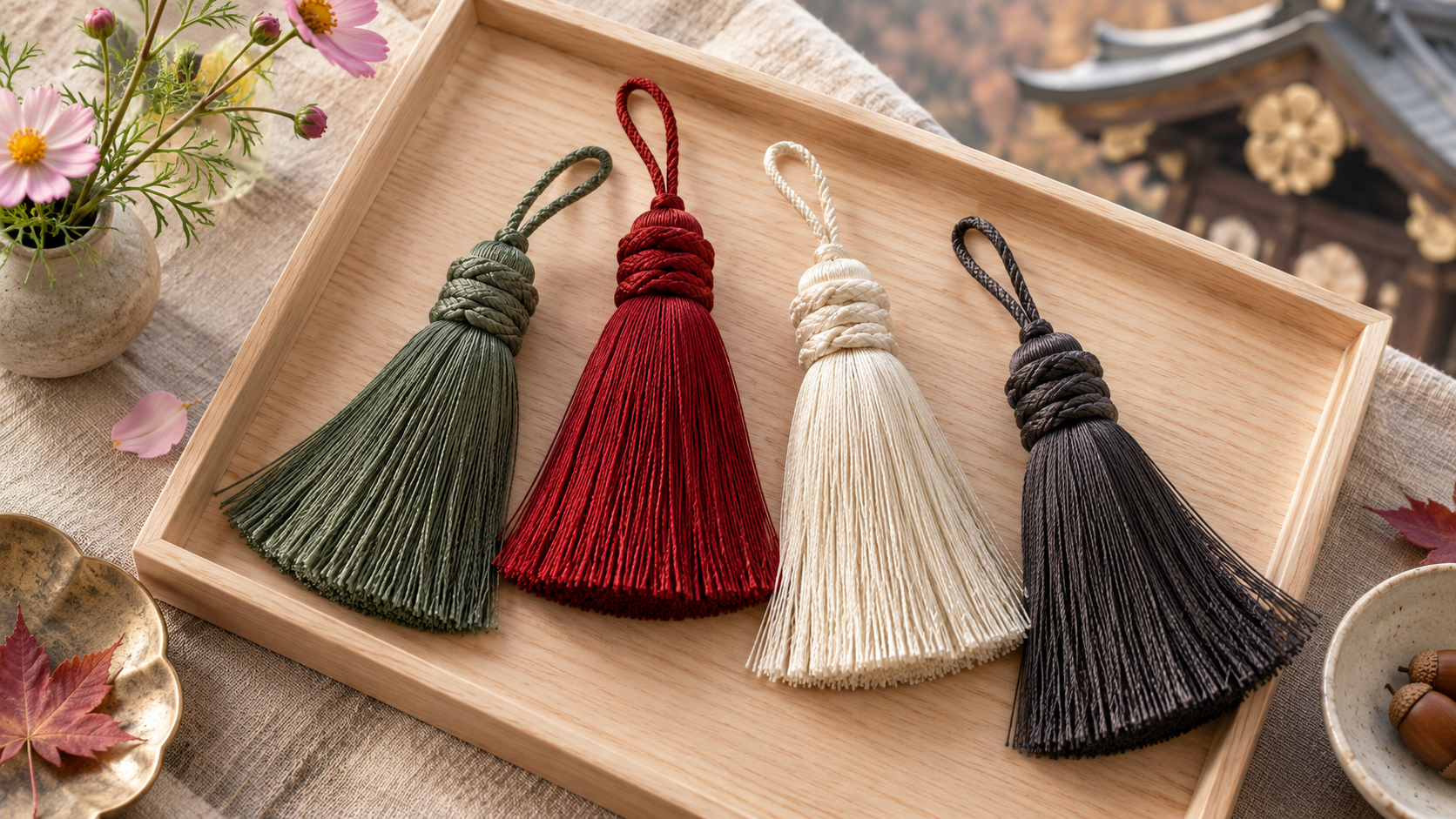
Four tassels hang from the suspended roof above the dohyo: blue or blue-green, red, white and black. The blue tassel represents spring, east and the Azure Dragon; red represents summer, south and the Vermilion Bird; white represents autumn, west and the White Tiger; black represents winter, north and the Black Tortoise. From the arena’s designated front, east is on your left and west on your right. One colour can therefore help you read an unfamiliar venue.
During a bout, the wrestlers pull every eye towards the clay and the enormous roof can almost disappear. Look up while the action pauses and the colours appear at its corners. They are not simply decoration: each one carries a season, a direction and a guardian creature. Suddenly the small circular ring seems to sit inside a much wider map.
Detailed description of this diagram
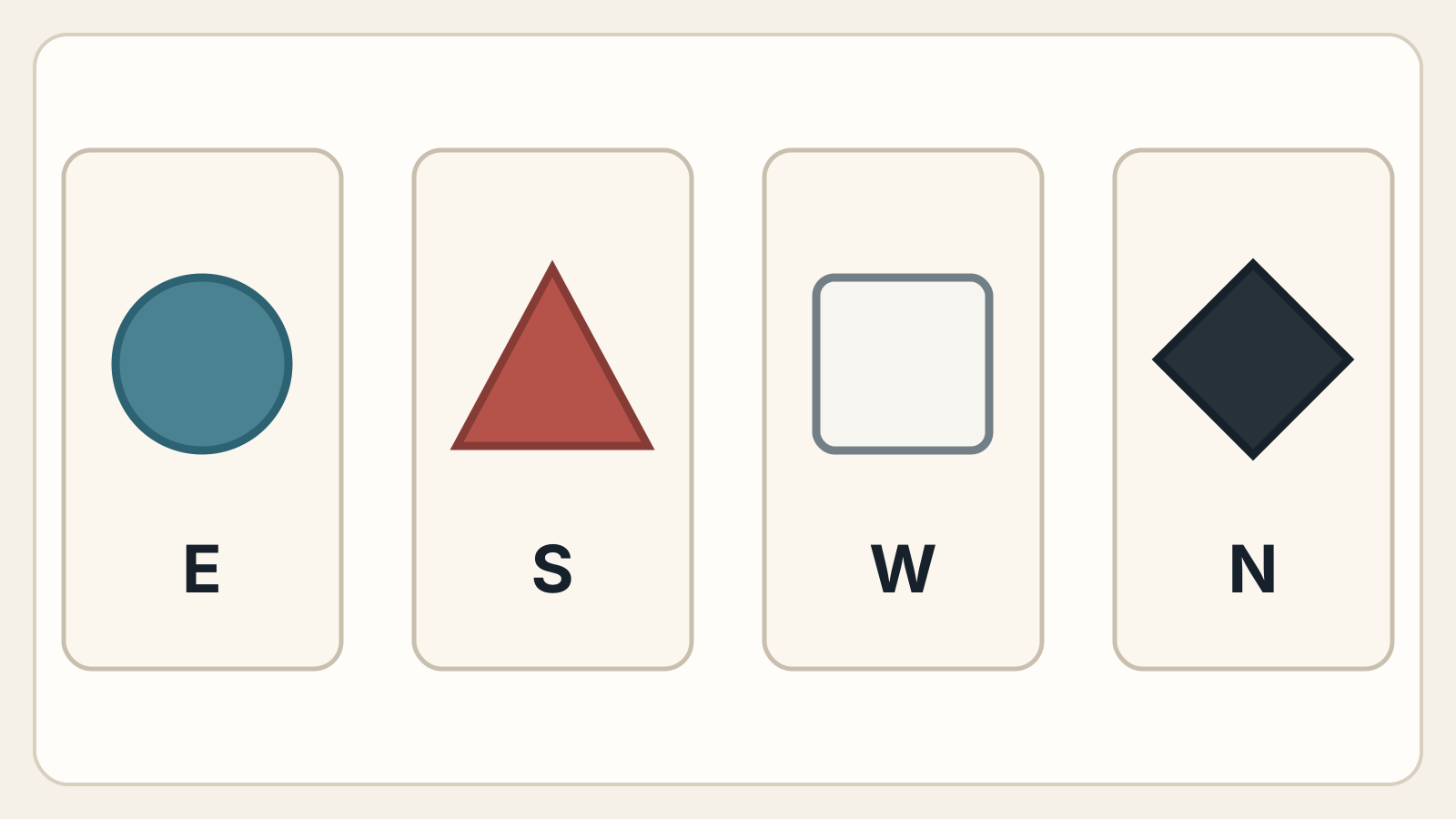
Four independent cards use a circle, triangle, square and diamond as redundant cues alongside E, S, W and N. The source-backed associations are blue or blue-green with spring, East and Azure Dragon; red with summer, South and Vermilion Bird; white with autumn, West and White Tiger; and black with winter, North and Black Tortoise. On-screen colours are explanatory categories, not samples, dyes, calibrated RGB values or predictions under arena lighting. Card order and position reproduce no roof, ring, seating plan, designated front or geographic orientation.
Graphic: SUMO ARCHAEOLOGY CLUB · Figure source 1 · Figure source 2
Four colours, four seasons and four guardians
The Japan Sumo Association gives the correspondences as follows:
- Blue tassel: spring, east and the Azure Dragon
- Red tassel: summer, south and the Vermilion Bird
- White tassel: autumn, west and the White Tiger
- Black tassel: winter, north and the Black Tortoise
The official Japanese material describes the first colour as blue while noting that the physical tassel may appear green. English translations of the guardian names also vary—Azure Dragon is sometimes rendered as Blue-Green Dragon—but the directional relationship remains the useful viewing clue.
Arena east and west are defined from the front
These directions do not necessarily match the building’s geographical compass points. According to the Association’s explanation, stand conceptually at the designated front, or *shomen*, and look towards the ring: east is to your left and west to your right. The front lies between the black and blue tassels; the opposite side, *muko-jomen*, lies between red and white.
Beginning at the front-right corner and moving clockwise, the colours run black, blue, red and white. If a ticket says front, opposite side, east or west, the hanging colours can confirm where you are sitting and which entrance path a wrestler will use.
Why are there tassels instead of supporting pillars?
The ring roof was once held up by four physical pillars. The Association’s historical account says that those pillars obstructed spectators’ sightlines and were removed in 1952. The structure became the suspended, shrine-like roof seen today, with a coloured tassel hanging at each former corner.
The Association sources establish that the pillars were removed to improve sightlines and that four coloured tassels now hang at the corners. Reading the tassels as markers that preserve the absent supports is our visual interpretation, not a verified statement of the 1952 designer’s intention. Establishing that causal design story would require the renovation plans or contemporary records.
We can enjoy the surviving four-sided pattern while keeping the boundary clear: present layout is fact; the idea that the tassels deliberately memorialise the pillars remains an inference. The Association explainers consulted here do not settle the origin of that design choice or compare competing design accounts. Until contemporary plans or records are found, that origin is unknown and another interpretation remains possible.
The same dohyo changes with your seat
From the front, the gyoji’s movements and the east–west relationship may be easy to read. From the opposite side, the front stands form the background. From east or west, the initial charge is closer to a side-on view. There is no single universally “best” direction; the tassels help you notice what your direction reveals.
The east and west printed on the banzuke also become physical in the arena. The caller announces each side, and wrestlers arrive along their respective entrance routes. Blue and white overhead place colour at those two ends of the contest.
Find just one colour before the next bout
There is no need to memorise the whole system on your first day. Find the blue tassel. The arena’s east side is beneath it. Watch where the wrestlers line up during the ring entrance, then notice how the referee turns as the bout begins. Add red, white and black on later visits.
The dohyo is a circle, but it contains four directions and an entire cycle from spring to winter. Once you notice that the seasons are hanging above a contest that may last only seconds, even the interval before the next wrestler steps onto the clay becomes part of sumo.
Sources
- Japan Sumo Association, Sumo Quiz No. 7 on the four tassels (published 15 January 2022; checked 2 September 2026)
- Japan Sumo Association, Sumo Quiz No. 929 on dohyo orientation (published 25 July 2024; checked 2 September 2026)
- Japan Sumo Association, Sumo Quiz No. 87 on the suspended roof (published 5 April 2022; checked 2 September 2026)
Source links used for verification
Each link was used for the corresponding claim in this article; inclusion is not a blanket endorsement of the whole page.
Article verified:
- Japan Sumo Association Sumo Quiz No. 7: the four tasselsHistorical primary source (record from that period)
- Japan Sumo Association Sumo Quiz No. 929: dohyo orientationHistorical primary source (record from that period)
- Japan Sumo Association Sumo Quiz No. 87: the suspended roofHistorical primary source (record from that period)