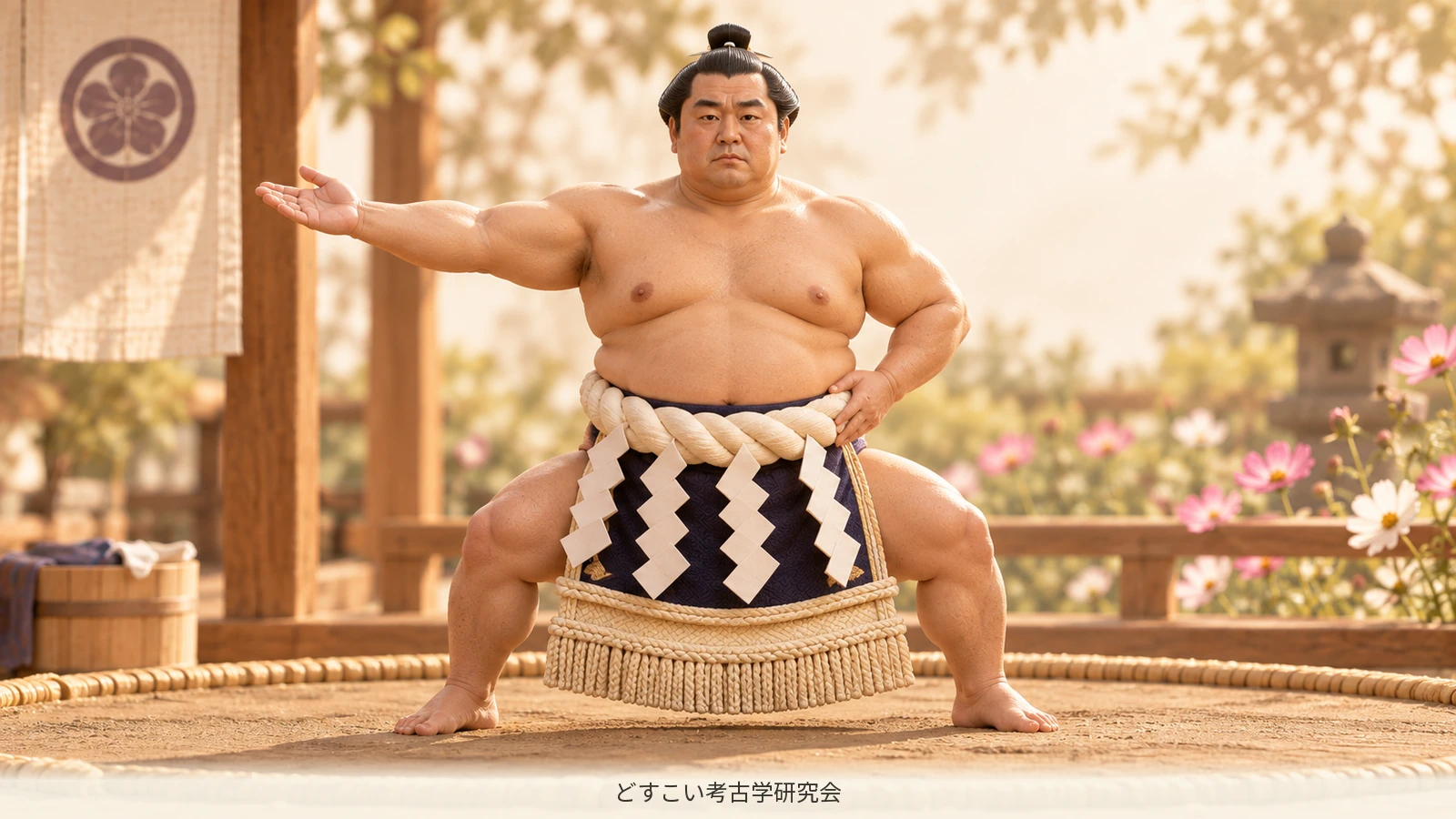
Watch the arms during the rising movement. In the Unryu style, the yokozuna opens his right arm and keeps his left hand near his side. In the Shiranui style, he opens both arms. From behind, the ceremonial rope has one loop in Unryu and two in Shiranui. For a first viewing, forget the whole history and ask only: one arm open, or two?
A yokozuna dohyo-iri can initially look like the same solemn ritual performed by different champions. Once the arms separate the two forms, the eye searches for the rope. Then it notices the attendants. A single clue makes the ceremony expand.
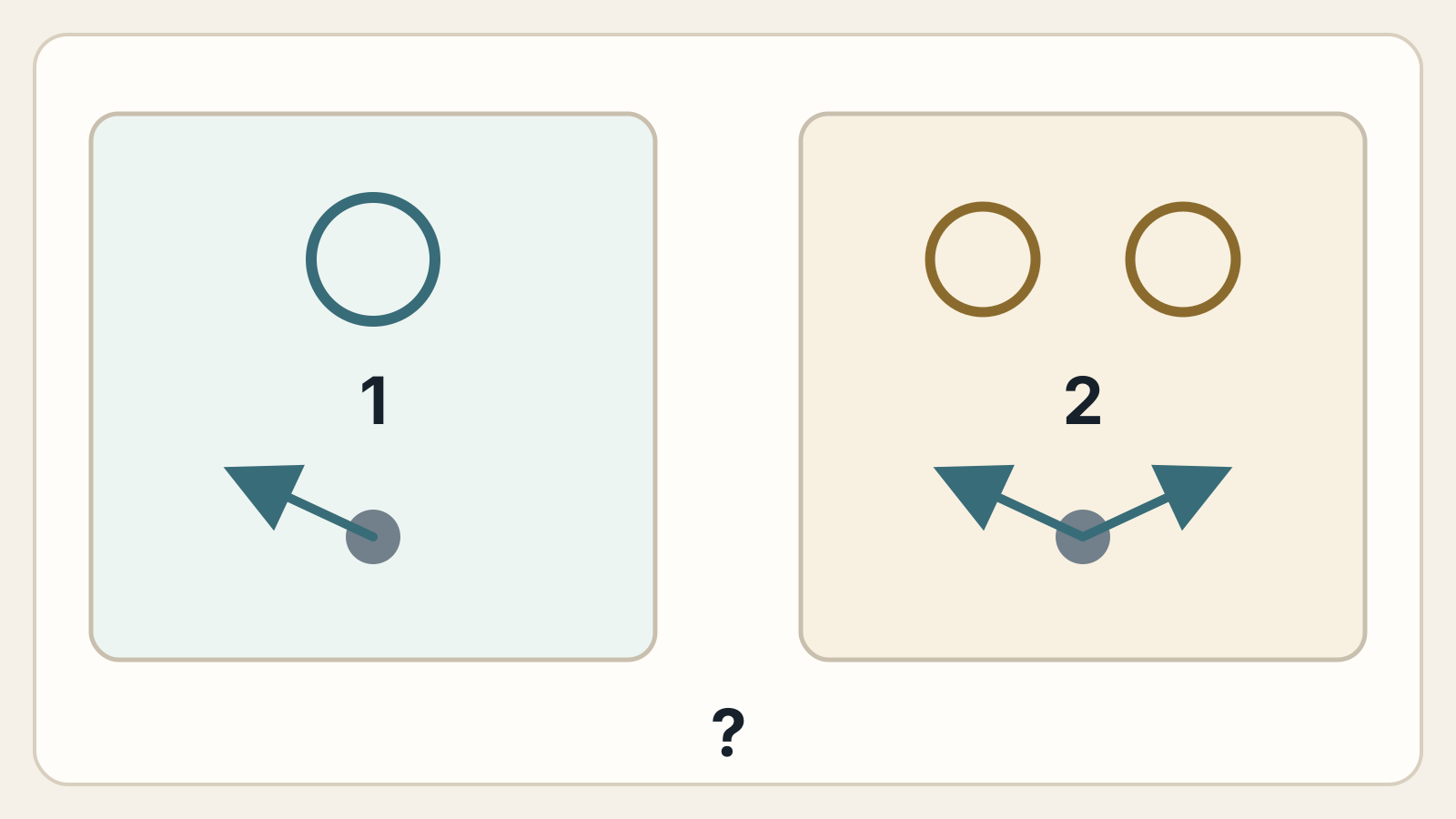
Detailed description of this diagram
The left column places one circle above a centre token with a ray on one side. The right column places two circles above a centre token with rays on both sides. Circles are count tokens for the rear-loop clue, and rays encode asymmetry versus symmetry; neither reproduces a rope, arm or person. A question mark below separates observable form from unsettled naming history and unsupported personality readings. Arm-side labels, angles, hands, feet, rising motion, speed, attendants, anatomy, rope shape, dimensions, fit and camera direction are omitted.
Graphic: SUMO ARCHAEOLOGY CLUB · Figure source 1 · Figure source 2 · Figure source 3
Unryu: one arm open, one held close
The Sumo Museum’s official exhibition explanation describes the Unryu rope as having one rear loop. During the seriagari, the slow rising movement, the yokozuna spreads his right arm while holding the left at his side. The form is said to represent both attack and defence.
The right and left are the yokozuna’s, which may look reversed depending on your seat or screen. The easiest first cue is asymmetry: one arm extends broadly while the other remains near the body. If your view includes the back of the tsuna, look for the single loop as confirmation.
Shiranui: both arms open
The Shiranui rope has two rear loops, and both arms spread during the rise. Official explanations say that the pose represents active attack. Both arms can be a useful clue, but distance, obstruction and camera angle may hide the movement. If the clue is unclear, do not assign a style.
Do not turn those symbolic descriptions into personality tests. “Unryu includes defence” does not prove that a particular yokozuna is cautious, and “Shiranui represents attack” does not measure his actual ring style. They are meanings traditionally associated with the ceremonial forms.
The names do not give us a perfectly straight origin story
This is where a simple visual difference opens a historical puzzle. An Association feature notes that the actual entrance once performed by Shiranui Koemon is not known with certainty and that some enthusiasts have argued it looked closer to what is now called Unryu. The same official explanation connects the earliest filmable Unryu form with the second Umegatani and the two-arm form inherited by modern Shiranui with Tachiyama.
It is therefore too neat to say that a wrestler named Unryu invented the exact present Unryu form and a wrestler named Shiranui invented the exact present Shiranui form. The labels survived while performance, memory and later classification shaped their histories. That uncertainty does not weaken the ritual; it gives the names something to investigate.
There are three wrestlers in the entrance
This article limits itself to the yokozuna’s arms and rope loops. The attendants’ roles, sides, affiliations and apron relationships are not supplied by these three sources and belong in an article with separate primary evidence.
The return of sound matters too. A foot stamp reaches the upper seats differently from a close television microphone. If you take photographs, lower the device for one complete seriagari and let the movement finish in your eyes.
A three-viewing route into the ritual
On the first viewing, identify the arms. On the second, confirm the rope loops. On the third, learn which earlier yokozuna used the same style and where the historical account becomes uncertain. Knowledge grows out of something you actually saw rather than arriving as homework before the ceremony.
A seat or camera angle may hide the arms or rope. Do not decide from one clue alone: compare the arm asymmetry with the loop count only when another view makes both visible. If they remain hidden, record the style as unresolved rather than infer it from a product name or impression.
Sources
- Sumo Museum, exhibition on the Unryu and Shiranui styles (2024; checked 2 September 2026)
- Japan Sumo Association, Sumo Quiz No. 1296 (published 27 July 2025; checked 2 September 2026)
- Japan Sumo Association, Sumo Quiz No. 203 (published 30 July 2022; checked 2 September 2026)
Source links used for verification
Each link was used for the corresponding claim in this article; inclusion is not a blanket endorsement of the whole page.
Article verified:
- Sumo Museum exhibition on the Unryu and Shiranui stylesHistorical primary source (record from that period)
- Japan Sumo Association Sumo Quiz No. 1296Historical primary source (record from that period)
- Japan Sumo Association Sumo Quiz No. 203Historical primary source (record from that period)