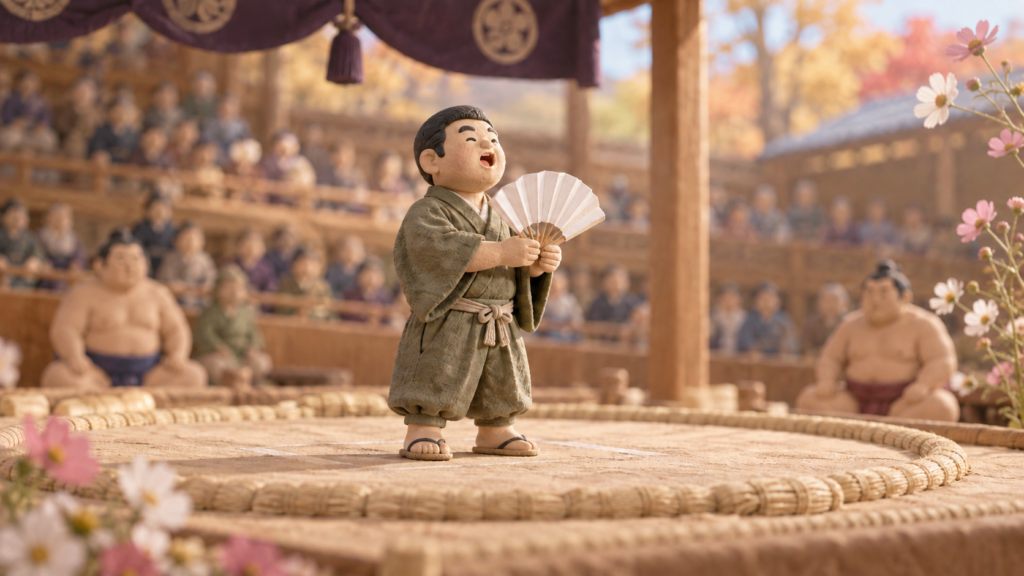
Before a bout, you may hear the same wrestler’s ring name called again. This double call, used at main tournaments and regional tours, is called futagoe.
It is used for bouts featuring the higher ranks and for the last juryo bout. A championship playoff during a main tournament is an exception: the name is called once.
When to listen for it
| Situation | Call |
|---|---|
| A bout featuring a komusubi, sekiwake, ozeki or yokozuna | Twice |
| The final juryo bout, called chubane | Twice |
| A championship playoff in a main tournament | Once |
The Japan Sumo Association explains that gyoji and yobidashi use the double call for bouts featuring sanyaku or higher. Sanyaku comprises ozeki, sekiwake and komusubi; yokozuna is included above them.
Both wrestlers do not have to be in those ranks. A maegashira facing an ozeki is still a bout featuring an ozeki.
Nor does “twice” mean one call for each of the two wrestlers. It means repeating an individual wrestler’s name.
An older bout order survives in the sound
The final juryo bout is called chubane. Its double call preserves a trace of an older schedule.
According to the Association, yokozuna and ozeki bouts also took place before the main intermission until May 1926. The double call at the end of juryo is a remnant of that arrangement.
Something that seems puzzling from today’s ranks starts to make sense when you look at the old bout order. It gives you another reason to listen before makuuchi begins.
Who is calling, and which side comes first?
The person opening a white fan and calling the wrestlers before the bout is a yobidashi. Gyoji also call the names on the dohyo. Noticing the moment in the proceedings helps distinguish these calls from the public-address announcement or television commentary.
Yobidashi call the East side first on odd-numbered tournament days and the West first on even-numbered days. Count from Day 1 of the tournament; this is not the odd or even date on the calendar.
There’s no need to memorize everything at once. Listening for a repeated name at the end of juryo is a good place to start. Commentary or applause may cover part of the call on a broadcast, so it’s fine to try again another time.
Sources and update
- Japan Sumo Association, Quiz No.1142: qualifying bouts, chubane, its history and the playoff exception.
- Quiz No.613: explanation of futagoe.
- Quiz No.1316: the East/West calling order.
- Quiz No.253: gyoji and public-address announcements.
Checked October 2, 2026. The qualifying cases are now presented in a table, with an additional chubane source and a clearer explanation of the calling order.
Related reading
Which side does a yobidashi call first?
What does a yobidashi do?