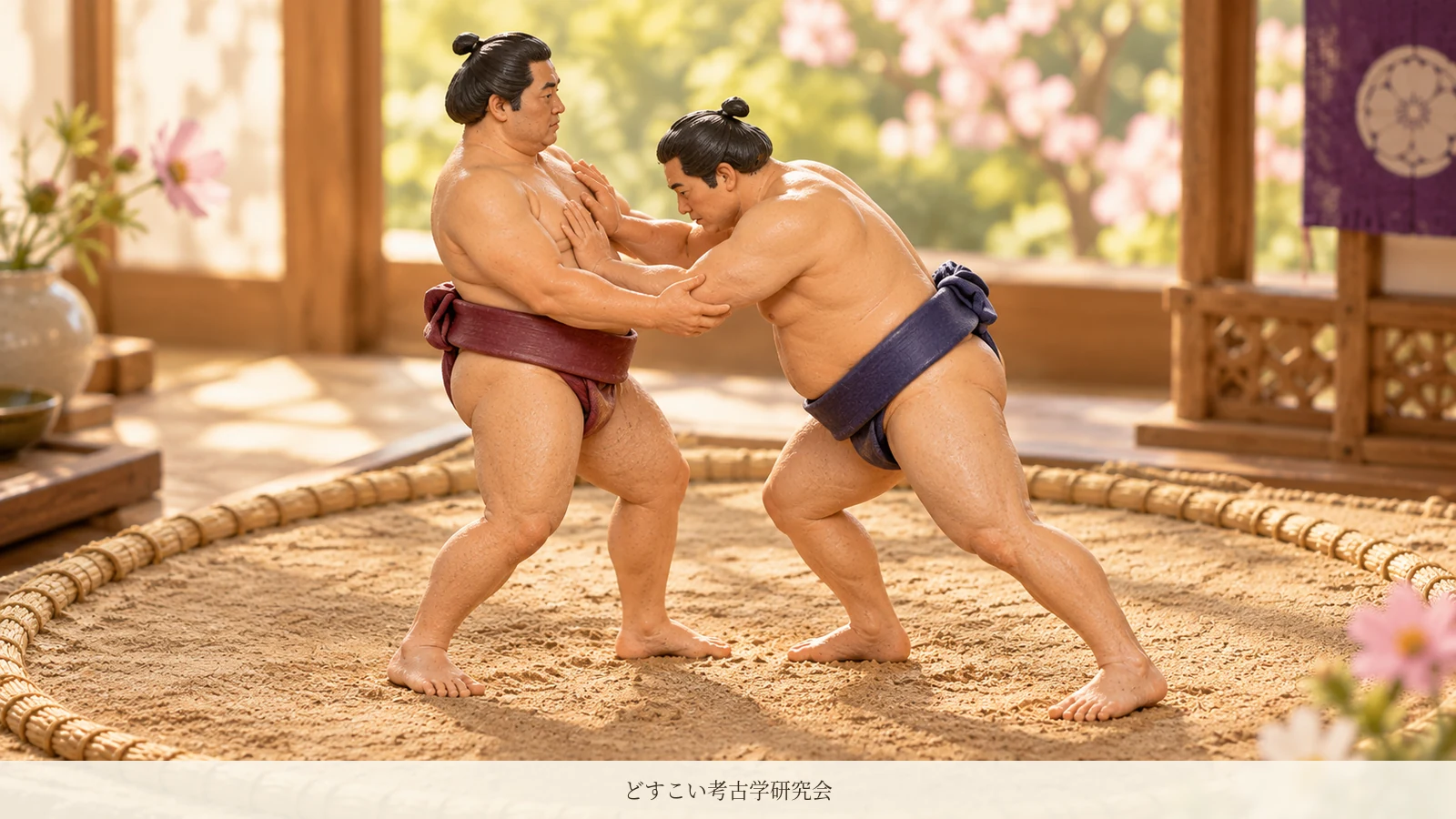
Both techniques send a standing opponent out of the ring, but the official distinction lies in how the hands work. In tsukidashi, the winner uses the palms to thrust strongly at areas such as the chest or shoulders. In oshidashi, one or both hands form a *hazu* shape and push at the chest or under the arms. For the next bout, do not count strikes. Ask whether the decisive palms struck in as thrusts or stayed engaged to push the opponent out.
To an English-speaking newcomer, “thrust out” and “push out” can sound like two translations of the same event. Even in a replay, both may look like a wrestler extending his arms while moving forwards. That confusion is useful: once you look for the difference, an exchange that seemed to be only fast hands begins to reveal the feet underneath them.
Tsukidashi uses strong palm thrusts
The Japan Sumo Association defines tsukidashi as winning by strongly thrusting with the palms at the opponent’s chest, shoulders or similar targets until he goes outside the ring. Its explanation adds an important detail: hand strength alone is not enough; sharp forward movement of the feet is also required.
That sentence gives a beginner a better viewing clue than trying to memorise a pose. When a palm lands, does the attacker’s base travel with it? Does the rear foot recover forwards so the next action still has the body behind it? The official page does not reduce the technique to arms, and neither should we.
Oshidashi pushes with the hazu hand shape
For oshidashi, the Association describes a *hazu*: the thumb opens away from the other four fingers, making a Y-like shape. One or both hands are placed at the opponent’s chest or under the arms and used to push him out.
You may not see individual fingers from a distant arena seat. A more practical clue is the relationship between palm and torso. Does the winner appear to maintain pushing contact and advance through it? That can point you towards oshidashi. Does the decisive action look like a forceful palm thrust into the chest or shoulder? That can point you towards tsukidashi.
These are observations, not a substitute for the judges’ view. Bodies overlap, camera angles hide contact, and a bout can change shape in less than a second. Make a prediction, then let the arena announcement test it.
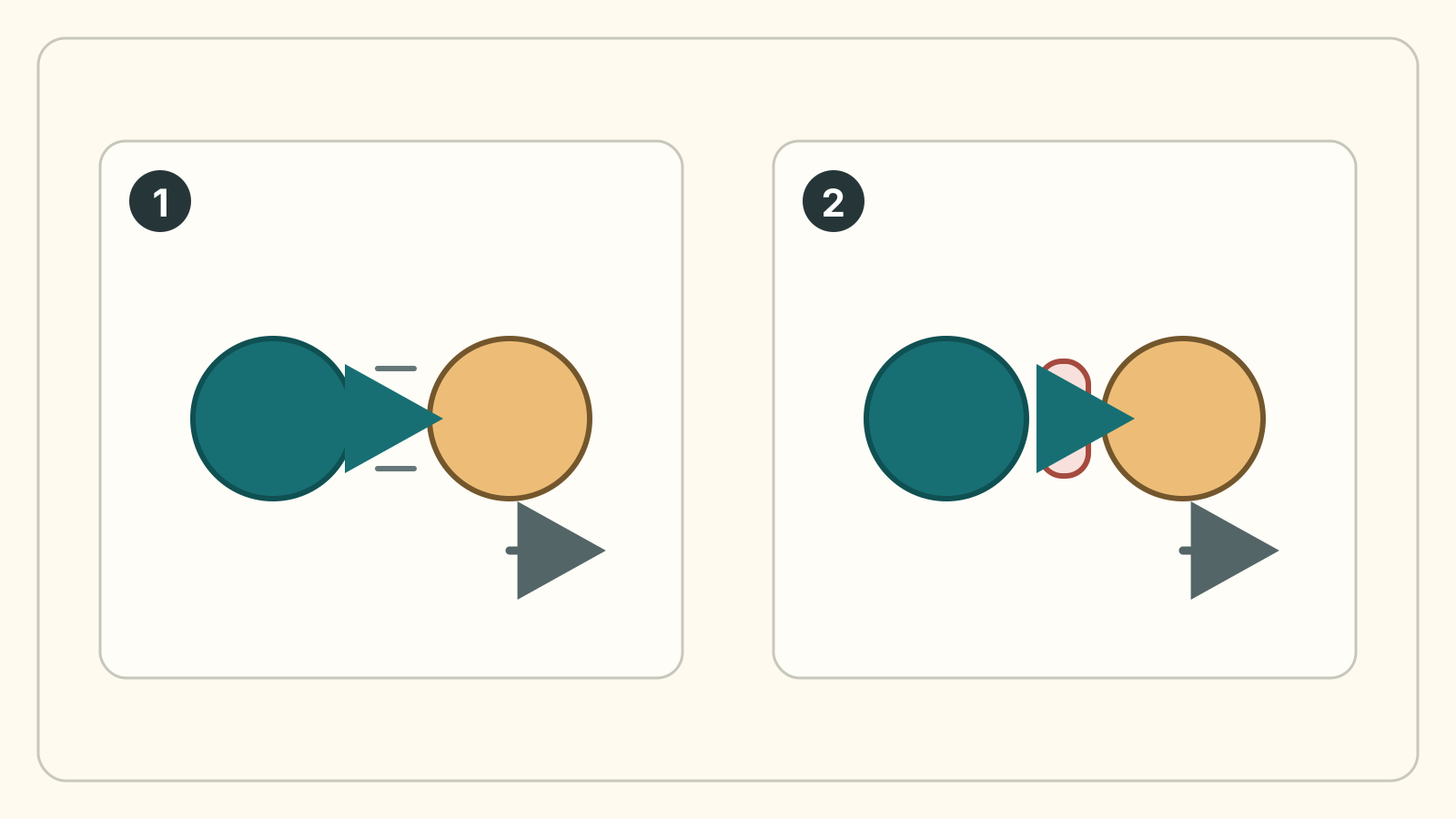
Detailed description of this diagram
Card 1 separates blue and gold competitor tokens and places a thick directional arrow with small accent lines between them, symbolising only the official strong-palm-thrust relation. Card 2 places a thick red contact bar between the tokens with an arrow continuing towards the opponent, symbolising only the official hazu push. Each branch also has an abstract forward-outcome arrow. Arrow size, token gap and bar dimensions encode no force, timing, number of contacts or body position. Camera and arena views may hide the decisive contact, so the schematic does not replace the official result.
Graphic: SUMO ARCHAEOLOGY CLUB · Figure source 1 · Figure source 2 · Figure source 3
There is no official “number of strikes” shortcut
The Association’s definitions do not say that a particular number of hand movements automatically makes tsukidashi. Nor do they say that one visible contact must be oshidashi. A simple counting rule would create confidence without evidence, so we do not use one.
A wrestler may begin with conspicuous thrusting attacks but finish by pushing with the hazu position; the announced kimarite can be oshidashi. Another exchange may contain pushing before a decisive strong thrust sends the opponent out. Kimarite name the winning action, not the entire tactical history of the bout.
First separate “out” from “down”
Tsukitaoshi is the useful neighbour to tsukidashi. The official tsukitaoshi page says the attacker strongly thrusts with the palms and makes the opponent fall, whether inside or outside the ring. If the opponent does not fall and instead leaves the ring, the page directs us back to tsukidashi.
The same result distinction helps with oshidashi and oshitaoshi: remaining upright while being forced outside is different from being knocked down by the push. Do not decide only by the first hand or foot to touch. Ask what decisive action produced the loss, because the official definition of a “down” technique can apply inside or outside the boundary.
One thing to watch in the next bout
Choose the advancing wrestler and watch only his rear foot when a palm lands. Does that foot come forwards under the body, linking the hand action to another sharp step? You may discover why the Association mentions footwork on a page that appears to describe a hand technique.
If the announcement says oshidashi rather than tsukidashi, your observation still worked. You have seen how sustained hand contact and advancing legs can make a push, or how a sharp thrust needs the whole body behind it. The Japanese names are not vocabulary to recite before enjoying sumo. They are small invitations to return your eyes to the previous second—and notice that the feet were speaking as loudly as the palms.
Sources
- Japan Sumo Association, kimarite explanation for tsukidashi (checked 2 September 2026)
- Japan Sumo Association, kimarite explanation for oshidashi (checked 2 September 2026)
- Japan Sumo Association, kimarite explanation for tsukitaoshi (checked 2 September 2026)
Source links used for verification
Each link was used for the corresponding claim in this article; inclusion is not a blanket endorsement of the whole page.
Article verified:
- Japan Sumo Association kimarite: tsukidashiPrimary source (as checked for this article)
- Japan Sumo Association kimarite: oshidashiPrimary source (as checked for this article)
- Japan Sumo Association kimarite: tsukitaoshiPrimary source (as checked for this article)