Abisetaoshi occurs when the opponent has arched backwards or his hips have buckled into a low, broken posture, and the winner commits his full body weight over him to crush him down. It is more specific than “the heavier wrestler fell on top.” In the next bout, watch the eventual loser first: did his back curve away or his hips suddenly sink before the other body covered him?
Two wrestlers lock together, one body disappears lower, and the other seems to become a roof above it. A final photograph may suggest only weight. The Japan Sumo Association’s definition begins one beat earlier, with a change in the opponent’s structure. Find that change and the finish becomes more than an accident of size.
The official definition starts with the opponent’s posture
The Association gives two possible states before the decisive weight arrives:
- The opponent’s body has arched backwards.
- His hips have given way and his stance has become low.
The winner then places his full weight over the opponent as if covering and crushing him down. The posture and the weight transfer belong together. A large wrestler ending above a smaller one does not, by that image alone, establish abisetaoshi.
For a newcomer, this reverses the natural viewing order. Instead of following the apparent winner’s upper body, follow the person under pressure and ask when his spine or hip line ceased to support him.
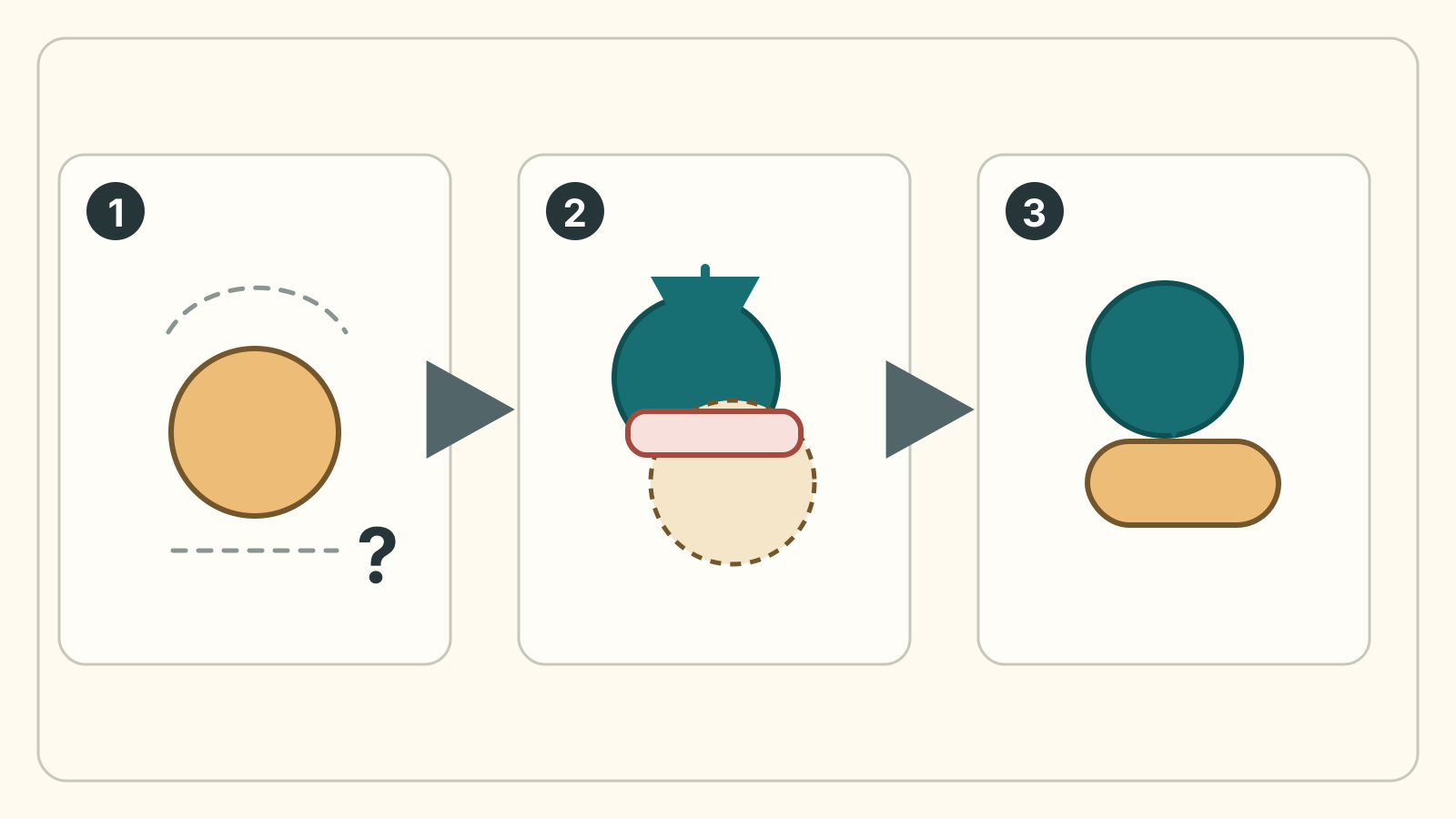
Detailed description of this diagram
Card 1 uses a gold opponent token, an upper curve, a lower dashed line and a question mark to preserve the official either-or entry state without drawing a spine or waist. Card 2 overlaps a blue winner token with a ghosted gold token and adds a downward arrow and contact band, representing only the full-weight-over relation. Card 3 uses a horizontal gold token as a categorical down marker, with the blue token and a downward cue. Token height, overlap and arrows encode no spinal angle, waist level, body mass, pressure or fall path.
Graphic: SUMO ARCHAEOLOGY CLUB · Figure source 1 · Figure source 2 · Figure source 3
Abisetaoshi vs yoritaoshi
Yoritaoshi also involves close contact and the winner committing his body into a fall. Its official definition starts with the winner advancing forwards while staying close, then leaning his body into the opponent to topple him.
The abisetaoshi page foregrounds a different setup: the opponent is already arched back or has collapsed into a low position, and the winner covers that broken posture with his full weight. For yoritaoshi, follow close advancing pressure into the topple. For abisetaoshi, focus on the opponent’s arch or sinking hips immediately before the full-body covering action.
The boundary can be too fast or hidden from one seat. Do not build false certainty from which wrestler landed on top. Make a posture-based prediction and let the official announcement resolve it.
Abisetaoshi vs oshitaoshi
The Association defines oshitaoshi through one or both hands pushing in a *hazu* shape and knocking the opponent down. It explicitly says the downing can occur inside or outside the ring. The decisive force is the push.
Abisetaoshi is defined through the opponent’s arched or low, collapsed position and the winner placing his full body weight over him. Ask whether the visible cause is a hazu push that topples, or a whole-body covering action over a posture that has already broken.
Both can end with a backwards fall. The direction of the loser’s body is therefore not enough; the final contact and the second before it matter.
“He won because he was heavier” misses the interesting part
The official definition uses full body weight, so it is tempting to explain the technique only through the wrestlers’ listed kilograms. A weight figure cannot tell you when a stance became vulnerable. The opponent first arches or sinks, creating the posture into which the winner can commit.
That makes abisetaoshi an article about balance as much as mass. Can the lower wrestler bring his hips back beneath him? Can he restore his back before the upper body settles? Does the apparent winner retain enough support to place weight rather than simply lose his own balance?
Those are viewing questions, not claims about what either wrestler intended. They let us respect the physical work without inventing thoughts or reducing an athlete to a number.
One thing to watch in the next bout
When a clinch drops in height, choose the more pressured wrestler’s hips. Do they stay beneath his upper body, or suddenly sink while the back arches? If the opponent then covers that broken posture with his full weight and crushes him down, predict abisetaoshi.
The hips may recover and the technique may never appear. That recovery is the reward for watching. You started by searching for a spectacular finishing pile; you discovered the quiet instant when a wrestler rebuilt his base and refused to become the floor. A downing technique has taught you to enjoy the bout that did not go down.
Similar Motion Does Not Set the Official Technique
A hand action or fall may look similar while the recorded kimarite differs according to the decisive action, sequence of balance loss and whether a body part touched down or crossed the ring first. Do not settle the difference between a similar technique, non-technique or foul from one camera angle; use the official result for that bout. A schematic marks viewing cues, not a substitute judges’ decision.
Sources
- Japan Sumo Association, kimarite explanation for abisetaoshi (checked 2 September 2026)
- Japan Sumo Association, kimarite explanation for yoritaoshi (checked 2 September 2026)
- Japan Sumo Association, kimarite explanation for oshitaoshi (checked 2 September 2026)
Source links used for verification
Each link was used for the corresponding claim in this article; inclusion is not a blanket endorsement of the whole page.
Article verified:
- Japan Sumo Association kimarite: abisetaoshiPrimary source (as checked for this article)
- Japan Sumo Association kimarite: yoritaoshiPrimary source (as checked for this article)
- Japan Sumo Association kimarite: oshitaoshiPrimary source (as checked for this article)