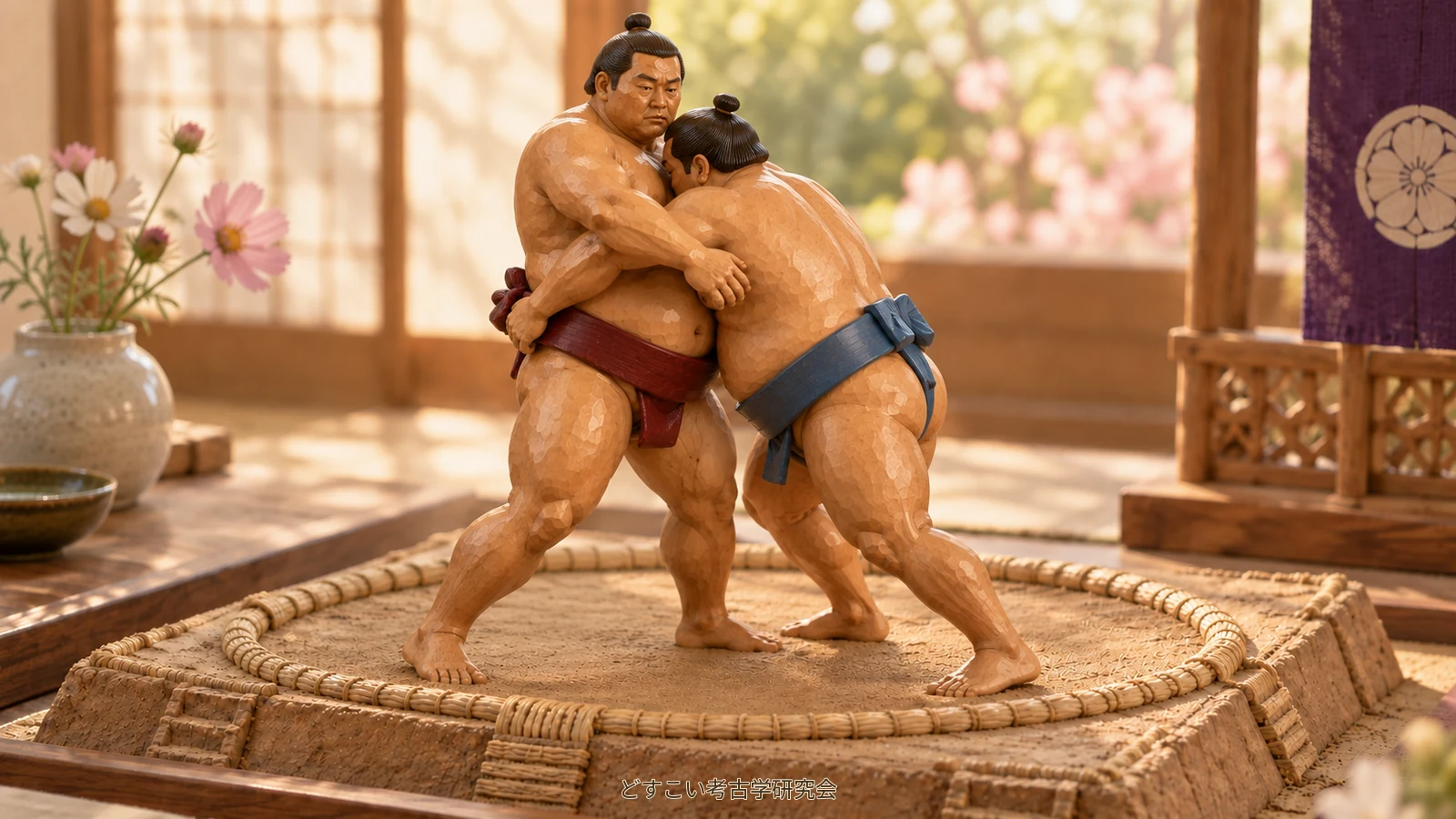
Both techniques begin in close body contact and use forward movement. In yorikiri, usually called a force-out, the winner stays close and carries the opponent outside. In yoritaoshi, often rendered as a frontal crush-out, the winner advances in contact, leans his body into the opponent and topples him. In the next bout, look past the belt grip: at the edge, does the opponent leave while upright, or do the connected bodies tip into a fall?
Two large bodies reach the straw bales and slowly acquire an angle from which neither seems able to return. A newcomer may reasonably expect yorikiri, only to hear yoritaoshi. The advance looked the same because much of it was the same. The distinction lives in the final effect of that close pressure.
Yorikiri carries the opponent outside
The Japan Sumo Association defines yorikiri as keeping the body in close contact with the opponent and moving forwards or sideways until he is outside the ring. The central clues are closeness, advancing movement and an out-of-ring finish.
A mawashi grip is common in such exchanges, but the official definition does not specify one required grip. For viewing purposes, the distance between the torsos may tell you more than a partly hidden hand. If the wrestlers remain close and the loser is transported across the boundary while still upright, yorikiri is the useful prediction.
Yoritaoshi adds the downing action
The Association describes yoritaoshi as first advancing forwards in close body contact, then keeping that contact while committing the body’s weight to topple the opponent. It is not simply a pull made with the hands. The same forward, connected pressure that looked like yorikiri ends by taking the opponent down.
Do not turn this into an “inside versus outside” location rule. A fall can carry bodies across the tawara. What matters is whether the decisive action was a close-contact advance that toppled the opponent, rather than an upright exit. A freeze-frame of the landing may hide that distinction; the second before it is more informative.
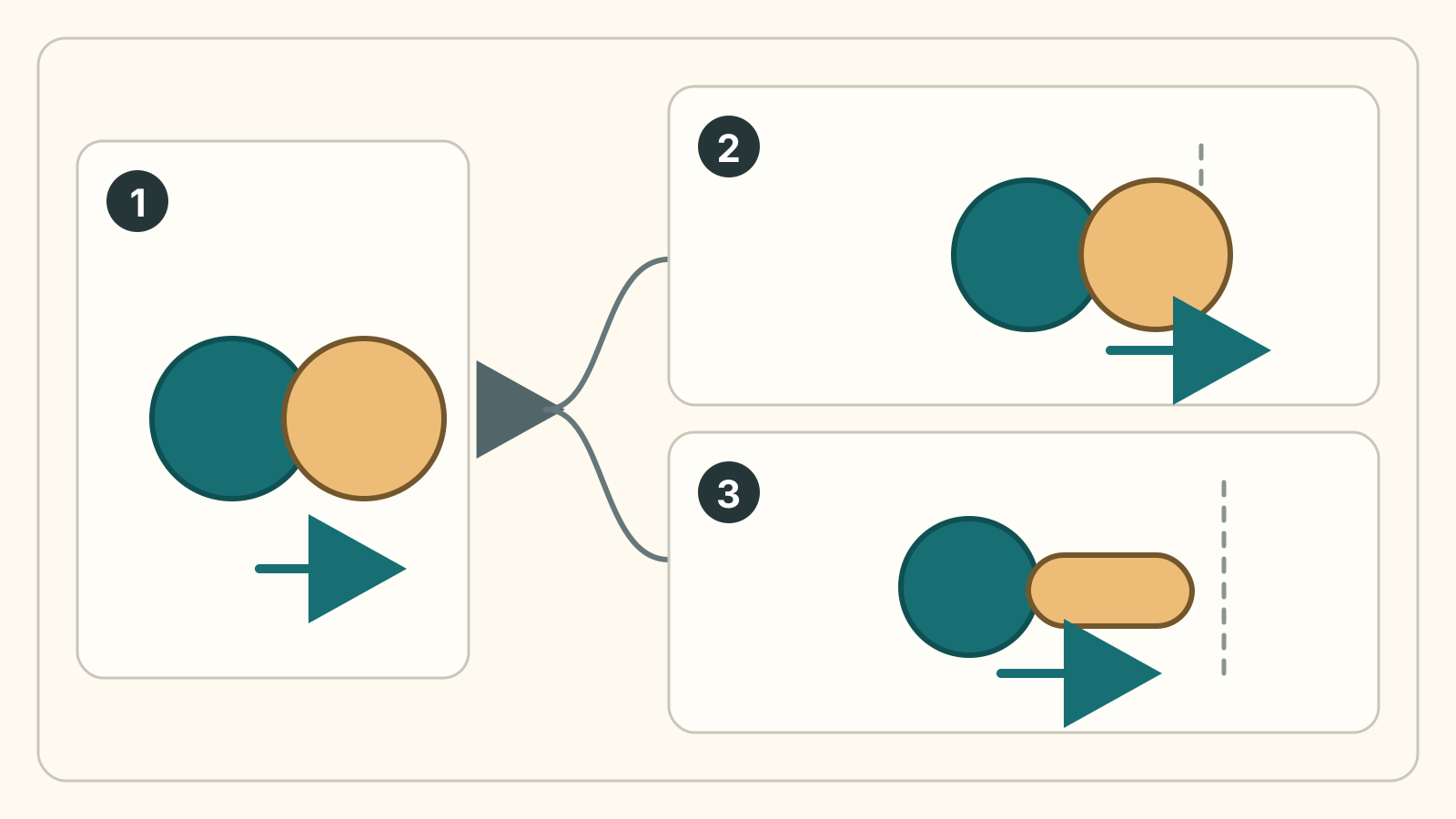
Detailed description of this diagram
Card 1 touches blue and gold competitor tokens and gives them one advance direction for the shared close-contact phase. Upper card 2 keeps the tokens touching as they cross an abstract dashed boundary, recording only the yorikiri outside outcome. Lower card 3 touches a blue circular token to a horizontal gold token for the close-contact down state of yoritaoshi. Token orientation, overlap, boundary and arrows encode no body angle, first contact, belt grip, pressure, distance, boundary geometry, location of the down, timing, fall path or judging test.
Graphic: SUMO ARCHAEOLOGY CLUB · Figure source 1 · Figure source 2 · Figure source 3
A belt grip is evidence, not the verdict
Finding the mawashi helps you recognise a grappling exchange, but “belt grip equals yorikiri” is too short a route. A wrestler can hold the belt and finish with uwatenage, shitatenage or another technique. Kimarite describe the action that decides the bout, not every useful position that came before it.
Follow the feet and torso after the grip forms. Is the winner taking compact steps while keeping chest or shoulder contact? Does the opponent remain standing as he crosses the boundary? Or does the winner’s body come into the final tilt that brings him down? Those questions preserve the whole finish.
How is abisetaoshi different?
Another official technique, abisetaoshi, can also look like one wrestler placing weight on the other. The Association describes it in a more specific situation: the opponent is arched backwards or has sunk into a low, broken posture, and the winner places his full weight over him as if crushing him down.
Yoritaoshi’s definition emphasises the close-contact forward advance followed by leaning in to topple. Abisetaoshi begins with an opponent whose posture has already arched or collapsed low. From one seat or camera angle, that boundary can remain difficult. Rather than pretending certainty, look for when the losing posture changed and use the official announcement as the final answer.
One thing to watch in the next bout
As the wrestlers reach the tawara, watch the sliver of space between their chests. If contact stays close and the opponent steps outside upright, predict yorikiri. If the bodies remain connected as the winner leans through and topples him, predict yoritaoshi.
Following that space may lead your eyes to the feet. The winner must move another person’s weight while keeping his own base beneath him, then decide whether to carry the position out or commit it into a fall. You began with one extra syllable in a Japanese technique name. You end with a new appreciation for the small, balanced steps that made the final weight transfer possible.
Similar Motion Does Not Set the Official Technique
A hand action or fall may look similar while the recorded kimarite differs according to the decisive action, sequence of balance loss and whether a body part touched down or crossed the ring first. Do not settle the difference between a similar technique, non-technique or foul from one camera angle; use the official result for that bout. A schematic marks viewing cues, not a substitute judges’ decision.
Sources
- Japan Sumo Association, kimarite explanation for yoritaoshi (checked 2 September 2026)
- Japan Sumo Association, kimarite explanation for yorikiri (checked 2 September 2026)
- Japan Sumo Association, kimarite explanation for abisetaoshi (checked 2 September 2026)
Source links used for verification
Each link was used for the corresponding claim in this article; inclusion is not a blanket endorsement of the whole page.
Article verified:
- Japan Sumo Association kimarite: yoritaoshiPrimary source (as checked for this article)
- Japan Sumo Association kimarite: yorikiriPrimary source (as checked for this article)
- Japan Sumo Association kimarite: abisetaoshiPrimary source (as checked for this article)