
The circular fighting area in professional sumo is 4.55 metres in diameter. Its boundary is made from twenty short straw bales: sixteen regular ring bales and four offset *toku-dawara*. Crucially, the Japan Sumo Association says the outer edge of the bales is the boundary. A foot balanced on top of a bale is still in.
That last detail changes a close finish. A wrestler’s heel reaches the straw, his body leans beyond the circle and the crowd begins to react—but the bout is not necessarily over. Instead of trying to watch two entire bodies at once, you can look for one small thing: does the final foot stay on the bale, or pass its outside edge?
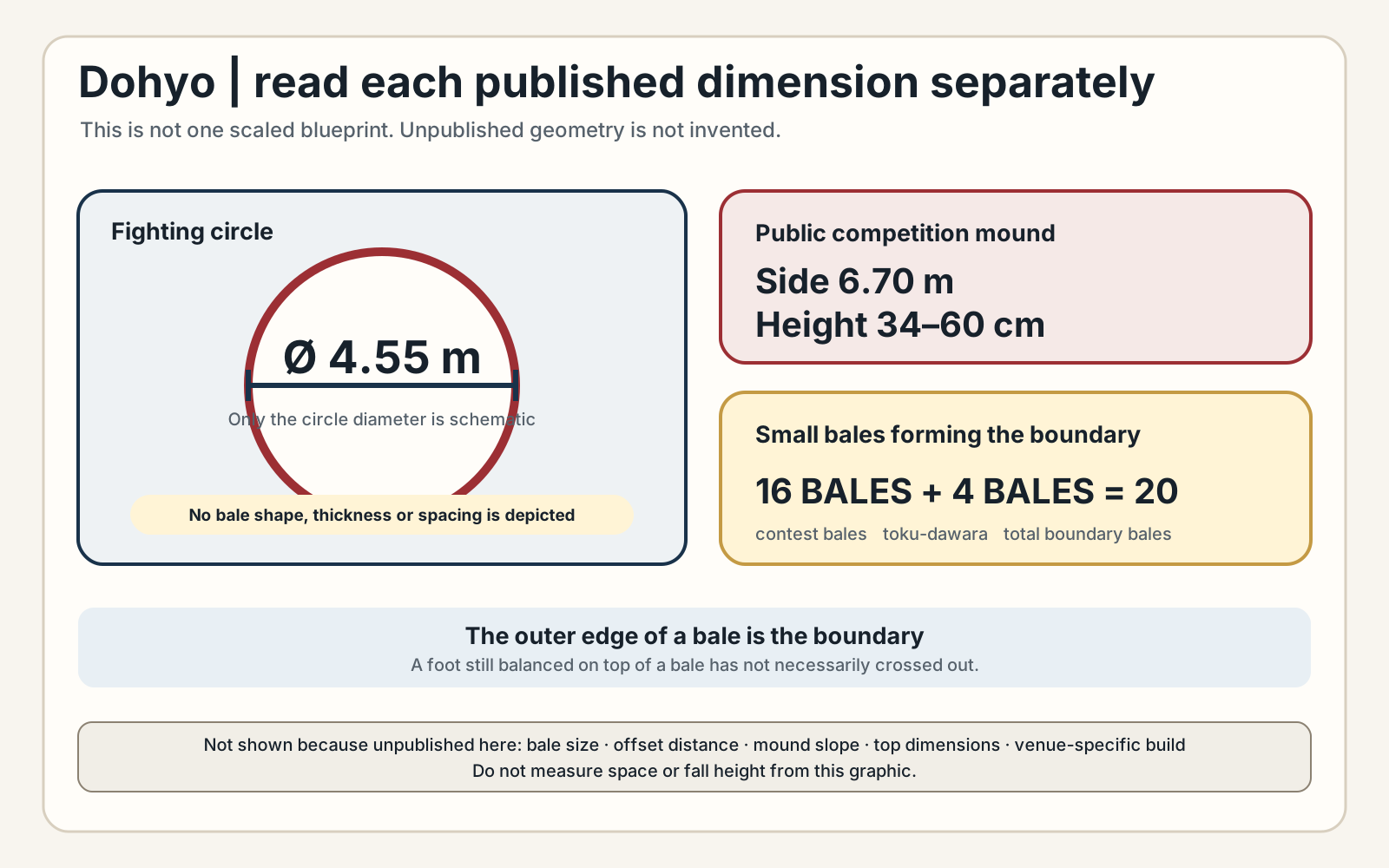
Detailed description of this diagram
The left card schematically marks only the 4.55-metre fighting-circle diameter. The upper-right card separately states the 6.70-metre side and 34-to-60-centimetre height of a public competition mound. The lower-right card states sixteen contest bales plus four toku-dawara equals twenty boundary bales. The footer says the outside edge of a bale is the boundary. Bale geometry, offset distance, mound slope, top dimensions and venue differences are not drawn, so space and fall height cannot be measured from this graphic.
Graphic: SUMO ARCHAEOLOGY CLUB · Measurement source 1 · Measurement source 2 · Measurement source 3
The dohyo is a raised platform as well as a circle
The word *dohyo* is often translated simply as “ring”, which can make it sound like a line drawn on a flat floor. The Association’s explanation of its dohyo regulations is more precise. A practice ring may be set into a flat surface, with the bales forming a 4.55-metre circle. A public competition dohyo is built as a trapezoidal mound, 34 to 60 centimetres high, with a side measuring 6.70 metres. The 4.55-metre circle sits on top.
This is why a ringside fall is not the same as stepping across a painted line. The wrestlers, referee and ringside judges occupy different levels around a compact mound. The permitted height is a range, so this article does not claim that every venue’s platform looks identical.
Twenty separate bales make the circle
Sixteen curved sections are called *shobu-dawara*, the regular contest bales. At four points, one bale is shifted slightly outwards from the circle. Those four are the *toku-dawara*. Together, sixteen plus four makes twenty.
The name *toku-dawara* is sometimes introduced as a special “advantage bale”. The useful visual fact is simpler: at each of those four points, the boundary gives a wrestler a little more room than the otherwise smooth circle. It is not a magic escape route. Reaching it under pressure and keeping a foot alive still depends on balance, placement and timing.
The outside edge—not the inside edge—is decisive
The Association’s description explicitly places the boundary at the outer line of the small bales. Merely touching or standing on one does not mean the wrestler has stepped out. That distinction explains why a heel can appear to be “on the edge” for longer than a new viewer expects.
On the next close finish, try following the wrestler being driven backwards. Does the toe hook inside the straw? Does the heel settle on top? Does the opponent touch down before that foot crosses the far edge? You do not need to identify the winning technique to see the contest for the last usable centimetres.
Even the bales have engineered interiors
Another Association feature on dohyo construction explains that small rounded gravel, just under one centimetre in diameter, is mixed with earth and packed into the sixteen contest bales to make them firm. The visible straw is therefore only the outer skin of a carefully prepared boundary.
This does not mean that the entire dohyo is filled with gravel. The official explanation is specifically about material used to tighten the *shobu-dawara*. It is a lovely hidden detail: the line that must survive feet, weight and repeated bouts has structure inside it that spectators never normally see.
Turn a measurement into one moment of the bout
There is no examination at the arena. You do not need to memorise 4.55 metres, all twenty bales and the platform height. Take just one observation into the next match: the top of a straw bale is still live territory.
When the referee calls the action as the crowd shouts at the brink, your eye may now go to the far edge of the straw rather than the centre of the ring. The official measurement stops being an abstract statistic and becomes one wrestler’s final foothold. Then look up between bouts: the four coloured tassels above the dohyo give this small circle directions and seasons as well. A patch of clay that first seemed simple starts revealing an entire piece of architecture.
Sources
- Japan Sumo Association, Sumo Quiz No. 830 on the dohyo regulations (published 17 April 2024; checked 2 September 2026)
- Japan Sumo Association, Sumo Quiz No. 355 on the twenty bales and outer boundary (published 29 December 2022; checked 2 September 2026)
- Japan Sumo Association, Sumo Quiz No. 988 on contest bales, offset bales and their filling (published 22 September 2024; checked 2 September 2026)
Source links used for verification
Each link was used for the corresponding claim in this article; inclusion is not a blanket endorsement of the whole page.
Article verified:
- Japan Sumo Association Sumo Quiz No. 830: dohyo regulationsPrimary source (as checked for this article)
- Japan Sumo Association Sumo Quiz No. 355: twenty bales and the boundaryPrimary source (as checked for this article)
- Japan Sumo Association Sumo Quiz No. 988: shobu-dawara and toku-dawaraPrimary source (as checked for this article)