A Japan Sumo Association explainer published on 10 March 2022 said yobidashi build a new dohyo before a grand tournament and use a beer bottle while making the embedded bales. A separate 2022 explainer described the contest boundary as twenty kodawara, including four toku-dawara. These are dated official explanations; they do not establish that tools, crew size and procedure are identical at every 2026 venue.
Learning that the contest circle is 4.55 metres across gives us a specification. Learning that someone makes each piece of its boundary gives us a place. The finished ring looks inevitable, as if the arena were designed around an ancient permanent platform. Construction photographs show soil being moved and compressed, bales being formed, and the circle emerging through repeated tasks.
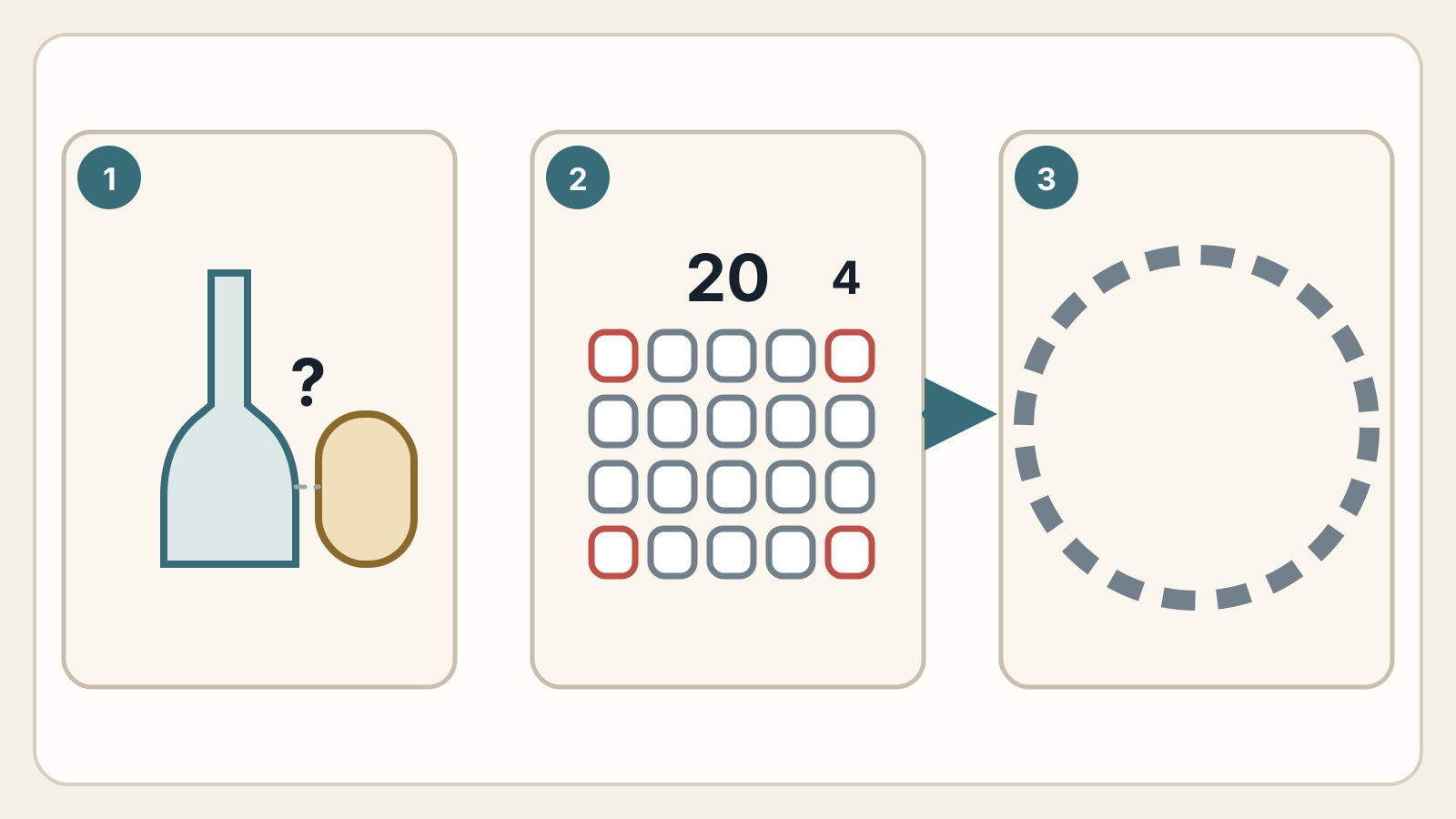
Detailed description of this diagram
Card 1 connects an unlabelled generic bottle outline to a short bale token with a dotted line and question mark. It simultaneously records official bottle involvement and the lack of an established method in the cited page. Card 2 uses a five-by-four counting matrix of twenty small rectangles, four with a distinct outline for the four toku-dawara and sixteen for regular units; the grid is not their physical arrangement. Card 3 uses only a dotted circle as the categorical endpoint. No bottle shape standard, volume, brand, material, sequence, pressure, grip, bale dimension, toku-dawara projection, arc, spacing or dohyo diameter is depicted.
Graphic: SUMO ARCHAEOLOGY CLUB · Figure source 1 · Figure source 2 · Figure source 3
The tournament ring is rebuilt, not simply uncovered
The Association’s official explanation says that before each grand tournament, yobidashi make a new dohyo in a process called *dohyo-zuki*. The familiar English translation “ring attendant” can make their job sound narrowly ceremonial. Their labour includes helping create and maintain the surface on which the competition takes place.
The source does not give us permission to invent one fixed crew size, a universal timetable or an exact division of every task at every venue. Those operational details require their own evidence. The important, well-supported change in perspective is that the calling voice heard before a bout can belong to a person who helped build its physical stage.
A beer bottle is a tool, not a drinking story
In one Association quiz, the surprising correct answer to “Which tool is used in dohyo building?” is a beer bottle. The accompanying text says it is used when making the straw bales that will be embedded in the ring.
This fact is sometimes repeated because it sounds eccentric. Its value is not a joke about alcohol. The official item establishes that a beer bottle was used in making the bales, but it does not say which physical property of the bottle does what, describe every movement, or establish that only one bottle form can ever be used. We should not turn an intuitive explanation about hardness, smoothness or hand size into a factual tutorial. We can safely say that a very ordinary object enters a specialised craft.
That combination is precisely what makes the detail memorable. Formal sport regulations, embodied skill and an object from daily life meet in one bale. Tradition is often sustained with practical tools rather than picturesque antiques.
The circle is assembled from twenty kodawara
The short boundary units are called *kodawara*. According to the Association, twenty form the contest circle: four are *toku-dawara*, set slightly outward at the four main directions, and four regular bales lie between each of them. The outer edge of the bales is the legal boundary, so a foot can remain on top of one without being out.
A separate dimensions guide explains what that means for a close finish. Here, concentrate on making. The apparently continuous circumference is assembled from short pieces with joins. If a replay gives you a close view, look for one seam between neighbouring bales. A geometrical circle becomes a sequence of objects placed by hand.
The figure twenty should not tempt us to count during every bout. It gives scale to the work. Each unit has to contribute to a boundary that officials and wrestlers can trust through a tournament.
Written regulation meets embodied construction
The Association notes that dohyo regulations specify details ranging from the overall dimensions to the white starting lines, the sand outside the bales and the suspended roof. Written rules describe the form. Yobidashi, materials and tools turn that description into clay and straw.
The contrast is irresistible: 4.55 metres measured with precision, but visible straw fibres never perfectly identical; formal provisions, but a bottle used at the workbench; a ring associated with long history, yet rebuilt for a current event. “Traditional” does not mean untouched, and “regulated” does not mean machine-made.
The dohyo ceremony takes place after the physical stage has been prepared. Keeping construction and ceremony separate helps both become clearer. Soil is shaped, bales are embedded and the surface is finished; then prayers for safety and a successful tournament address the completed place. An official historical tour once let supporters observe construction, but that precedent does not guarantee public access at a future tournament. Always check a current announcement rather than arriving at a work area uninvited.
One tiny join changes the next ringside finish
During the next bout at the tawara, lower your gaze to one small section of straw. That unit was not printed as part of a circle. It was made, set beside another and aligned until twenty pieces closed the ring. Someone prepared that line before a wrestler trusted his heel to it.
The beer bottle is a delightful doorway, but the room behind it matters more. It leads to the yobidashi as craftspeople, to regulation made physical, and to a boundary that has to survive repeated impacts. A visually narrow margin at the edge depends on the straw boundary holding its place, but a broadcast image does not justify estimating that margin in centimetres. Confirm the decision through the official result rather than image geometry. Once you see the join, the perfect circle never looks anonymous again.
Sources
- Japan Sumo Association, Sumo Quiz No.61, published 10 March 2022 (checked 3 September 2026)
- Japan Sumo Association, Sumo Quiz No.355, published 29 December 2022 (checked 3 September 2026)
- Japan Sumo Association official fan club, dohyo-building observation tour report, published 9 January 2022 (checked 3 September 2026)
- Japan Sumo Association, Sumo Quiz No.830, published 17 April 2024 (checked 3 September 2026)
Source links used for verification
Each link was used for the corresponding claim in this article; inclusion is not a blanket endorsement of the whole page.
Article verified:
- Japan Sumo Association Sumo Quiz No.61: dohyo building and the bottlePrimary source (as checked for this article)
- Japan Sumo Association Sumo Quiz No.355: twenty kodawaraPrimary source (as checked for this article)
- Japan Sumo Association official fan club dohyo-building tour reportHistorical primary source (record from that period)
- Japan Sumo Association Sumo Quiz No.830: dohyo regulationsPrimary source (as checked for this article)