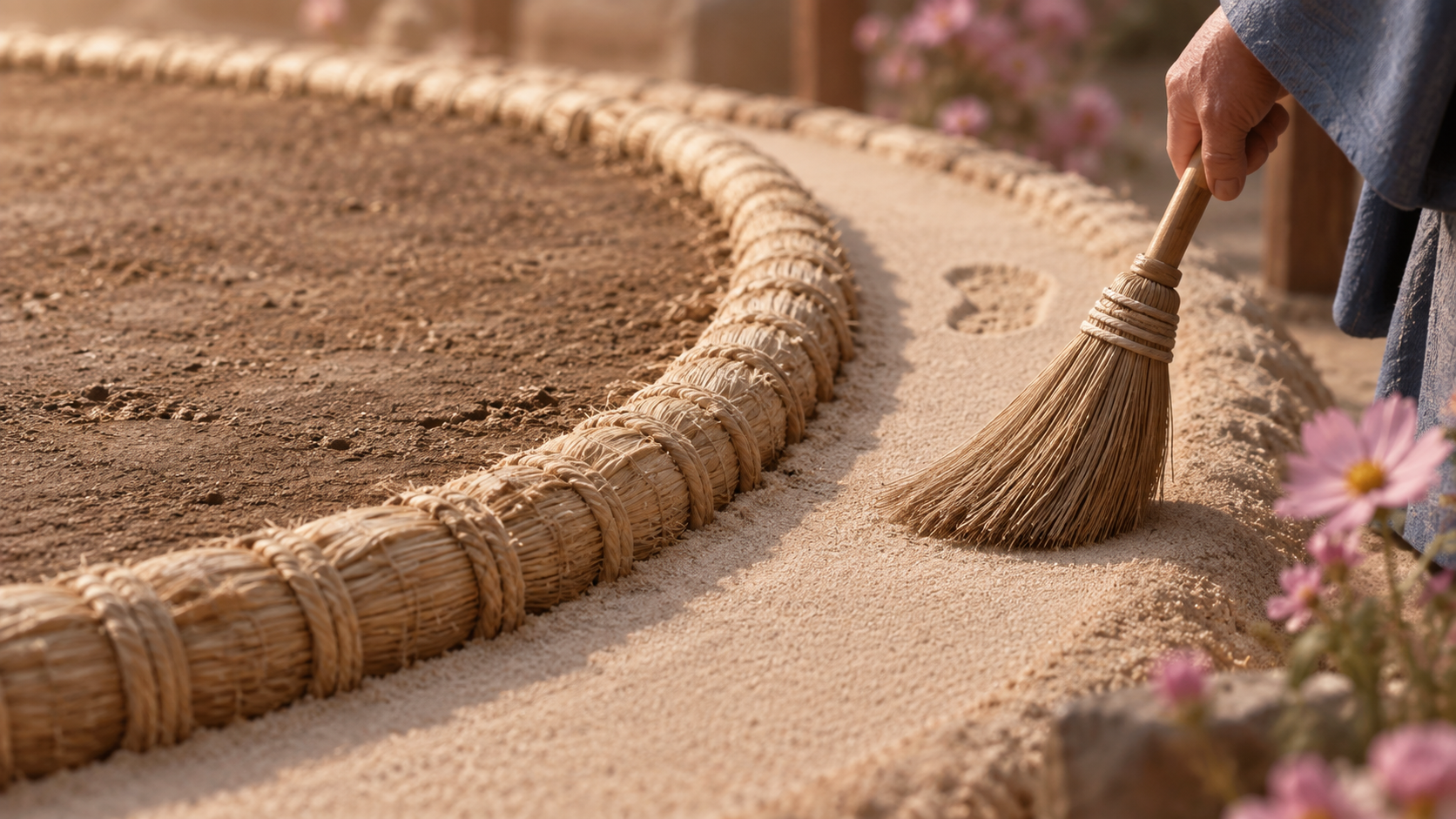
Janome is the carefully prepared strip of sand immediately outside the small straw bales that form the sumo ring. The Japan Sumo Association gives its width as 25 centimeters and says it helps officials see whether a wrestler stepped or touched down outside. A yobidashi smooths it with a hand broom between bouts. On the next close finish, look just beyond the bales: that quiet band of sand is waiting to record the edge of the contest.
If the dohyo looks like no more than a circle drawn in clay, the sand beyond the bales can disappear as empty space. Then a yobidashi sweeps only that outside edge after a bout. The apparent gap has a name, a measured width and a job: it is part of making the boundary readable, not scenery around it.
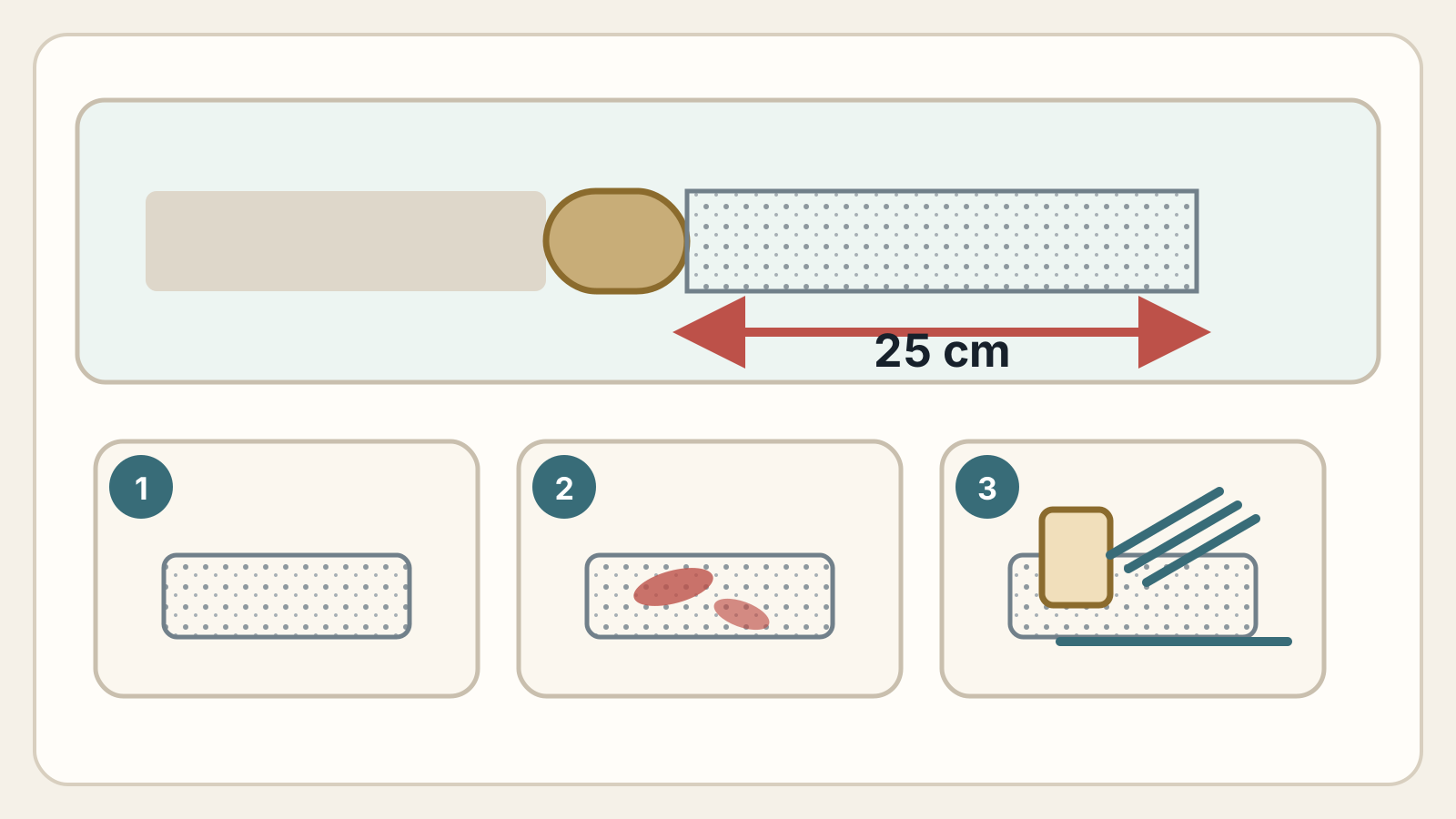
Detailed description of this diagram
The upper strip places an untextured inside band, one rounded boundary-bale token and a dotted outside-sand band side by side. A double arrow and 25 cm label apply only to the outside sand; all drawn widths and the bale form are non-scale symbols. Three lower cards show a level dotted surface, two irregular contact marks, and an abstract hand-broom with parallel reset lines. The graphic gives no sand depth, grain size, source, colour, compaction, bale dimensions, full-ring geometry, identity of the contacting body or sufficient judging rule.
Graphic: SUMO ARCHAEOLOGY CLUB · Figure source 1 · Figure source 2
Janome is the sand, not the bale itself
The buried bales define the circular ring. Janome refers to the 25-centimeter band of sand along their outer edge. Our guide to dohyo dimensions explains the bales and the 4.55-meter circle; this article stays with what lies immediately beyond them.
The Association describes the sand as a way to check a step or touch outside. It is not an automated verdict. The gyoji must still indicate a winner, and the ringside judges may call a mono-ii conference if the finish is disputed. Janome gives the human decision-makers a clean surface on which contact can become more visible.
Why it is swept before the next bout
The official explanation says a yobidashi carefully smooths the strip with a hand broom between contests. If old footprints and gouges remained, a mark from the next finish would be harder to separate from what came before. Resetting the sand gives each bout a fresh outer edge.
It is tempting to fill in extra technical detail—the precise grain, depth or source of the sand—but the cited primary material does not establish those specifications. The safe facts are useful enough: location, 25-centimeter width, purpose and the between-bout sweep.
The name remembers an older double circle
Janome literally evokes a “snake’s eye,” a familiar design of concentric circles. The Association explains that sumo once used a double dohyo: an inner circle of 13 shaku, roughly 3.94 meters, and an outer circle of 15 shaku, roughly 4.55 meters. Sand lay between the two rings, making the concentric pattern associated with the name janome.
The double ring was used in regular tournaments through January 1931. Later that year, after a reconfigured ring was used for an imperial-viewing event, the 15-shaku outer circle became the competitive boundary at honbasho. The old inner ring disappeared, but its name remained attached to the sand outside the modern bales.
The Association also notes that contemporary newspapers and magazines offer little clear evidence for why the ring was enlarged. Explanations such as “to make bouts last longer” should therefore be treated as speculation, not settled history.
A boundary made of three textures
At a dramatic finish, a wrestler hooks a heel against the bale while the rest of the foot searches for clay. Just beyond it lies the smooth janome. The edge is not an abstract line on a graphic: packed earth, woven bale and loose sand meet within the length of one foot.
That is why the 25-centimeter figure becomes interesting only when a body reaches it. A numerical specification turns into a last place to leave—or avoid leaving—a trace.
One thing to watch next
After a bout, keep the video or your eyes on the ring. Find the yobidashi’s hand broom and watch the outer band become smooth again. When the next pair reaches the edge, follow the heel across bale and sand without deciding the result before the official call.
Someone has erased the previous contest so that this footprint can belong to this finish. Once you notice that small act of preparation, the pause between bouts stops feeling empty. The next match begins while its evidence surface is still being made ready.
Sources
- Japan Sumo Association, Grand Sumo Quiz Nos. 785 and 1088; Japan Sumo Association Official Fan Club, dohyo-construction photo report (accessed September 2, 2026)
Source links used for verification
Each link was used for the corresponding claim in this article; inclusion is not a blanket endorsement of the whole page.
Article verified:
- Japan Sumo Association Grand Sumo Quiz No.785: janome sandPrimary source (as checked for this article)
- Japan Sumo Association Grand Sumo Quiz No.1088: the double ring and 1931 expansionHistorical primary source (record from that period)
- Japan Sumo Association Official Fan Club: photo report from dohyo constructionHistorical primary source (record from that period)