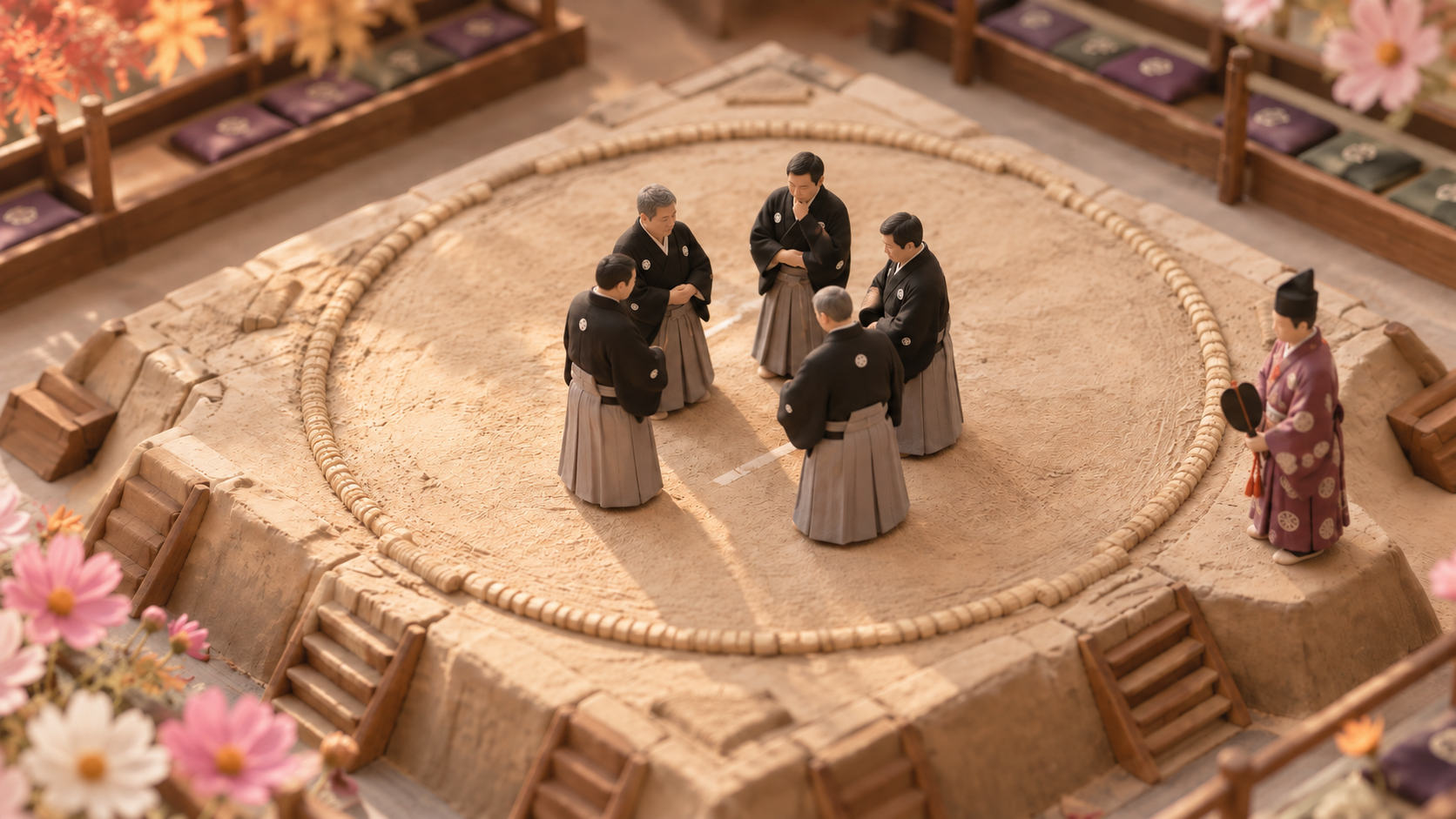
A *mono-ii* is a formal objection to the gyoji’s initial decision. Ringside judges gather on the dohyo, communicate with the video room and confer before the chief judge announces the result. The original call may stand, it may be reversed, or the wrestlers may be ordered to contest a rematch. It is not a fan vote or a challenge requested by the losing wrestler.
The scene can be bewildering on a first visit. A bout ends in a burst of movement, the gyoji points his gunbai, and then several officials calmly form a circle in the very place where the collision happened. That pause is not disorder. It is sumo’s formal way of resolving a close finish.
The gyoji makes the first call
After the action ends, the gyoji raises his gunbai toward the wrestler he believes has won. A mono-ii therefore starts with an existing decision. It is not a situation in which the gyoji declines to choose and hands the bout to somebody else.
The Japan Sumo Association explains that when a judge objects to the gyoji’s ruling, the objection leads to a conference. Its organisation page also assigns the judging department responsibility for deciding bout results as well as making the match schedule.
What happens inside the circle?
The Association says that the judges assemble on the dohyo and communicate with the video room, using the footage as a reference. This is an important middle ground: the decision is not made from memory alone, but nor does a screen generate an automatic verdict. The judges combine what was seen at ringside with the available video and reach an agreed conclusion. The chief judge then addresses the arena.
A television replay may make one hand or foot look decisive, but a single angle does not necessarily reveal every relevant point of contact. Until the official explanation, it is better to treat your preferred interpretation as a guess rather than a confirmed result.
Three outcomes to listen for
The Association’s explainer identifies three main directions:
- *Gunbai-dori*: the gyoji’s original call stands.
- *Gunbai-sashichigai*: the original call is reversed.
- *Torinaoshi*: the finish is judged simultaneous and the wrestlers meet again.
A mono-ii does not automatically mean that the gyoji was wrong. The discussion can confirm his call. A torinaoshi is also different from a *matta*: a matta resets a start that was not accepted, while a torinaoshi follows a bout that took place but did not yield a separable winner.
Can anybody other than a judge object?
There is a useful wrinkle. In an official quiz, the Association quotes Article 5 of the judging rules: if a waiting wrestler raises an objection, the judges must take it up and confer. That means it is too broad to say that only the ringside judges can ever initiate the process.
This does not turn shouting from the audience into a formal mono-ii. Spectator reaction and the regulated procedure around the dohyo remain different things.
Watch the circle open
The next time a mono-ii occurs, resist the urge to solve the replay immediately. Watch for the circle to open and the chief judge to face the audience. His explanation will tell you whether the gunbai stands, is reversed, or the wrestlers must begin again.
There is something compelling about the change of tempo. A few seconds of violence are followed by an arena waiting on carefully chosen words. Once you know what the circle is doing, the pause becomes part of the bout rather than dead time between bouts.
Sources
- Japan Sumo Association quizzes No.559 and No.935, and its organisation page (verified 2 September 2026).
Source links used for verification
Each link was used for the corresponding claim in this article; inclusion is not a blanket endorsement of the whole page.
Article verified:
- Japan Sumo Association quiz No.559: mono-ii and the judges’ conferenceHistorical primary source (record from that period)
- Japan Sumo Association quiz No.935: an objection from a waiting wrestlerHistorical primary source (record from that period)
- Japan Sumo Association: mission and organisation of the judging departmentPrimary source (as checked for this article)