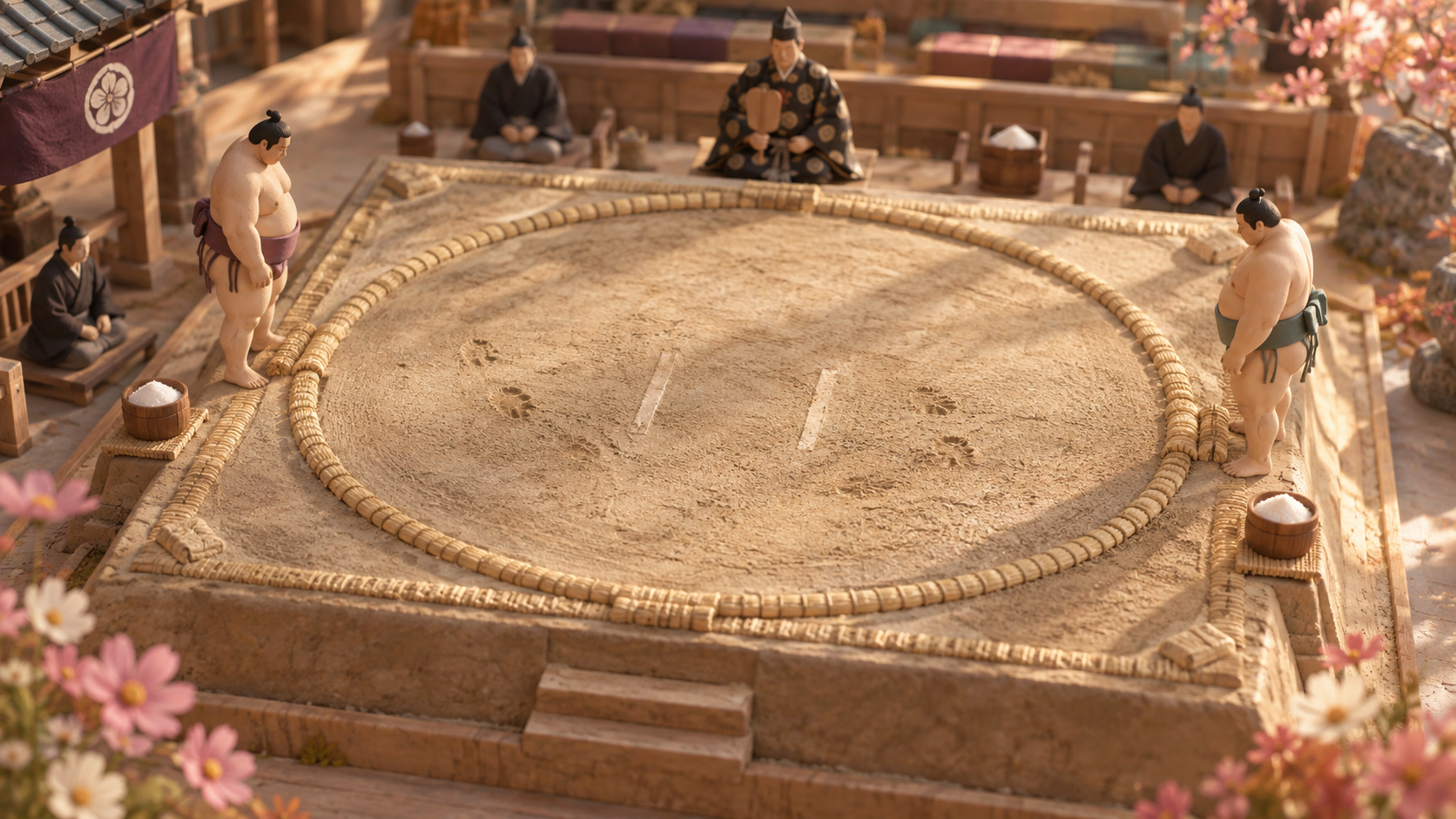
A *torinaoshi* is a completely new bout ordered when the judges conclude that the two wrestlers finished simultaneously. It normally follows a mono-ii conference after a valid bout has taken place. That makes it fundamentally different from a *matta*, which sends the wrestlers back to shikiri because an acceptable tachiai was not established. Torinaoshi is not a penalty or a bonus chance requested by one wrestler.
Seeing it live feels almost improbable. Two wrestlers have already collided, fought to the edge and spent their strength. Then they collect themselves, prepare once more and face the same opponent from the beginning. The rule is simple; the second encounter rarely feels simple.
How a torinaoshi is reached
A normal sequence starts with the gyoji pointing his gunbai toward the wrestler he believes won. If there is a mono-ii, the ringside judges gather and confer, communicating with the video room and using the footage as a reference. The Japan Sumo Association lists three main conclusions: the original gunbai stands, the call is reversed, or a simultaneous finish leads to torinaoshi.
The rematch is therefore the result of an official judging process. It is not added because the audience enjoyed the first bout, and a wrestler does not claim it in the manner of a replay challenge in some international sports.
Matta and torinaoshi return to different points
Both can look like “do it again,” especially if Japanese terminology is new. The distinction is about when the reset happens:
- With a matta or shikiri reset, the valid start has not been completed. The Association’s tachiai explainer mentions unmatched breathing or inadequate hand contact as reasons to return to preparation.
- With torinaoshi, a valid bout has already taken place, but the finish does not separate a winner. The wrestlers must contest another bout.
If you are watching in the arena and cannot hear every word, look for the mono-ii conference and the chief judge’s announcement. A quick return to the crouch before a bout develops is a different sequence from judges assembling after a finish.
It is not simply a recorded draw
The Association’s historical explainer says that draws and the old *azukari* “hold the decision” system were abolished in November 1925 and replaced by torinaoshi. The modern idea is to resolve the contest with another bout rather than leave that close result undecided.
The same official page notes a special term, *itamiwake*, for a situation in which an injury or worsening illness during the contest prevents the wrestler or wrestlers from continuing with a subsequent rematch. That is an official determination, not something spectators should diagnose from a grimace or a slow walk. Wait for the announced ruling rather than speculating about health.
Compare only the first step
When a torinaoshi is ordered, keep one detail from the first bout and compare it with the second: the first step after impact. Did the wrestler who reached for the belt switch to pushing? Did the one driven backwards begin lower? Does either wrestler avoid the grip or angle that nearly decided the first meeting?
Both competitors now carry a fresh piece of knowledge about the person opposite them, as well as the fatigue of the first contest. That is what makes a torinaoshi so absorbing. You do not need to recognise every kimarite. Watching one changed decision can make two bouts between the same wrestlers feel like a tiny tactical conversation.
Sources
- Japan Sumo Association quizzes No.559, No.829 and No.38 (verified 2 September 2026).
Source links used for verification
Each link was used for the corresponding claim in this article; inclusion is not a blanket endorsement of the whole page.
Article verified:
- Japan Sumo Association quiz No.559: a simultaneous finish and torinaoshiHistorical primary source (record from that period)
- Japan Sumo Association quiz No.829: the historical change to rematchesHistorical primary source (record from that period)
- Japan Sumo Association quiz No.38: tachiai and a reset before a valid startHistorical primary source (record from that period)