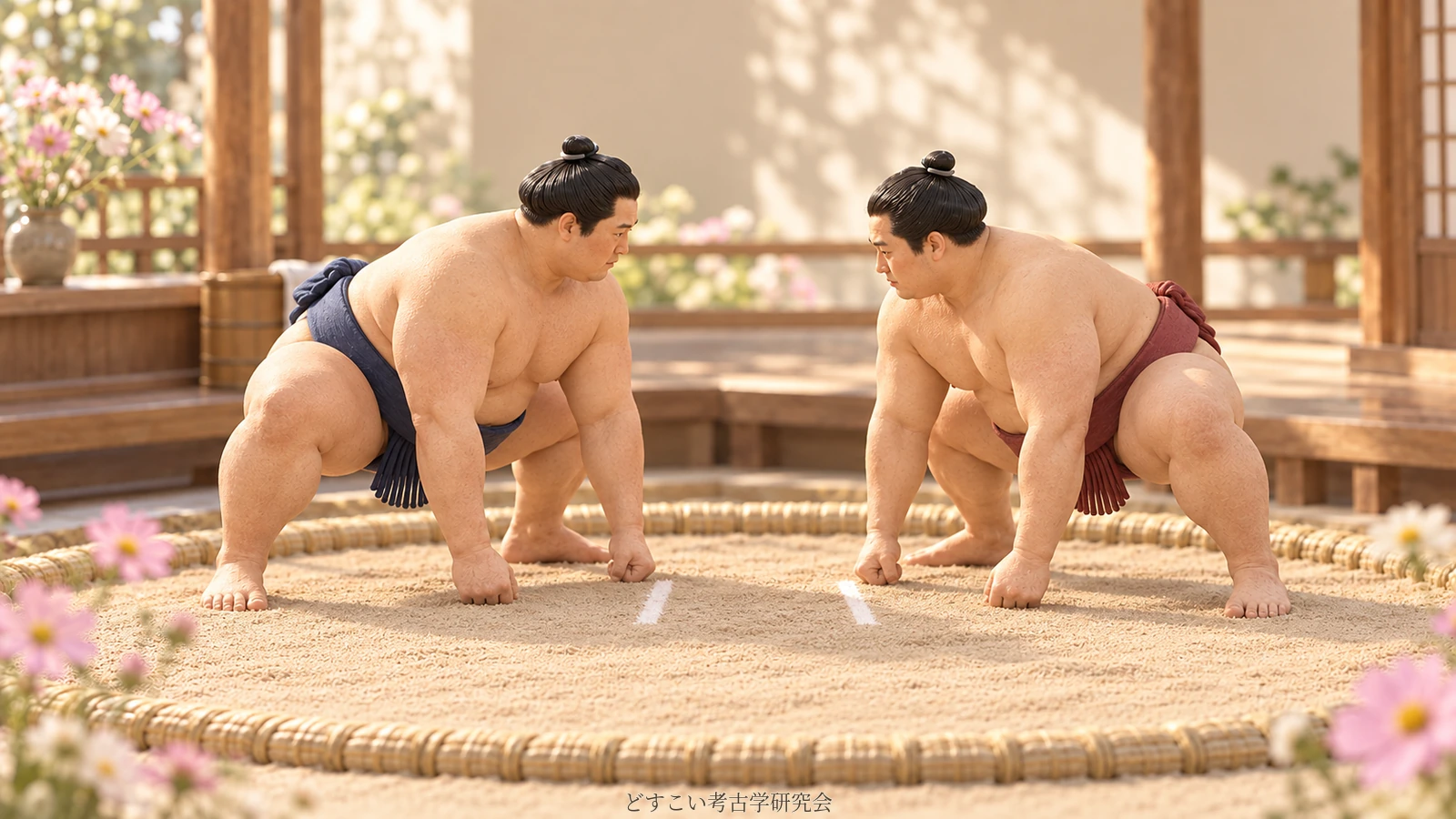
Professional sumo has no third-party starting signal like a sprint’s gun. A bout begins when both wrestlers place their hands down and establish the tachiai by matching their timing. If their breathing is not together or the hand contact is insufficient, they return to shikiri and try again. When you see a matta or reset, do not assume that somebody has lost a point; the valid start has not yet been completed.
There is a gyoji in the ring, so expecting him to press an invisible start button is perfectly reasonable. Many first-time viewers also hear *hakkeyoi* and assume it means “go.” The Association’s own explanation puts the decisive agency elsewhere: in the two crouching wrestlers.
The wrestlers make the start together
The Japan Sumo Association says that, unlike sports begun by a referee’s signal, a professional sumo contest starts when both wrestlers put their hands to the dohyo and synchronise their breathing for the tachiai. The gyoji’s call *miiatte* is not merely an instruction to glare at the opponent. The official explanation says it encourages them to match their breathing and produce a clean instantaneous start.
“Breathing” here is not an audible count that a visitor can score from the stands. You do not need to referee the moment. Watch the hands and hips converge on the same instant: one hand lowers, the other wrestler completes his contact, and two bodies release forwards.
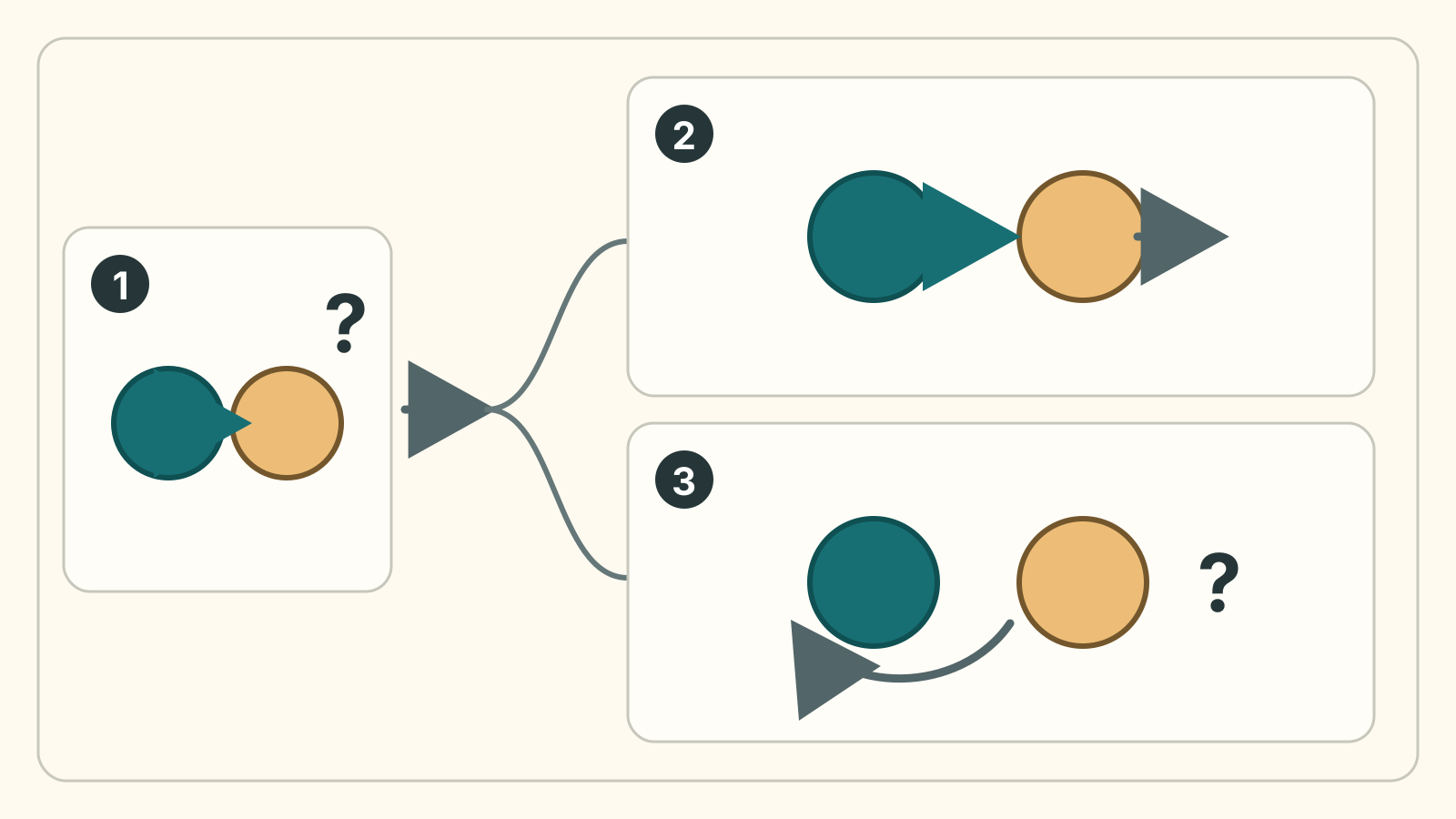
Detailed description of this diagram
Card 1 directs blue and gold competitor-role tokens toward one shared-start relation and keeps validity unresolved with a question mark. It branches to card 2 for bout continuation and card 3 for a return to preparation. The reset branch records possibility only and attributes neither fault nor cause. Tokens and arrows encode no hand, fist, breathing, gaze, voice, posture, distance, shikiri-line position, impact, speed, force, advantage, result or replay test.
Graphic: SUMO ARCHAEOLOGY CLUB · Figure source 1 · Figure source 2
*Hakkeyoi* is not a starter’s gun
Because there is no external start signal, the wrestlers are not supposed to wait for one particular word and then launch. The gyoji manages the ring, addresses the competitors and judges the bout with his gunbai, but the tachiai itself is created between the wrestlers.
On the next bout, let the sound sit at the edge of your attention and watch only the hands. When both bodies unfold from stillness together, the impact becomes confirmation rather than the first thing you understand. It is a remarkably intimate way for a combat sport to begin.
What does a reset mean?
The Association’s explainer says the wrestlers return to shikiri when their breathing is not matched or the hand contact is inadequate. In other words, the process goes back to the point before a valid tachiai. The reset itself is not the scored result of the contest.
It is tempting to use a matta to judge character—careless, nervous or deliberately disruptive. The view from a seat rarely proves an intention. Unless an official explanation adds more, the honest description is simply that the start was not accepted and the preparation resumed.
One wrestler’s hand may be hidden by the other body or the gyoji from your seat, and a broadcast can cut away at the instant of contact. A spectator will not necessarily see both hands clearly every time. If the contact was invisible, do not upgrade “I could not see it” into “he did not touch down.” Record only the observable reset, check a replay if one exists, and otherwise leave the hand position unknown.
Follow only the first step after impact
The second after a tachiai is crowded with information: thrusts, pushes, belt attempts, lateral movement and changes of balance. A beginner does not need to decode it all. Follow the first step. Does a wrestler drive straight through the opponent’s centre? Does a foot open to the side? Does the hip keep travelling forwards after contact?
That one step leads naturally to the difference between yorikiri and oshidashi, or between a thrust and a push. Tachiai is not vocabulary to memorise before watching. It is the first door into every winning technique. Once you know that the wrestlers make the start themselves, the change from silence to collision becomes startlingly clear.
Sources
- Japan Sumo Association quizzes No.38 and No.1016 (verified 2 September 2026).
Source links used for verification
Each link was used for the corresponding claim in this article; inclusion is not a blanket endorsement of the whole page.
Article verified:
- Japan Sumo Association quiz No.38: the tachiai and resetsHistorical primary source (record from that period)
- Japan Sumo Association quiz No.1016: miiatte and synchronisingHistorical primary source (record from that period)