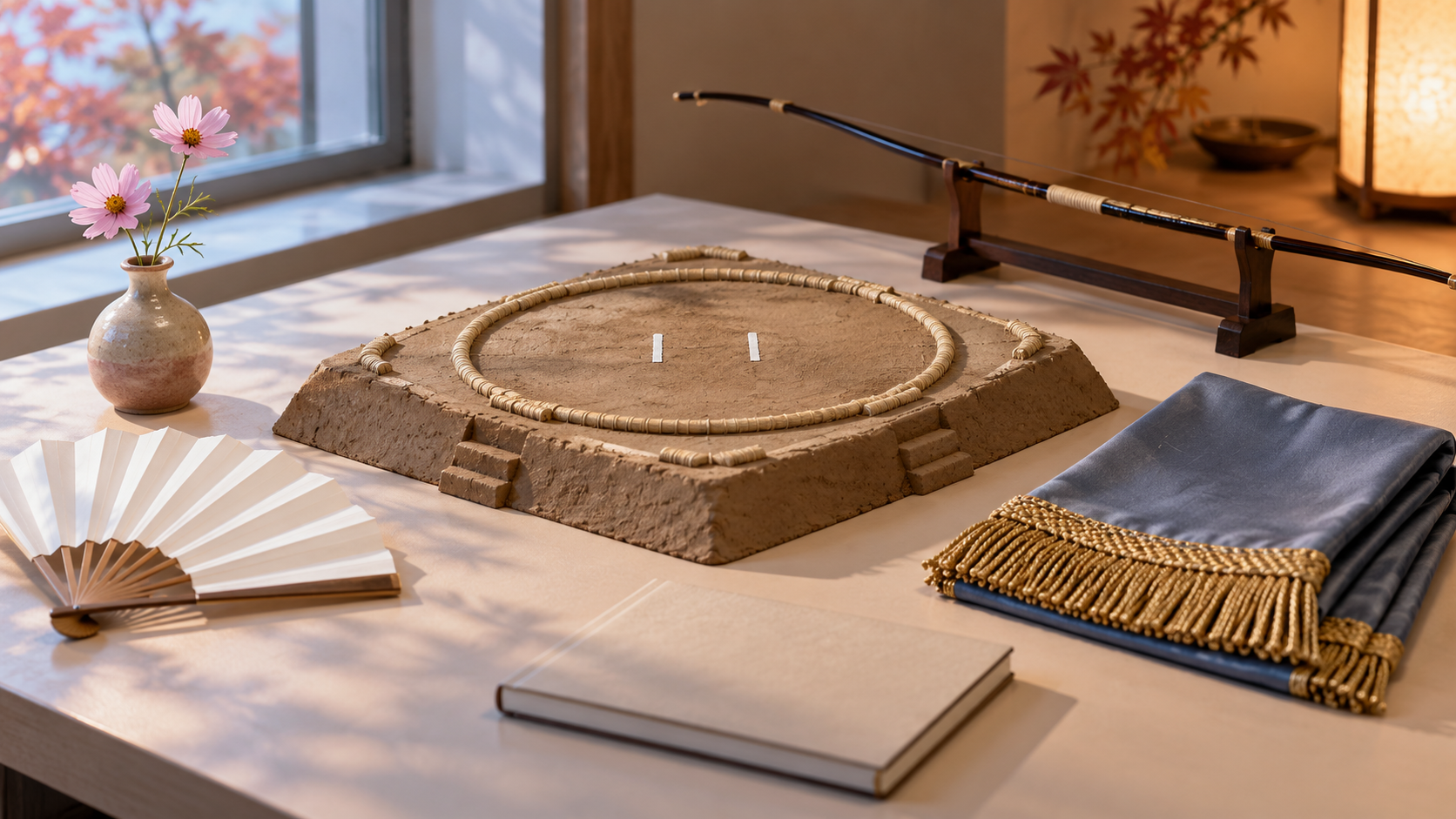
A grand tournament day progresses from lower-division bouts through the juryo ring entrance and bouts, nakairi with the makuuchi and yokozuna ring entrances, the makuuchi contests, and the bow-twirling ceremony after the final bout. Exact start times and special events vary by day. Learn the sequence, but use the Association’s current day schedule—not an old clock time—when planning your visit.
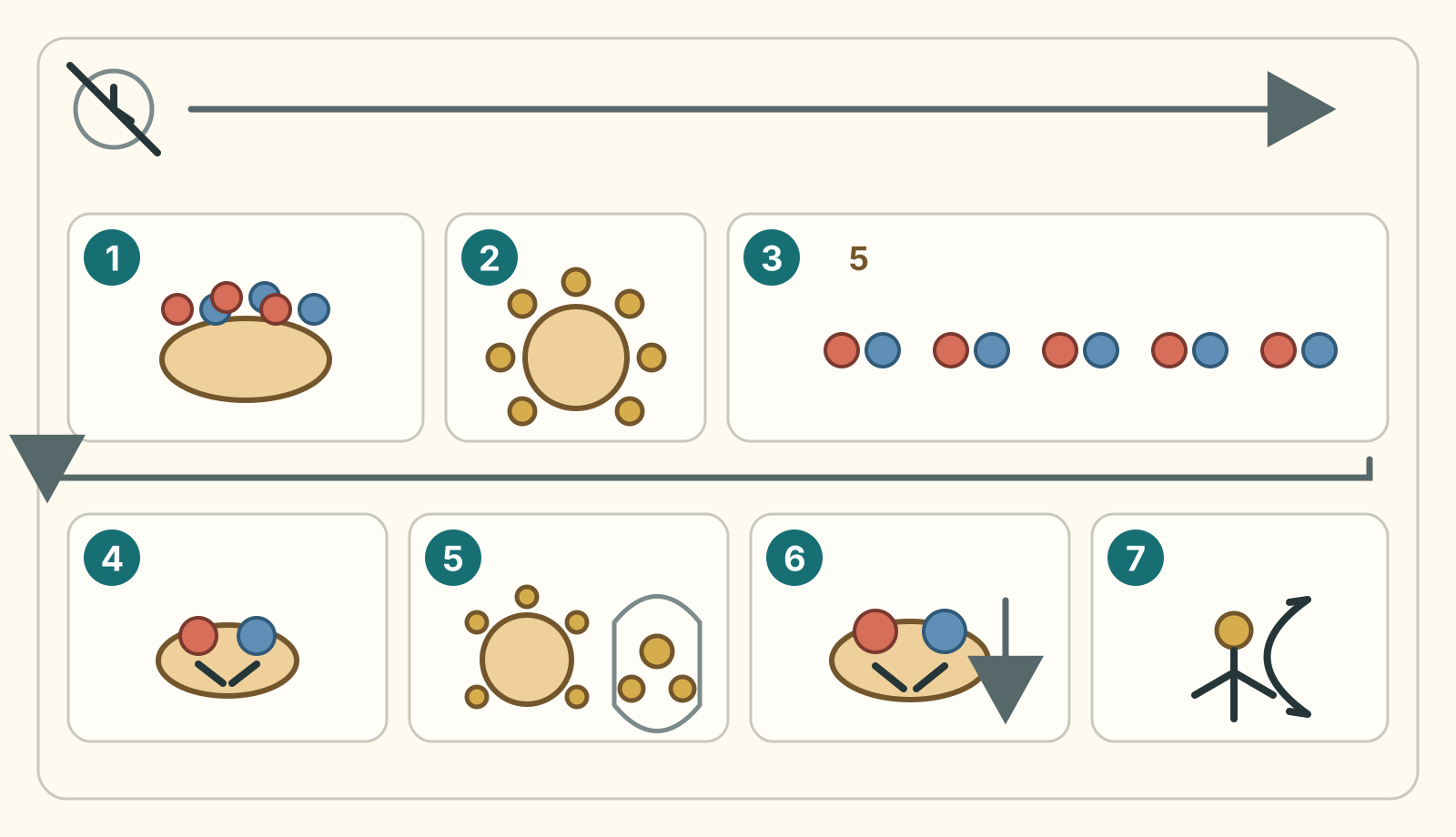
Detailed description of this diagram
Read stages 1 to 3 from left to right on the top row, then follow the return arrow and read stages 4 to 7 from left to right on the lower row. A crossed clock means the graphic contains no fixed times. Stage 1 covers lower-division bouts such as jonokuchi, jonidan, sandanme and makushita; maezumo appears only when scheduled. Stage 2 is the juryo ring entrance. Stage 3 shows the number five and five abstract bout-pairs because the Japan Sumo Association explains that five upper-makushita bouts remain after the juryo ring entrance. Stage 4 is the juryo programme. Stage 5 is nakairi, the interval after juryo and before makuuchi bouts; it normally includes the makuuchi ring entrance, a yokozuna ring entrance when applicable, and a change of ringside judges. Stage 6 covers makuuchi bouts through the final bout. Stage 7 is the bow-twirling ceremony after the final bout. Day-specific additions such as the new-entrant presentation, opening- and final-day Association greeting, senshuraku sanyaku soroibumi and awards are omitted. Card widths, arrow lengths, ring shapes and human-like symbols do not represent durations, attendance, actual formations or venue dimensions.
Graphic: SUMO ARCHAEOLOGY CLUB · Figure source 1 · Figure source 2 · Figure source 3
It is easy to imagine that the evening’s famous wrestlers are “the sumo” and everything before them is a long warm-up. Follow the actual order instead: a yobidashi calls a young wrestler’s name and bout after bout rises from the lower ranks. The morning is not a diluted evening. The full day grows rank by rank.
The early programme belongs to tomorrow’s sekitori
The Association’s Tokyo guide places maezumo where scheduled, followed by jonokuchi, jonidan, sandanme and makushita bouts. Maezumo and the ceremony presenting newly qualified entrants do not appear in exactly the same way every day, so check the official information if either is important to you.
The early session is not an emptier version of makuuchi. There is no division ring entrance with kesho-mawashi yet. Bouts accumulate one by one: the yobidashi summons the wrestlers, the gyoji steps into position, and the dohyo returns to stillness. With fewer distractions, the working roles around the ring can actually be easier for a newcomer to see.
The juryo circle appears before makushita is finished
The Japan Sumo Association explains that the juryo ring-entering ceremony occurs with five makushita bouts still to come. The sekitori form a circle in decorative aprons, then leave the ring. Hair condition varies, so this guide does not claim that every participant has a formal oicho topknot. After the ring entrance, they prepare to compete while the remaining makushita wrestlers continue their bouts.
That overlap is a beautiful piece of the day. The status makushita wrestlers are trying to reach appears physically on their dohyo, then their own contests resume. A line on the banzuke becomes a before-and-after sequence in the same patch of clay.
Juryo leads into nakairi
The juryo bouts follow. Nakairi comes after juryo and before the makuuchi contests. The Association describes it as a break that normally includes the makuuchi and yokozuna ring entrances and a change of ringside judges. The formal announcement of the next day’s bouts may also occur, but the current guide warns that it can be omitted depending on the running order.
During a division ring entrance, names are called and the kesho-mawashi designs join into a bright circle. An Association quiz explains that the clapping, lifting of the apron and raising of both hands simplify, in order, *chiri-chozu*, the three-stage stance and shiko stamping. It is not merely a fashion parade; the ceremony enlarges important sumo movements so the entire arena can see them.
Makuuchi increases the density, not the rules of the universe
The top-division bouts bring the higher-ranked wrestlers towards the end of the programme. The crowd grows louder and more names are familiar, yet an early arrival reveals continuity. The same dohyo, calling voice, preparation and winning boundary remain. The evening is the day becoming denser rather than a different sport suddenly beginning.
If you want one thread to follow from morning to evening, choose the yobidashi’s call. The basic job remains, while the arena’s echo and the audience’s response transform around it. You can hear the day climb without knowing every wrestler.
The final bout is followed by the bow ceremony
The scheduled list ends with the concluding bout. The bow-twirling ceremony follows, performed on behalf of that bout’s winner. Senshuraku adds its own final-three-bout ritual and awards, so the fifteenth day does not close in exactly the same way as an ordinary day.
You do not have to remain seated continuously. Sample several lower-division bouts, return for juryo, watch the ring entrances, and be present for the final bout and bow if your energy allows. Seeing even a little of both ends changes the scale of the experience. Sumo stops looking like a glamorous evening event and starts to resemble a living ladder that climbs all day.
What is verified: The official Tokyo guide shows the day’s anchors: maezumo when scheduled, lower-division bouts, the juryo ring entrance and bouts, nakairi, the makuuchi ring entrance and bouts, and the bow ceremony.
What remains unknown: This evergreen sequence does not establish a particular day’s start times, maezumo, new-entrant presentation, Association greeting, senshuraku programme, or yokozuna availability.
Editorial preparation: Choose two anchors that fit your energy—lower-division bouts, a ring entrance, or the final bout and bow—instead of memorising the whole day. This is not an official recommended itinerary.
If the plan changes: Treat the missing event as a programme change, not a failed visit, and move to a visible anchor such as the yobidashi’s call, a ring entrance or the next bout.
Sources
- Japan Sumo Association, “A tournament day in Tokyo” and quizzes No.1317, No.1264 and No.912 (verified 2 September 2026).
Source links used for verification
Each link was used for the corresponding claim in this article; inclusion is not a blanket endorsement of the whole page.
Article verified:
- Japan Sumo Association: A tournament day in TokyoPrimary source (as checked for this article)
- Japan Sumo Association quiz No.1317: timing of the juryo ring entranceHistorical primary source (record from that period)
- Japan Sumo Association quiz No.1264: nakairiHistorical primary source (record from that period)
- Japan Sumo Association quiz No.912: movements in the ring entranceHistorical primary source (record from that period)